

Entrepreneurship is often portrayed as a lone wolf’s journey: a visionary founder grinding late hours behind a laptop screen in total isolation until success finally strikes. However, in reality,
building a company alone is one of the fastest ways to stall your momentum, burn out, and endlessly repeat expensive mistakes that someone else has already solved.
Therefore, plugging into a high-trust business community is no longer a casual hobby; it has become a core operational advantage for modern founders and small business owners.
Whether you are validating an early-stage product, driving B2C customer acquisition, or scaling a growing team, the people around you directly dictate your execution speed.
In this guide, we explore how an active business community accelerates decision-making, unlocks distribution channels through peer recognition, and sharpens your skills by learning directly from fellow operators.
The Hidden Cost of Building a Business Alone
When you operate without a peer network, every operational challenge feels heavy and takes twice as long to overcome. You spend weeks agonizing over pricing models, wrestling with cold outbound campaigns that yield zero replies, or testing marketing channels without a single drop of honest feedback.
Instead, a business community replaces this guessing game with shared experiences. Rather than relying on generic blog advice or surface-level social media tips, you gain direct access to fellow entrepreneurs, creators, and operators who are tackling the exact same challenges in real time.
The 5 Core Reasons Why Small Business Owners Need a Business Community
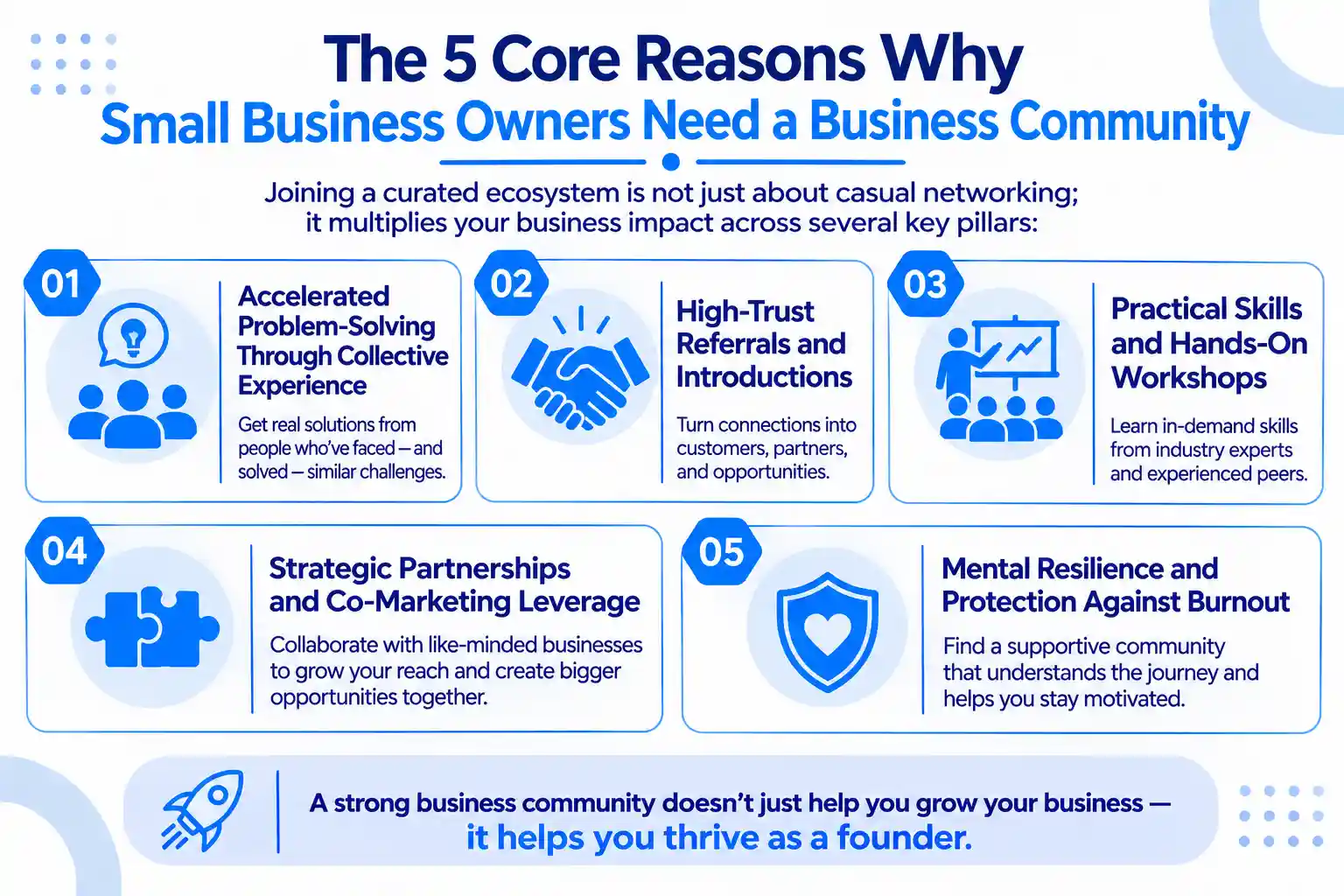
Joining a curated ecosystem is not just about casual networking; it multiplies your business impact across several key pillars:
1. Accelerated Problem-Solving Through Collective Experience
Every entrepreneur faces predictable hurdles, whether it is hiring your first sales team, fixing customer churn, or streamlining vendor procurement. Within a strong business community,
a single question asked during a peer discussion or workshop can save you months of trial and error. Learning from founders who crossed that exact roadblock six months ago shrinks your learning curve instantly.
In addition, these shared insights help founders make smarter decisions and improve their business strategies.
As a result, learning from experienced founders helps you avoid common mistakes and make better business decisions.
2. High-Trust Referrals and Introductions
Cold outbound outreach grows more expensive and noisy every quarter. Decision-makers routinely ignore automated emails, but they immediately accept warm recommendations and introductions facilitated by a trusted peer.
As a result, trusted introductions can make it easier to build business relationships and find new opportunities.
Community-based ecosystems naturally generate warm referrals because members actively look for ways to help fellow business owners.
3. Practical Skills and Hands-On Workshops
For example, workshops allow entrepreneurs to apply new skills directly to their business challenges.
Traditional business education moves far too slowly for a fast-changing market.
Therefore modern founder networks bridge this gap through practitioner-led workshops and hands-on skill-building sessions.
4. Strategic Partnerships and Co-Marketing Leverage
The fastest customer acquisition wins come from partnering with non-competing businesses that serve your exact target audience.
Surrounding yourself with peer founders makes it easy to forge alliances, creating co-hosted workshops, bundle offers, cross-referrals, and shared distribution channels that lower your customer acquisition cost (CAC).
Additionally, collaborating with like-minded founders creates opportunities to reach new customers and expand your business network.
5. Mental Resilience and Protection Against Burnout
Entrepreneurship is filled with intense highs, deep lows, and isolation that friends and family outside the startup world rarely understand.
Having a reliable circle of peers who normalize the chaos of building a business sharpens your perspective during tough quarters and sustains your long-term energy.
Moreover, having a reliable circle of peers provides emotional support, builds confidence, and helps entrepreneurs stay motivated during difficult times.
Building Alone vs. Scaling With a Business Community
The gap between struggling solo and scaling inside an active ecosystem shows up clearly across every core business metric:
Growth Dimension | Building Alone (Isolation) | Scaling With a Business Community |
Customer Acquisition | Heavily reliant on expensive ads and cold outbound | Driven by warm peer referrals, launchpad showcases, and partner channels |
Decision-Making Speed | Slow; bogged down by overthinking and endless research | Fast; backed by real-time feedback from experienced operators |
Skill Development | Fragmented learning from scattered articles and trial-and-error | Accelerated through hands-on workshops, founder talks, and skilling programs |
Strategic Partnerships | Difficult to initiate without shared context | Formed naturally through recurring collaboration and mutual trust |
Founder Mental Health | High risk of isolation and decision fatigue | Supported by peer accountability, shared wins, and ecosystem mentorship |
As a result, entrepreneurs who actively participate in business communities can gain valuable knowledge, stronger connections, and new growth opportunities.
How to Choose the Right Business Community for Your Stage
Not all networking groups yield real business results. Before investing your time, evaluate any business community against these four practical criteria:
- Quality of Members: Look for ecosystems filled with active builders, business owners, and operators rather than passive spectators or aggressive salespeople.
- Action-Oriented Initiatives: Prioritize communities that host structured workshops, product launchpads, skilling sessions, and curated founder talks instead of just casual social mixers.
- Give-First Collaboration Culture: The best ecosystems reward members who share frameworks, make introductions, and contribute openly without expecting an immediate transaction.
- Local Chapters + Broader Reach: Having local chapter meetups for deep face-to-face trust combined with a wider network for cross-market expansion gives you the best of both worlds.
Ultimately, choosing the right community can make a significant difference in your business growth and long-term success.
How eRoof Empowers Founders, Creators, and Business Owners
Built specifically for ambitious founders and small business owners, eRoof brings together practitioners who believe in growing through shared knowledge and authentic collaboration.
Furthermore, eRoof provides practical opportunities for founders to connect, learn, collaborate, and showcase their businesses.
Through dedicated initiatives including practical workshops, curated networking, the eRoof Launchpad to showcase new products, eRoof Talks featuring real builder stories, practical skilling programs, and community awards, members find the exact environment needed to turn ideas into scalable businesses.
5 Ways to Maximize ROI After Joining a Community
Simply signing up for a membership does not grow your business automatically; active participation does. Therefore, entrepreneurs should participate actively in community activities to build meaningful relationships and achieve better results.
Follow these five habits to extract maximum value from your business community:
- Show Up Consistently: Regularly attend workshops, chapter sessions, and founder meetups so peers recognize your face, your work, and your reliability.
- Lead With Generosity: Before asking for a favor, offer honest feedback on another member’s landing page, share a useful tool, or make a warm introduction.
- Ask Specific Questions: Instead of asking broad questions like “How do I get more clients?”, ask, “What outbound channel works best for B2B services priced between a $1k and $5k ticket size?”
- Showcase Your Progress: Use community launchpads and demo sessions to present what you are building and invite constructive critique.
- Follow Up Within 24 Hours: Whenever you connect with a fellow entrepreneur at an event, send a personalized note referencing your conversation and suggest a quick follow-up chat.
FAQs
1. How Does a Business Community Help Small Businesses Grow?
A business community helps small businesses grow by providing access to experienced entrepreneurs, trusted referrals, practical workshops, strategic partnerships, and valuable business connections. It also helps business owners solve problems faster and discover new growth opportunities.
2. Why Should Entrepreneurs Join a Business Community?
Entrepreneurs should join a business community to connect with like-minded business owners, exchange knowledge, find potential customers, build partnerships, and learn from the experiences of other entrepreneurs. It also provides peer support and helps reduce business isolation.
3. What Are the Benefits of Joining a Business Community?
The major benefits of joining a business community include:
- Access to trusted business referrals
- Opportunities for strategic partnerships
- Practical learning through workshops
- Faster problem-solving
- Business networking opportunities
- Peer support and accountability
4. How Can Entrepreneurs Maximize ROI From a Business Community?
Entrepreneurs can maximize ROI by attending events consistently, sharing valuable knowledge, helping other members, asking specific business questions, showcasing their products, and following up with new connections within 24 hours.
5. How Does eRoof Community Help Entrepreneurs and Small Business Owners Grow?
eRoof Community helps entrepreneurs and small business owners grow through networking initiatives, practical workshops, eRoof Launchpad, eRoof Talks, skilling programs, and community awards. These initiatives create opportunities for collaboration, knowledge sharing, product showcasing, and meaningful business connections.