

Imagine you have an idea that could completely disrupt the market. You have sacrificed weeks of sleep, poured in your life savings, and built a product or service that, in your eyes, is absolutely perfect. Even your close friends and family have cheered you on: This is amazing, it’s going to sell itself!
With pure excitement, you step into the market. You launch your website or open your doors. You sit back and wait for the phones to start ringing and customers to line up outside.
But reality hits, and there is nothing but dead silence.
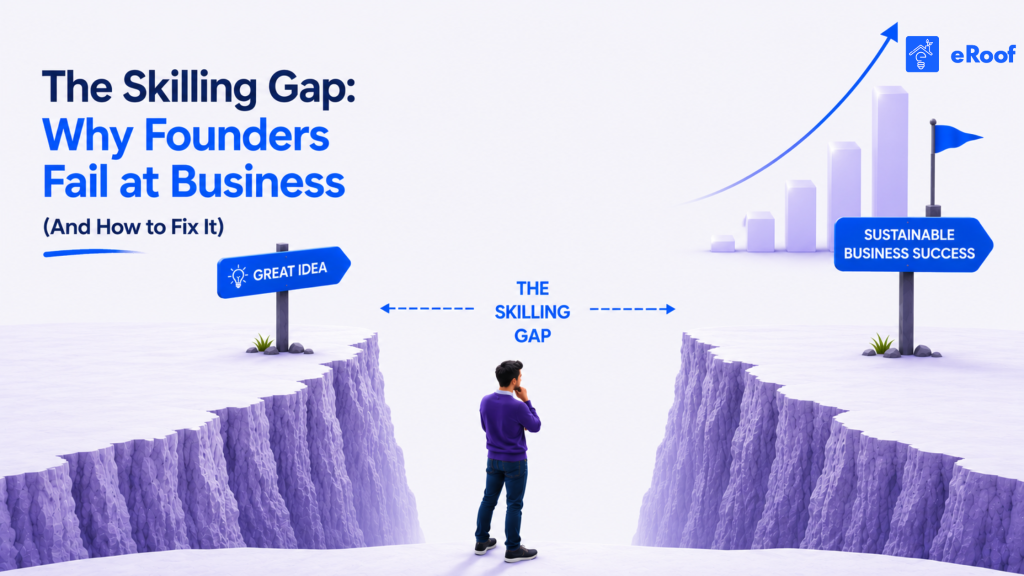
Weeks pass by. A few trickles of people show up, ask a couple of generic questions, and leave without buying. Your bank balance is draining, expenses are mounting, and you are holding your head in your hands, wondering: If my idea is this good, why isn’t anyone willing to pay for it?You aren’t under some magical curse. You have simply fallen into the trap of The Skilling Gap.
This is the harsh reality of the entrepreneurial world, where brilliant offers die in obscurity because the founder fails to upgrade themselves from a maker to a seller. In this comprehensive guide, let’s unpack the true psychology behind this gap and exactly how you can fix it.
1. The Trap of Perfection: Pleasing Yourself Before the Market
Founders have a dangerous habit: they fall deeply in love with their own product or service. They genuinely believe that if they just add one more feature, tweak the packaging to look a little prettier, or make their office space a bit flashier, the business will magically take care of itself.
This is what we call Perfection Procrastination.
- The Reality: The market does not care how perfect your product is. The market only cares about whether your product solves a burning, immediate problem in their life or business.
- Hiding from the Real Work: When sales dry up, founders instinctively hide in back-end work (like redesigning the company logo or auditing inventory for the fifth time). This internal work acts as a psychological shield. Founders avoid the open field of sales and marketing because they are terrified of raw, public rejection.
Remember: A mediocre product backed by an aggressive, hyper-targeted marketing and sales strategy will beat a world-class product with zero distribution every single day.
2. Where Founders Miss the Mark: The 3 Core Myths
The skilling gap widens when a founder fundamentally misunderstands how a commercial business operates. Let’s break down the three most common myths blocking your growth:
The Myth (What Founders Believe) | The Reality (The Commercial Truth) |
Marketing is only for companies with huge budgets. | Organic visibility and SEO require absolute consistency, not massive capital. High-value content targets pain points for free. |
My product will speak for itself. | No product sells itself in a noisy room. You must design your positioning so clearly that its economic value is obvious at a single glance. |
Customer feedback means getting compliments. | Polite praise is a false metric. The only feedback that matters is when a customer opens their wallet and hands you their hard-earned money. |
3. Deepening the Gap: The Hidden Commercial Blind Spots
Beyond theoretical myths, there are two distinct execution traps where even the most hardworking founders lose their entire business momentum:
A. The Trap of Productive Procrastination (Fleeing from Commercial Responsibility)
Most founders easily clock 12 to 14 hours of work a day and end up completely exhausted, yet their business revenue doesn’t budge an inch. This happens because they unconsciously fall into a dangerous psychological trap known as Productive Procrastination.
- Hiding Behind Internal Work: When the time comes to step directly into the market to send cold emails to highly skeptical buyers, pick up the phone, or make sales pitches where the terrifying risk of rejection exists, the founder’s brain triggers a defense mechanism. It safely retreats by keeping itself busy with tasks that feel like hard work, such as constantly tweaking the company logo, over-customizing internal spreadsheet layouts, or holding endless internal strategy meetings.
- The Damaging Impact: All of this work looks vital on the surface and satisfies the craving to feel productive. However, it generates exactly zero dollars in revenue. It serves merely as an operational shield to avoid the real battlefield of sales, allowing the company’s financial runway to quietly bleed out while the founder feels falsely accomplished.
B. Invisible Friction and Over-Complicated Pricing Models
Many times, a founder has an incredible product or service, and their marketing manages to bring highly targeted prospects to their website or storefront, only for those visitors to leave instantly without taking a single action. The founder usually concludes that the market simply doesn’t like their offer, whereas the real culprit is Invisible Friction in the buying process.
- Hidden Costs and Exhaustive Forms: Modern buyers have an extremely low threshold for unnecessary effort. If a prospect has to click a vague Contact Us or Request a Quote button and wait 24 hours just to find out basic pricing, or if they have to fill out a 15-field onboarding form just to test the product, they will naturally disengage.
- The Damaging Impact: Hiding prices or making the path to purchase complex, manual, and exhausting breeds immediate skepticism. The prospect instinctively thinks, This is going to be way too expensive or too much of a headache to deal with.
They immediately close your tab and bounce over to a competitor who lays out their terms transparently and lets them buy or book in just two clicks.
4. Practical Strategies to Bridge the Gap
If you want to step out of the skilling gap and transform your venture into a highly profitable asset, implement these three structural shifts immediately:

1. The 5-Second Value Test
Show your homepage, landing page, or sales brochure to a complete stranger and give them exactly 5 seconds to look at it. Take it away and ask them: What does my business do?
- If they answer: You sell software, or you provide consulting services, you failed. Those are features and modalities.
- If they answer: You eliminate the tax headache for small businesses, or You save corporate logistics teams 10 hours a week, you passed. That is the ultimate outcome.
Stop telling customers what you do; tell them how much better their life becomes after they buy from you.
2. Leverage Community-Led Validation
Stop building in deep isolation. In the modern business landscape, the fastest path to sustainable growth is Ecosystem-Led Growth. Become an active member of peer-to-peer builder networks and collaborative communities (your Startup Tribe) where active operators reside.
- Hands-on Workshops: Skip theoretical textbooks. Attend practical workshops where you can watch live case studies, break down outbound email frameworks, and see real lead-generation systems set up in real-time.
- Peer-to-Peer Feedback: When you sit down with fellow founders, you get unvarnished, brutal honesty about your landing page copy or sales deck. This community-led validation saves you months of building the wrong things for the wrong audience.
3. Enforce the 50/50 Rule of Distribution
The ultimate tactical fix for productive procrastination and invisible friction is restructuring your daily pipeline. Stop treating distribution as a secondary thought.
- The Execution Framework: Commit to spending exactly 50% of your operational energy on creation and 50% on distribution. If your doors are open for 8 hours, 4 of those hours must be spent removing buying friction, displaying transparent pricing models, engaging with your network, running outbound outreach, and analyzing customer drops.
If you do not actively bring your product to the market, the market will never uncover your product.
Conclusion
Bridging the skilling gap doesn’t mean you need to go back to school to get an MBA or magically become a world-class marketing guru overnight. It simply means accepting a fundamental truth: running a successful business requires a completely different skillset than just building a great offer.
Shift 50% of your operational energy away from creation and toward distribution. Step away from your internal processes, talk to your users daily, share your building journey transparently within your community, and remember the ultimate founder isn’t the person who creates the most flawless product; it’s the person who builds a repeatable system where people happily pay for it.
FAQs
1. What is the skilling gap in entrepreneurship?
The skilling gap refers to the difference between a founder’s ability to create a product and their ability to market, sell, and grow a business successfully.
2. Why do many startup founders fail despite having a great product?
Many founders fail because they focus heavily on product development while neglecting sales, marketing, customer acquisition, and distribution.
3. How can founders overcome the skilling gap?
Founders can overcome the skilling gap by joining communities and practical workshops that teach real-world business skills. Learning directly from experienced founders and industry experts helps improve sales, marketing, networking, and growth strategies faster than theory alone.
4. What is the 50/50 rule of distribution for startups?
The 50/50 rule suggests spending half your time creating products and the other half marketing, selling, networking, and distributing those products.
5. How can founders validate their business ideas faster?
Founders can validate ideas by gathering customer feedback, testing offers in the market, and measuring actual purchases rather than relying on compliments.