


The worst day in a founder’s life follows a highly predictable script. You spend six months locked in a room, downing caffeine, and writing thousands of lines of pristine code. You perfect the UI, stress-test the servers, and double-check your APIs.
Finally, you hit Publish on your public launch campaign, sit back, open a real-time analytics dashboard, and wait for the floodgates to open. And then. absolute silence. No server crashes. No influx of sign-ups. Just a single visitor on your dashboard, which happens to be you, refreshing the page from your phone.
The Solo Launch Trap: Isolated Startup > Public Internet > Crickets Zero built-in affinity
The Ecosystem Launch: Integrated Startup > Community Ecosystem > Rapid Traction & Validation
Launching a startup in complete isolation is the digital equivalent of opening a brick-and-mortar storefront in the middle of a desert. If you want to survive the brutal initial phases of early-stage growth, you cannot rely on cold traffic, generic ads, or empty press releases. You need an unfair distribution advantage.
You need a community ecosystem. When you anchor your startup within a vibrant, pre-existing professional network or builder community, you aren’t launching at people; you are launching with them. This comprehensive guide explores why traditional solo launches fail, how a community ecosystem alters your early-stage trajectory, and a tactical blueprint to leverage these networks to secure sustainable market validation.
1. The Death of the Solo Product Launch
For a long time, standard startup advice followed a reliable formula: build a basic MVP (Minimum Viable Product), launch it on generic directories, run targeted performance marketing ads, and buy your way into early user acquisition. In the current market, that playbook is broken. Three major shifts have made solo launches incredibly difficult for early-stage companies;
The Ad Fatigue and Privacy Crunch
Relying entirely on paid acquisition to find your initial user base is a financial trap. With privacy updates restricting third-party tracking and ad networks getting crowded, the Customer Acquisition Cost (CAC) for B2B and SaaS platforms has skyrocketed. If you try to acquire your first 1000 users solely via cold Google or LinkedIn ads without an established organic presence, your budget will run out before you find product-market fit.
The Rise of Video Debt and Content Overload
Buyers are constantly bombarded with marketing noise, automated email sequences, and generic AI-generated blog posts. They’ve developed a natural defense mechanism against standard corporate pitches. If an unknown startup drops an explainer video into the wild without any social proof, context, or community backing, modern buyers simply scroll past it.
The Trust Deficit
Because it has never been easier or cheaper to spin up software, the market is flooded with half-baked tools that disappear within six months. Buyers, especially enterprise operators, developers, and specialized service professionals, are highly risk-averse. They don’t want to invest time onboarding onto a platform that lacks external validation.
2. Defining the Community Ecosystem
A community ecosystem is not a passive email newsletter list, nor is it a basic social media following. It is a highly interactive, interconnected network of individuals, including operators, industry peers, early adopters, and domain experts who regularly gather around a shared professional focus, industry niche, or problem set.
Consider platforms like Indie Hackers for bootstrapped builders, GitHub for open-source developers, or specialized sector-specific networks like the Eroof Community for modern construction and B2B roofing professionals.
The Core Pillars of a Community Ecosystem
Strategic Asset | Market Advantage |
Continuous Feedback | Real-time product validation directly from your early adopters. |
High Trust & Social Proof | Organic credibility driven by peer-to-peer recommendations. |
Built-In Distribution | Immediate access to a highly engaged target audience with zero added CAC. |
Network Effects Ecosystem | A self-sustaining growth engine where users actively recruit more users. |
These networks are fundamentally different from open social platforms because they are anchored by high-intent engagement. Members aren’t mindlessly scrolling for entertainment; they are actively sharing execution strategies, discussing operational challenges, and attending workshops.
3. The 4 Structural Advantages of a Community-Led Launch
When you embed your development process and launch strategy directly into a community ecosystem, you fundamentally shift the underlying mechanics of startup growth. Here are the four primary advantages this approach offers over going it alone:
I. Built-In Distribution (With Zero Added CAC)
The single biggest bottleneck for any new software or service provider is getting eyeballs on the product. In a community ecosystem, your target audience is already aggregated. By actively contributing value to the space, sharing your building journey, and participating in discussions well before your official launch date, you establish organic visibility.
When you finally release your product, you don’t need a massive ad budget to reach your ideal customer profile (ICP), they are already sitting right in front of you.
II. Accelerated Feedback Loops and Real-Time Validation
When you launch in isolation, diagnosing why users drop off during onboarding is an uphill battle. You have to rely on passive analytics tools, heatmaps, and unreturned exit surveys. In contrast, launching within a community gives you a direct line to your users. Early adopters from a dedicated ecosystem are highly vocal.
If your onboarding flow feels clunky, if a specific feature crashes, or if your value proposition is confusing, they will tell you directly in the comments or forum threads. This allows you to ship patches, iterate on your core product infrastructure, and hit your true validation milestones in days rather than months.
III. Instant Trust, Credibility, and Peer Validation
People don’t buy from anonymous software entities; they buy from peers they respect. When an active, respected member of a community validates your tool, their endorsement carries immense weight.This type of peer-driven social proof breaks through the natural skepticism of modern buyers. A single positive review or recommendation thread from an industry operator inside a trusted network does more for your conversion rates than a multi-week cold email nurturing sequence ever could.
IV. Organic Network Effects
Community ecosystems naturally amplify good ideas. When a core group of early adopters within a network discovers a tool that solves an annoying workflow bottleneck, they don’t keep it to themselves.They share it in sub-channels, talk about it during workshops, and recommend it to external colleagues. This organic word-of-mouth creates a self-sustaining growth engine that independent startups have to pay thousands of dollars to replicate.
4. The Pre-Launch Playbook: From Observer to Ecosystem Pillar
You cannot treat a community ecosystem like an extraction site. If you join a professional network, drop a link to your product registration page on day one, and leave, the community will reject you as a spammer.To successfully leverage an ecosystem, you have to earn the right to launch within it. This requires a deliberate, multi-week pre-launch validation strategy built entirely around adding value.
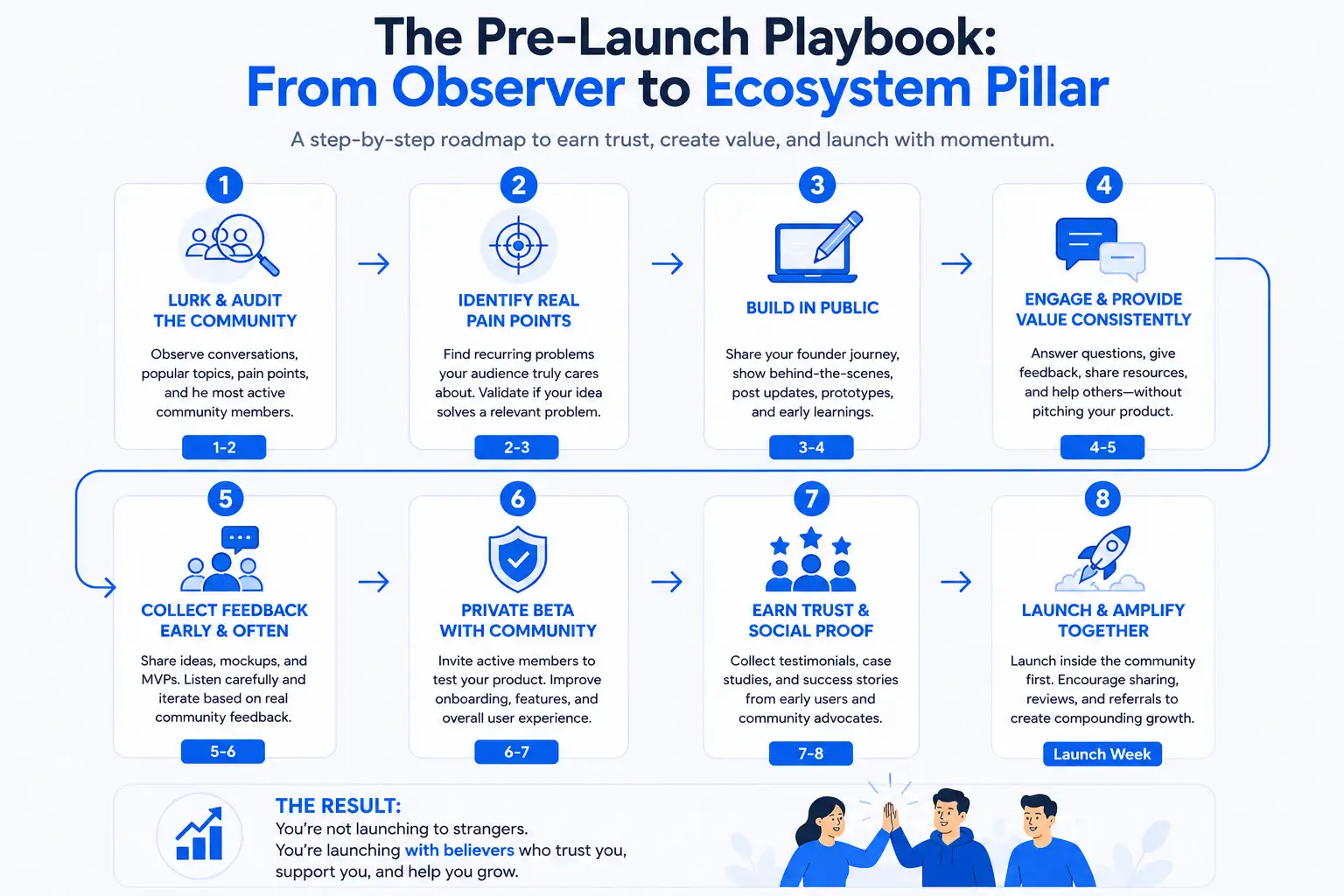
The Lurk and Audit Phase (Weeks 1-2)
Before writing any posts, spend time mapping out the cultural dynamics of the community.
- What are the recurring complaints, bottlenecks, and frustrations members share?
- Which legacy software solutions do they complain about most?
- What tone resonates best with the members? Is it deeply technical, casually strategic, or strictly professional?
Use this phase to refine your product’s positioning. If you realize the community is deeply frustrated by a specific administrative bottleneck, make sure your tool addresses that pain point directly on the landing page.
The Build in Public Strategy (Weeks 3-6)
Start documenting your development process openly within the community workspace. Share your design iterations, talk about engineering challenges you’ve overcome, and publish insights from early interviews with industry operators.
Isolate Development > Secret Build > Big Reveal > High Risk of Mismatch
Build in Public > Share Hurdles > Ask Input > Community Co-Ownership
For instance, if you are designing a centralized execution layer or workflow tool, post two different dashboard mockups and ask the community: We’re building this module to streamline vendor management, which layout helps you get work done faster? This shifts the dynamic from passive consumption to active co-creation.The community stops viewing your startup as an outside product and starts seeing it as a solution they helped shape.
Run Low-Friction Private Betas (Weeks 7-8)
Before your broad public launch, offer exclusive, limited access to active community members. Frame it as a special privilege for the network:We’re opening up 30 private beta slots specifically for this community to help us stress-test our tool before we open the waitlist globally.This creates healthy scarcity while allowing you to gather critical qualitative feedback, secure initial testimonials, and fix major performance issues in a controlled environment.
5. Launch Day Mechanics: Activating the Network Effect
When launch day arrives, your goal is to turn your weeks of pre-launch relationship-building into a concentrated wave of momentum. A successful ecosystem launch relies on clear execution timing and immediate engagement loops.
1. Publish the Origin Narrative:0-2 Hours.
Don’t just post a feature checklist. Share a compelling narrative post explaining the ‘why’ behind the project. Remind the community of the specific discussions, feedback, and collaborations that shaped the final build. Thank the individual members who helped during the private beta phase.
2. Introduce a Dedicated Community Benefit:2-6 Hours.
Provide an exclusive incentive tailored specifically to the ecosystem. Whether it’s an extended free trial, priority onboarding assistance, or a lifetime discount structure, make the community feel valued for their early support.
3. Maintain High-Responsiveness Moderation:6-12 Hours.
Treat your launch thread like a live interactive Q&A session. Respond to every comment, bug report, and feature inquiry within minutes. If an operator points out a technical issue, acknowledge it instantly, work with your team to patch it, and reply with an update showing the fix is live.
4. Synthesize and Share Early Data:12-24 Hours.
As the first day wraps up, share a quick update post transparently summarizing the launch metrics such as accounts created, systems processed, or interesting initial user behavior patterns. This keeps the community engaged in the unfolding narrative of your launch.
6. Sustaining Post-Launch Growth: Moving Beyond the Initial Spike
The ultimate danger of any successful product launch is the post-launch dip. The initial excitement fades, the announcement thread drops down the community feed, and your daily sign-up volume starts to slow down.To convert an explosive launch into sustainable, compounding growth, you need to turn your early community traction into an institutionalized customer acquisition strategy.
Turn Early Adopters into Brand Advocates
The users you acquire from a trusted professional community are your most powerful marketing assets. Reach out to your most active early users and conduct deep-dive interviews. Document how your software altered their daily workflow or metrics.Turn these early success stories into detailed, data-driven case studies and problem reports. When other members of the community see real, measurable proof of their peers succeeding with your tool, it triggers an ongoing wave of organic registrations.
Accelerate Your Search Engine Optimization (SEO) Strategy
A launch within a high-authority community ecosystem leaves a valuable digital footprint. Take that momentum and channel it into a long-term organic content marketing strategy:
- Map Out Pain-Point SEO Keywords: Identify the exact phrases and long-tail questions community members use when searching for solutions on Google.
- Repurpose Community Discussions: Turn common forum questions and support threads into deep, comprehensive blog posts that answer those queries directly.
- Optimize the Conversion Funnel: Ensure your internal linking structure seamlessly guides readers from informational industry guides straight into your optimized product landing page or interactive tools, much like the strategies outlined in our comprehensive guide on using a startup launchpad to gain your first 1,000 users.
7. Crucial Mistakes to Avoid When Launching in an Ecosystem
Working within a community requires high emotional intelligence and respect for the space. One misstep can alienate the exact group of users you need most. Avoid these common pitfalls:
- Treating the Relationship as Transactional: If you only show up to post updates about your product and never engage with other members’ questions or milestones, the community will quickly tune you out. Genuine engagement must be an ongoing habit, not just a launch-week tactic.
- Defensiveness in the Face of Negative Feedback: Early software has bugs, and community members will point them out publicly. If you respond defensively or try to minimize their complaints, you damage your credibility. Own the product’s shortcomings openly, explain how you intend to fix them, and share your timeline transparently.
- Overpromising on the Product Roadmap: It’s easy to get caught up in launch-day hype and promise every requested feature under the sun. This creates unrealistic expectations. Be honest about your immediate focus areas and protect your product’s core utility from feature creep.
Conclusion
Launching in a vacuum is a gamble you will likely lose. In today’s crowded market, cold ads and generic pitches cannot compete with trust.A community ecosystem changes everything. It turns a high-stress product drop into a collaborative milestone, giving you built-in distribution, rapid validation, and instant credibility.
Success requires shifting from extracting value to depositing value. When you build in public and launch with a community rather than at them, your launch stops being a 24-hour gamble. Instead, it becomes a self-sustaining growth engine that carries your startup far past its first 1,000 users. Step out of the development silo, engage with your tribe, and let them help you build the future.
FAQs
1. Why is launching a startup within a community ecosystem better than launching alone?
A community ecosystem gives startups trust, visibility, and early users. It helps founders grow faster without relying only on paid ads.
2. What are the biggest risks of launching a startup without a community?
Launching alone often leads to low visibility and fewer signups. Startups also struggle with trust and user validation.
3. What are the benefits of building in public before a startup launch?
Building in public improves visibility and feedback. It also creates excitement around the product before launch.
4. What is the best pre-launch strategy for startup founders in 2026?
Founders should build an audience and run beta tests. Community engagement and content creation are also important.
5. How can startups get their first 1000 users without paid ads?
Startups can use communities, referrals, and SEO content. Organic engagement often brings highly interested users.
6. Why do solo product launches fail in today’s competitive market?
Solo launches lack trust and audience support. Without validation, products struggle to gain attention.