

A business opportunity does not always begin with a sales pitch.Sometimes, it starts with a conversation. A founder talks about a problem they are trying to solve. Another entrepreneur mentions a similar experience. Someone else knows a person who could help.
A few conversations later, what started as a casual discussion can become a partnership, referral, customer introduction, or new business idea.This is one of the reasons entrepreneur communities can be valuable for business owners.
Unlike a one-time networking event, a community gives entrepreneurs more opportunities to meet, interact, share knowledge, and stay connected. Over time, these repeated interactions can create relationships that lead to real business opportunities.
But how does that actually happen?
Business Opportunities Often Start With Relationships
Entrepreneurs naturally look for customers, partners, investors, employees, and mentors. The challenge is finding the right people. Searching online can help, but it does not always create trust.
A cold message may be ignored, while a recommendation from someone within a trusted network can open the door much faster. An entrepreneur community creates an environment where those introductions can happen naturally.
For example, imagine a founder who needs a video production partner for a product launch. Another member of the community already knows a reliable video company and makes an introduction.
The founder gets a potential solution. The service provider gets a qualified opportunity. The person who made the introduction strengthens an existing relationship. That is how a simple community connection can create business value.
One Community Can Bring Different Types of People Together
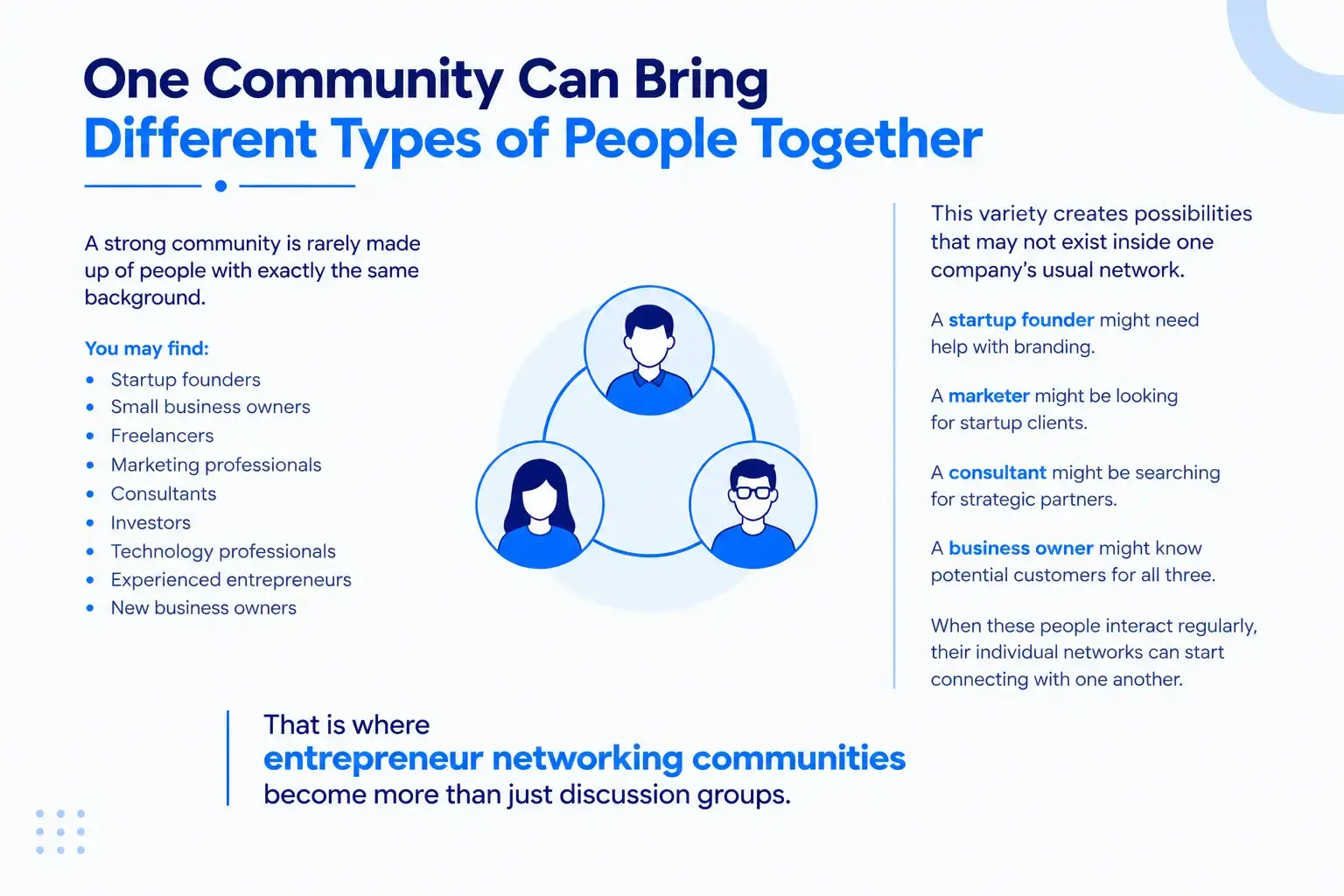
A strong community is rarely made up of people with exactly the same background.
You may find:
- Startup founders
- Freelancers
- Marketing professionals
- Consultants
- Investors
- Technology professionals
- Experienced entrepreneurs
- New business owners
This variety creates possibilities that may not exist inside one company’s usual network. A startup founder might need help with branding. A marketer might be looking for startup clients.
A consultant might be searching for strategic partners. A business owner might know potential customers for all three. When these people interact regularly, their individual networks can start connecting with one another.
That is where entrepreneur networking communities become more than just discussion groups.
From Connection to Opportunity
There is usually a simple progression behind successful community-based opportunities:
Connection → Conversation → Trust → Introduction → Opportunity
The first step is meeting someone. The second is understanding what they do and what they need.
Then comes trust. This takes time and usually develops through repeated interactions rather than one conversation. Once trust exists, people are more comfortable making introductions or discussing potential collaboration.
That opportunity could take many forms:
Referral: One member recommends another business.
Partnership: Two companies work together on a project.
Collaboration: Entrepreneurs combine skills to create something new.
Customer opportunity: A member introduces a potential buyer.
Mentorship: An experienced founder helps a newer entrepreneur avoid common mistakes.
Resource sharing: Members exchange useful contacts, tools, knowledge, or information.
Not every interaction produces an immediate result. The value often builds over time.
Communities Can Help Entrepreneurs Find the Right Partners
Finding a business partner is not simply about finding someone who is interested in starting a company.
Compatibility matters.
You need people who may have complementary skills, similar values, relevant experience, or access to different markets.
This is where entrepreneur communities to find business partners can be useful.
For example, one entrepreneur may be strong in product development while another has experience in sales and distribution.
Individually, they have different strengths.
Together, they may be able to build something neither could easily create alone.
The same idea applies to service partnerships. A web development company may partner with a digital marketing agency. A business consultant may work with an accounting professional. A startup may collaborate with another startup whose product complements its own.
The community provides the environment. The entrepreneurs decide whether the relationship makes sense.
Knowledge Sharing Can Create Opportunities Too
Business opportunities do not always come from direct introductions. Sometimes they come from information.
An entrepreneur may discover a new market through a conversation with another founder. A small business owner may learn about a tool that saves several hours each week. A startup may hear about an upcoming industry event where potential customers will be present.
These small pieces of knowledge can influence business decisions. Research from the U.S. Small Business Administration highlights the role of entrepreneurial ecosystems in connecting businesses with knowledge, relationships, resources, and capital.
That is one reason entrepreneur support communities can be valuable, especially for founders who are still building their professional network.
Why New Entrepreneurs Can Benefit the Most
Experienced entrepreneurs often already have established networks. New entrepreneurs usually do not. They may know friends and family, former classmates, or previous colleagues, but they may not yet have a strong business network.
Joining entrepreneur communities for new entrepreneurs can give them a place to meet people who understand the challenges of starting and growing a business.
They can ask questions, listen to other founders, learn from mistakes, and discover opportunities without having to figure everything out alone. For a new founder, even one useful introduction can make a difference.
It might lead to the first customer.
The first mentor.
The first supplier.
Or simply the person who points them toward the next useful opportunity.
Local Communities Create Local Business Opportunities
Online connections can reach almost anywhere, but local relationships still matter. A business owner searching for entrepreneur communities in Indore may want to meet people who understand the city’s business environment, customer base, and local opportunities.
The same applies to entrepreneurs looking for entrepreneur communities in India. A founder in Mumbai may want access to investors and technology companies. Someone in Delhi may be interested in government, consulting, or enterprise connections. A Bangalore founder may be looking for technology and startup partnerships.
Local communities can make these relationships easier to build because members may share geographic, cultural, or market context. For businesses that depend heavily on local customers, suppliers, or partnerships, that can be particularly useful.
Online Communities Expand the Possibilities
Physical communities are not the only option. Online entrepreneur communities in India can connect founders across cities and industries without requiring everyone to be in the same room.
This can be useful when you want to:
- Connect with entrepreneurs outside your city
- Find people in a specialized industry
- Participate in regular discussions
- Learn from founders in different markets
- Discover online events and workshops
- Build relationships before meeting in person
A practical approach is to combine both. Use online communities to discover people and ideas, then use local events or meetings to build stronger relationships when possible.
How to Turn Community Connections Into Business Opportunities
Joining a community is only the first step. If you want actual business value from it, your approach matters.
1. Start With Curiosity
Instead of immediately explaining what you sell, ask people about their business.
What are they building?
Who do they serve?
What challenges are they facing?
Good conversations often reveal opportunities naturally.
2. Be Useful Before Asking for Something
Share a relevant contact.
Recommend a useful tool.
Answer a question.
Share an article or resource.
Small acts of value can make future collaboration easier.
3. Follow Up
If you have a useful conversation, continue it after the meeting.
A short message or quick call can turn a casual introduction into a professional relationship.
4. Look for Mutual Value
The strongest business relationships are not one-sided.
Ask yourself:
“How can we help each other?”
That question often leads to better partnerships than simply asking, “What can this person do for me?”
What Should Businesses Look for in an Entrepreneur Community?
Not every community will be right for every entrepreneur.
Before joining, consider:
What to Check | Why It Matters |
Member profiles | Helps you understand who you can meet |
Industry mix | Shows whether complementary businesses are present |
Events and workshops | Creates opportunities for interaction |
Community activity | Indicates whether members actively participate |
Makes relationship-building easier | |
Location | Important for local partnerships |
Online access | Useful for wider connections |
The goal is not to find the largest community.
It is to find one where the people, conversations, and opportunities match your business needs.
How eRoof Community Can Help
A useful business community should make it easier for entrepreneurs to move from meeting people to building relationships.
eRoof Community brings entrepreneurs, startups, and businesses into a shared environment where they can discover networking opportunities, exchange ideas, attend relevant activities, and build professional connections.
For someone looking for entrepreneur communities for startups, business communities for entrepreneurs, or opportunities to connect with other founders and business owners, an active community can provide a consistent place to build those relationships.
The objective is not simply to collect contacts.
It is to create meaningful connections that can eventually lead to collaboration, referrals, partnerships, and business growth.
The Long-Term Value of Community
The most valuable opportunity may not appear during your first week or even your first event. A person you meet today may introduce you to a customer six months from now.
A founder you help today may become a business partner later. A conversation you have this month may give you an idea that changes your strategy next year.
That is why entrepreneur networking groups should be viewed as long-term relationship networks rather than short-term lead-generation channels. When entrepreneurs consistently share knowledge, introduce people, and support each other’s goals, the entire network becomes more valuable.
Final Thoughts
Entrepreneur communities can create business opportunities because they bring people together repeatedly. The first interaction creates awareness.
Continued conversations create familiarity. Familiarity can create trust. And trust can open the door to referrals, partnerships, customers, mentorship, and collaboration.
For founders and business owners, the goal should not be to join every community available. Find the communities where relevant people are active, participate genuinely, and focus on creating value for others.
The right connection may not produce an opportunity immediately—but it can become the starting point for one.
FAQs
1. What are entrepreneur communities?
Entrepreneur communities are groups or networks where founders, business owners, startups, and professionals connect to exchange ideas, share knowledge, and explore business opportunities.
2. How do entrepreneur communities create business opportunities?
They create opportunities by connecting entrepreneurs who may become customers, partners, referral sources, mentors, suppliers, or collaborators.
3. Are entrepreneur communities useful for small businesses?
Yes. Small businesses can use communities to build local connections, find partners, discover customers, exchange knowledge, and develop referral relationships.
4. Can entrepreneur communities help new founders?
Yes. New founders can meet experienced entrepreneurs, learn from their experiences, find mentors, and develop a professional network.
5. How can I find entrepreneur communities near me?
Look for local business groups, startup communities, coworking spaces, workshops, networking events, and online entrepreneur groups in your city or industry.