


Starting a business is exciting. But building a startup that continues to grow is a completely different challenge.
A founder may have a great product, a strong team, and an innovative idea. However, without consistent growth, even a promising startup can struggle to survive in a competitive market.
This is why startup growth matters.
Growth is not simply about making more sales. It can include acquiring new customers, increasing revenue, entering new markets, building a stronger team, improving products, developing partnerships, and creating a sustainable business model.
For founders, understanding growth early can help them make better decisions and identify opportunities before competitors do.
Whether you are building a technology startup, SaaS company, small business, or growing MSME, having a clear growth strategy can provide direction for the next stage of your business.
So, why is startup growth so important for founders?
Let’s explore the key reasons.
What Is Startup Growth?
Startup growth refers to the process of expanding a startup’s customers, revenue, market presence, team, product capabilities, and overall business impact.
Growth can happen in different ways.
A startup might grow by acquiring more customers. Another company may expand into new markets. A SaaS business may increase recurring revenue, while an early-stage startup may focus on building a strong customer base before scaling aggressively.
The right approach depends on the startup’s industry, business model, resources, and stage of development.
This is why founders need startup growth strategies rather than relying on growth that happens by chance.
1. Startup Growth Helps Founders Build a Sustainable Business
A startup needs more than a good idea to survive.
It needs customers, revenue, efficient operations, and a business model that can support long-term development.
Consistent growth helps founders understand whether their business model is working.
Growth Shows Market Demand
One of the clearest signs of business potential is customer demand.
If more customers are discovering, purchasing, and recommending your product, it can indicate that the business is solving a real problem.
Founders can use metrics such as customer acquisition, retention, revenue, conversion rates, and recurring revenue to understand their startup growth rate.
These numbers provide useful insights into what is working and where improvements are needed.
Growth Creates Financial Stability
Revenue growth can give startups more resources to invest in their future.
A growing business may be able to hire skilled employees, improve its product, invest in marketing, and enter new markets.
However, growth should also be sustainable. Rapid expansion without proper financial planning can create operational and cash-flow challenges.
2. Startup Growth Helps Founders Reach More Customers
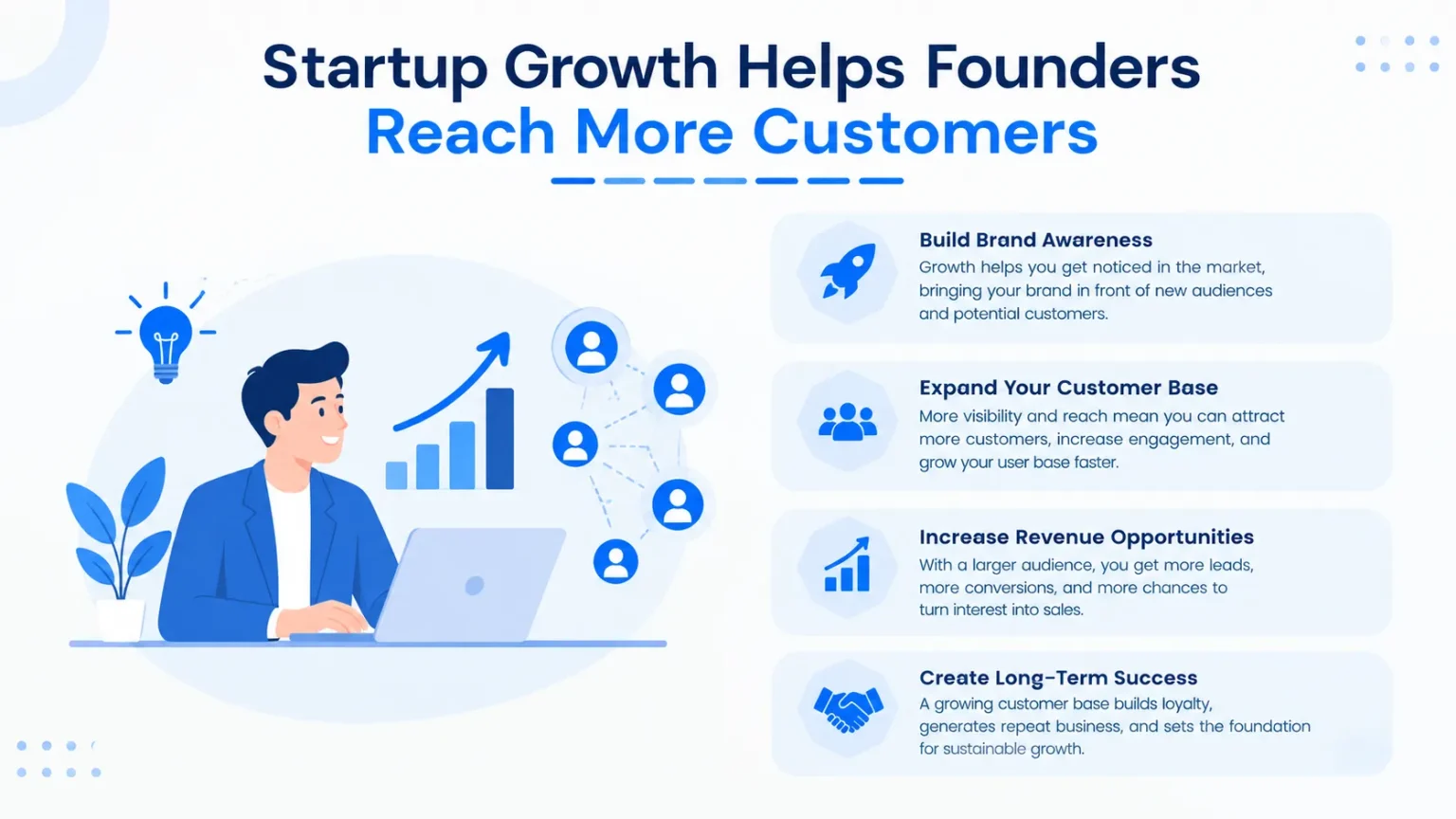
A startup cannot grow without customers.
This makes customer acquisition one of the most important parts of startup business growth.
Founders need to understand who their ideal customers are and how to reach them effectively.
Build a Strong Growth Marketing Strategy
Startup growth marketing focuses on finding scalable ways to attract and retain customers.
Depending on the business, this can include SEO, content marketing, social media, paid advertising, email marketing, referrals, partnerships, and product-led growth.
Instead of using every channel at once, founders should identify the channels that produce the most relevant customers.
Turn Customers Into Long-Term Relationships
Acquiring a customer is only one part of growth.
Retention is equally important.
A startup that keeps existing customers can create more predictable revenue and reduce the pressure to constantly find new customers.
Customer feedback, product improvements, onboarding, support, and personalized communication can all contribute to stronger customer relationships.
3. Startup Growth Helps Founders Build Strong Networks
Business growth is rarely achieved alone.
The right connections can introduce founders to customers, investors, mentors, employees, partners, and industry experts.
This is why startup growth through networking can be valuable for entrepreneurs.
Connect With Founders and Industry Experts
Networking events, founder communities, workshops, and business meetups can create opportunities for founders to exchange ideas.
A founder may discover a new marketing strategy from another entrepreneur or find a potential technology partner through a simple conversation.
These relationships can become valuable resources as the business develops.
Find Mentors and Advisors
Experienced professionals can provide perspectives that founders may not have yet developed.
Startup growth advisors can help founders think about areas such as business strategy, customer acquisition, product positioning, sales, operations, and scaling.
Similarly, startup growth consulting can provide structured guidance when a company is facing a specific growth challenge.
4. Startup Growth Creates Opportunities for Funding and Expansion
Funding can play an important role in the growth of many startups.
While not every startup needs external funding, additional capital can help businesses accelerate product development, hire employees, expand marketing, or enter new markets.
This makes startup growth through funding an important consideration for founders.
Prepare the Business for Investors
Investors usually want to understand how a startup creates value and how it can grow.
Founders should be prepared to explain their target market, business model, customer acquisition strategy, revenue, growth metrics, and future opportunities.
A clear startup growth roadmap can help communicate where the company is today and where it plans to go.
Use Funding Strategically
Receiving funding does not automatically guarantee growth.
Capital should be connected to specific business objectives.
For example, a startup may use funding to expand its sales team, improve its product, enter a new geographic market, or increase customer acquisition.
The key is to understand how each investment can contribute to measurable business outcomes.
5. Startup Growth Helps Founders Scale Their Operations
Growth creates new challenges.
A startup that moves from 10 customers to 1,000 customers cannot always use the same processes it used at the beginning.
As demand increases, founders need systems that can handle larger workloads.
Build Scalable Processes
Scalable processes can help businesses manage growth more efficiently.
Automation, documentation, technology, analytics, and clear responsibilities can reduce unnecessary manual work.
For example, a growing SaaS company may automate customer onboarding, sales follow-ups, reporting, and support processes.
Build the Right Team
A startup’s team becomes increasingly important as the company grows.
Founders need people with the skills required for the next stage of development.
Hiring should not only focus on filling immediate roles. Founders should consider whether new employees can help build systems, solve problems, and support future expansion.
6. Startup Growth Helps Founders Stay Competitive
Markets do not remain unchanged.
New competitors enter the market. Customer expectations evolve. Technologies develop.
A startup that stops improving can quickly lose its competitive position.
Keep Improving the Product
Continuous product improvement can help startups respond to customer needs.
Customer feedback, reviews, usage data, and market research can reveal where a product needs improvement.
This creates a continuous cycle:
Build → Measure → Learn → Improve → Grow
Founders who follow this cycle can make decisions based on real customer information instead of assumptions.
Identify New Growth Opportunities
Growth can also come from new markets, partnerships, products, or customer segments.
Founders should regularly ask:
- Can we serve a new customer segment?
- Can our product solve another problem?
- Can we enter another market?
- Can we create a new revenue stream?
- Can partnerships accelerate our growth?
These questions can help identify future opportunities.
Effective Startup Growth Strategies for Founders
There is no single formula for startup growth.
However, founders can build their strategy around a few fundamental areas.
Understand Your Target Customer
Before investing heavily in marketing, understand who your ideal customer is.
Identify their problems, goals, buying behavior, and expectations.
A clear customer profile helps founders create better products and more relevant marketing campaigns.
Track the Right Growth Metrics
Growth should be measurable.
Important metrics can include:
- Customer acquisition
- Revenue growth
- Customer retention
- Conversion rate
- Customer acquisition cost
- Lifetime value
- Monthly recurring revenue
Tracking these metrics helps founders understand whether their growth strategy is producing meaningful results.
Test Before Scaling
One of the useful growth hacks for startups is to experiment before making large investments.
Test different marketing messages, landing pages, sales channels, offers, or customer segments.
When a strategy consistently produces results, the startup can consider scaling it.
Growth of Startups in India
The growth of startups in India has created opportunities across industries such as technology, SaaS, fintech, healthcare, e-commerce, education, and professional services.
For Indian founders, this growing ecosystem provides access to customers, investors, mentors, accelerators, communities, and business networks.
However, competition is also increasing.
This makes strategic growth especially important. Founders need to understand their customers, differentiate their products, manage resources carefully, and build strong professional networks.
Startup communities, startup growth events, accelerators, workshops, and industry networks can provide useful resources during different stages of business development.
How Startup Growth Services Can Help Founders
Some founders manage growth internally, while others work with external specialists.
Startup growth services in India can support businesses with areas such as marketing, customer acquisition, branding, sales strategy, SEO, content, analytics, and business development.
A founder may also work with startup growth advisors, consultants, or a startup growth accelerator depending on their business stage.
The goal should not be to outsource every growth decision.
Instead, external experts can provide additional knowledge, resources, and execution support while founders continue to control the overall business direction.
Creating a Startup Growth Roadmap
A growth roadmap gives founders a clear view of where the business is going.
Start by identifying the current stage of your startup.
Then define specific goals for the next three, six, or twelve months.
For example:
Current Stage → Growth Goal → Strategy → Measurement → Optimization
A startup may set a goal to increase qualified leads, improve customer retention, enter a new market, or increase recurring revenue.
Once the goal is clear, the founder can choose the right strategies and metrics.
A roadmap also helps teams stay aligned.
Conclusion
Startup growth is important because it helps founders transform an initial business idea into a sustainable and scalable company.
Growth can help startups reach more customers, increase revenue, build stronger networks, attract funding, improve operations, and remain competitive.
However, growth should not be treated as simply getting bigger.
Sustainable growth means building a business that can create consistent value for customers while managing resources effectively.
Whether through startup growth marketing, networking, funding, consulting, communities, or strategic partnerships, founders have many ways to support their growth journey.
The most effective approach is to understand your current stage, identify the biggest growth opportunity, test your strategy, measure the results, and improve continuously.
For founders, growth is not a single destination. It is an ongoing process of learning, adapting, and building a stronger business.
FAQs About Startup Growth
1. What is startup growth?
Startup growth is the process of expanding a startup’s customers, revenue, market presence, team, product capabilities, and overall business impact.
2. Why is startup growth important for founders?
Startup growth helps founders build sustainable businesses, reach more customers, increase revenue, attract talent and funding, enter new markets, and remain competitive.
3. What are effective startup growth strategies?
Effective startup growth strategies can include SEO, content marketing, networking, partnerships, customer referrals, product improvements, paid marketing, customer retention, and strategic expansion.
4. How can startups achieve growth through networking?
Startup growth through networking can happen when founders build relationships with potential customers, investors, mentors, partners, and other entrepreneurs through events, communities, workshops, and professional networks.
5. What is a startup growth roadmap?
A startup growth roadmap is a structured plan that defines growth goals, strategies, timelines, key metrics, and actions needed to move a startup toward its next stage.