

Building a business can feel lonely, especially during the early stages.
A founder may spend the morning fixing a product issue, the afternoon speaking with customers, and the evening trying to figure out where the next lead will come from. There are plenty of online resources available, but having information is not the same as having people who understand what you are going through.
This is where startup communities can become useful.
A strong community gives founders a place to meet other entrepreneurs, exchange ideas, discuss problems, discover opportunities, and learn from people who have already faced similar challenges. Sometimes the most useful conversation is not a formal business meeting. It can be a quick introduction at an event, a recommendation from another founder, or an honest discussion about a problem that everyone in the room has experienced.
For early-stage businesses, these connections can gradually turn into partnerships, customers, mentors, employees, or simply a reliable support network.
What Are Startup Communities?
A startup community is a group of founders, entrepreneurs, business professionals, mentors, investors, and other people connected through a shared interest in building or supporting businesses.
These communities can exist in different forms. Some meet in person through workshops, networking sessions, and startup events. Others operate through online groups, private platforms, or regular virtual meetings.
The format can change, but the basic idea remains the same: people building businesses learn faster when they have access to other people building businesses.
For a new founder, this can be particularly valuable. Instead of trying to solve every problem alone, they can ask questions, compare experiences, and find people who may have already dealt with a similar situation.
Why Do Founders Join Startup Communities?
Not every founder joins a community for the same reason.
One person may be looking for their first business connection. Another may want feedback on a new product. Someone else may simply want to meet people outside their usual professional circle.
The common factor is access to relationships.
A founder who regularly participates in an entrepreneur network may come across opportunities that would never appear through a normal search. A conversation with another member could lead to an introduction, a collaboration, or useful feedback on a business idea.
The value often grows over time. You may not get something from your first meeting, but staying involved gives people a chance to know what you do and where you can help.
That familiarity matters in business.
1. Startup Communities Help Founders Build Real Networks
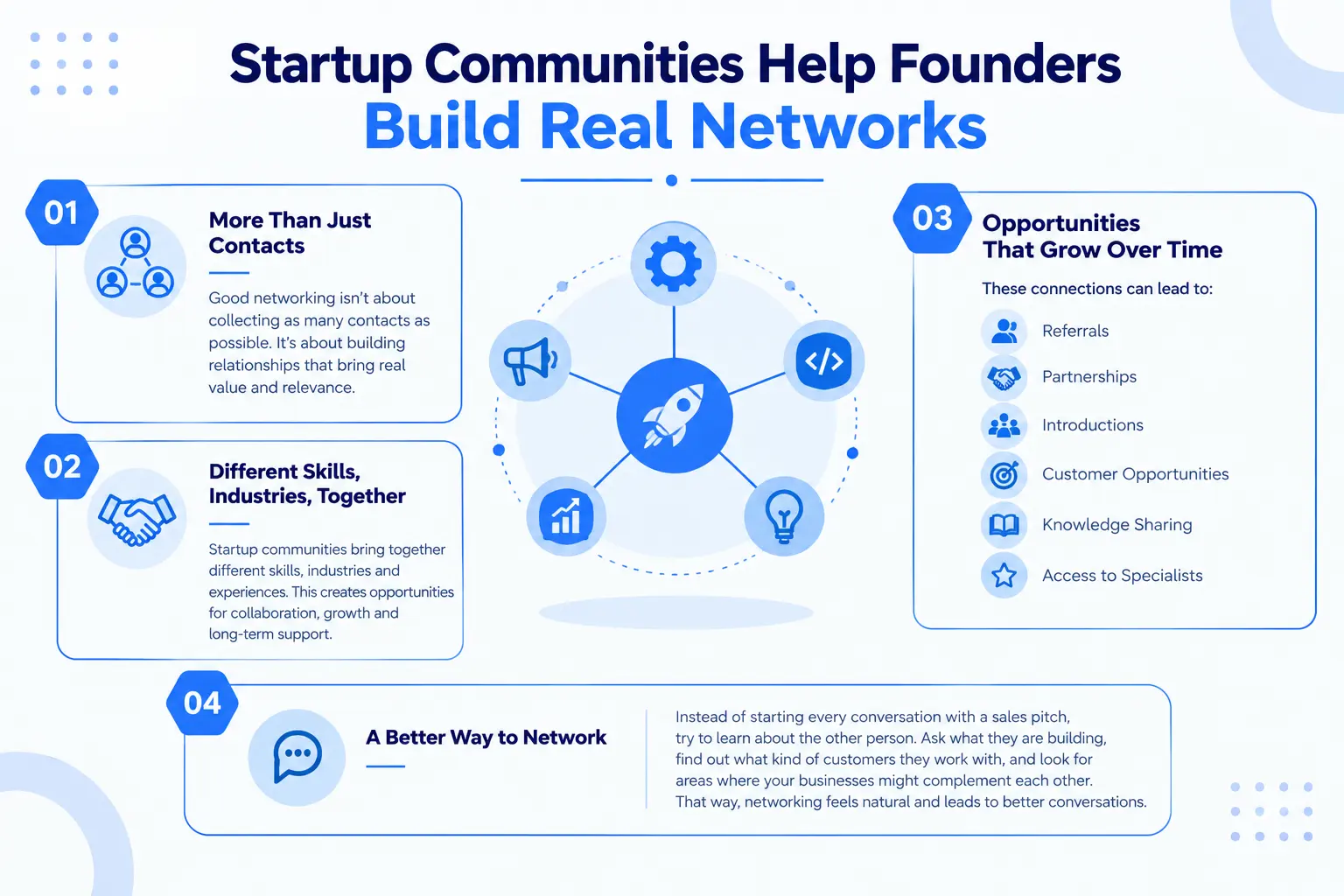
Networking is one of the most obvious benefits, but good networking is not about collecting as many contacts as possible.
It is about building relationships that have some relevance or value.
Imagine a founder developing software for small retailers. At a startup networking event, they meet a marketing consultant who works with retail businesses. The consultant may know potential customers, while the software founder may have clients who need marketing support.
Neither person necessarily joined the event looking for the other. The connection happened because they were in the same room.
This is how a startup founders network can become useful. The community brings different skills, industries, and experiences together.
Over time, these relationships can create:
- referrals
- partnerships
- introductions
- customer opportunities
- knowledge sharing
- access to specialists
The important part is to approach networking with a willingness to contribute, not just ask for something.
A Better Way to Network
Instead of opening every conversation with a sales pitch, start by learning about the other person.
Ask what they are building. Find out what kind of customers they work with.
Look for areas where your businesses might complement each other.That makes networking feel less transactional and often leads to better conversations.
2. They Give Founders Access to Different Perspectives
Founders can become too close to their own ideas.
After spending months developing a product, it is easy to assume that customers will understand its value immediately. Another founder may look at the same idea and point out something you had not considered.
That outside perspective can be useful.
Entrepreneur communities bring together people at different stages. Someone who has just started a company may be thinking about finding product-market fit, while a more experienced founder may be dealing with hiring, expansion, or operational challenges.
Those different experiences create opportunities for learning.
A founder does not have to copy someone else’s strategy. The real benefit is hearing how other people approached a problem and then deciding what applies to their own situation.
This is one reason the benefits of joining startup communities go beyond simple networking.
3. Startup Communities Can Create Business Opportunities
Business opportunities often come through relationships rather than direct advertising.
A community member may introduce you to a potential client. Another may recommend your service to someone in their network. A workshop discussion may reveal a partnership opportunity.
For example, consider a startup that provides accounting software. Its founder meets a business consultant through a community. The consultant works with dozens of small businesses and sees that several of them are struggling with financial reporting.
One introduction could become several conversations.
There is no guarantee that every connection will produce business. But communities increase the number of relevant people you can meet, and that expands the possibility of useful opportunities.
This is particularly relevant for startup communities for business growth, where networking is combined with knowledge sharing, workshops, and founder-focused activities.
Why Relationships Matter More Than Contacts
A spreadsheet containing 500 LinkedIn connections is not necessarily a strong business network.
People remember founders they have spoken with, helped, or learned from.
Regular participation gives those relationships time to develop.
4. They Provide Support During Difficult Stages
Running a business comes with problems that are not always easy to discuss publicly.
A founder might be struggling with hiring, customer retention, pricing, fundraising, or a product decision. Friends and family may be supportive, but they may not understand the business context.
Other founders often do.
This is where a startup support network can be valuable.
A community can provide practical suggestions, but it can also offer something less measurable: reassurance that other entrepreneurs have faced difficult periods too.
That does not mean every piece of advice should be followed. Founders still need to evaluate what makes sense for their own business.
But having people to talk to can make difficult decisions less isolating.
5. Communities Encourage Collaboration
Startups do not always need to compete with one another.
In many cases, two businesses can work together because their products or services solve different parts of the same problem.
For example, a web development company might partner with a branding agency. A SaaS company might work with a consultant who already serves its target customers. A founder running a business event may collaborate with another company for workshops or sponsorships.
These are examples of startup collaboration developing through relationships.
Communities create the environment for such connections because members already share an interest in entrepreneurship and business development.
The collaboration may start with something small—a conversation, introduction, or joint event—and develop into a longer-term partnership.
6. They Help Founders Stay Connected to the Startup Ecosystem
No startup operates in complete isolation.
Businesses are influenced by changing customer expectations, technology, funding conditions, regulations, hiring trends, and new competitors.
Being connected to the wider startup ecosystem can help founders stay aware of what is happening around them.
Startup events, workshops, founder meetups, and online discussions can expose entrepreneurs to ideas they may not encounter within their own company.
For instance, a founder focused entirely on product development may learn about a new customer acquisition approach during a community workshop. Another founder may discover a useful technology through a peer discussion.
The value comes from exposure.
You do not have to adopt every new idea. Sometimes simply knowing what other businesses are trying can help you make better-informed decisions.
Online Startup Communities vs In-Person Communities
Founders no longer need to rely only on local meetups.
Online startup communities make it possible to connect with entrepreneurs from different cities, industries, and countries.
They can be useful when:
- you live away from major startup hubs
- your schedule makes regular events difficult
- you want access to a specific industry
- you want to connect with international founders
- you prefer online discussions and resources
In-person communities offer something different.
A face-to-face conversation can make relationship building more personal, especially when members meet regularly. Workshops and startup events can also create spontaneous conversations that are difficult to reproduce online.
For many founders, using both formats makes sense.
An online startup community can help maintain connections, while local events can strengthen relationships through regular face-to-face interaction.
What Should You Look for in a Startup Community?
Joining the first community you find may not be the best approach.
Think about what you actually need.
What You Need | Community Feature to Look For |
Business connections | Regular networking sessions |
Founder advice | Experienced entrepreneurs and mentors |
Learning | Workshops and expert sessions |
Partnerships | Members from complementary businesses |
Local connections | In-person meetups and events |
Wider reach | Active online community |
Startup support | Founder discussions and peer groups |
The size of a community is not everything.
A smaller group with active members may create more useful conversations than a very large group where people rarely interact.
Look at the quality of discussions, the types of members, how often activities happen, and whether the community matches your stage of business.
How to Join a Startup Community and Get Value From It
Finding a community is only the first step.
If you want to get something useful from it, participate consistently.
Start by introducing yourself clearly. Explain what you are building and the kind of people you want to connect with.
Attend relevant workshops and networking sessions instead of only joining online and disappearing.
More importantly, contribute.
Share a useful resource. Introduce two people who could benefit from knowing each other. Answer a question when you have relevant experience.
Over time, people begin to recognize you and your work.
That is when a community can become more than a directory of contacts.
If you are looking for a place to meet founders, exchange ideas, and explore business connections, explore eRoof Community and see which community activities match your goals.
How Startup Communities Can Support Long-Term Growth
Growth does not always come from one major opportunity.
For many businesses, it is the result of several smaller improvements and relationships built over time.
One conversation may lead to a mentor. A mentor may introduce you to a partner. That partnership may bring a new customer. A customer may later recommend your business to someone else.
There is no fixed sequence.
That is why how startup communities help businesses grow is better understood as a long-term process rather than a single benefit.
The community provides access to people and opportunities. What a founder does with those connections depends on their own business, effort, and follow-through.
Why Startup Communities Matter More for Early-Stage Founders
Early-stage founders often have fewer resources and smaller professional networks.
They may not yet have a large customer base, an experienced leadership team, or established industry relationships.
A founder community can help close some of those gaps.
Through startup communities for early-stage founders, entrepreneurs can meet people who understand the uncertainty that comes with starting a business. They can ask questions, test ideas, find relevant events, and learn from experiences outside their own company.
For founders in India, local communities can be particularly useful because they can connect entrepreneurs with people who understand the local market and business environment.
This makes startup communities for entrepreneurs in India relevant not only for networking, but also for building stronger local business relationships.
A Practical Community-Building Approach for Founders
Founders can also think beyond joining communities and consider what makes a community valuable in the first place.
A strong community needs participation.
People should have reasons to return, whether that is a useful workshop, a founder discussion, a networking opportunity, or a chance to collaborate.
If you are helping build a founder group yourself, focus on three things:
Consistency: Give members regular opportunities to interact.
Relevance: Keep discussions and events useful for the people you want to attract.
Participation: Encourage members to contribute instead of making the community one-way communication.
This is the foundation of how to build a strong startup community.
Conclusion
Starting a business does not mean you have to figure everything out alone.
The right startup community can introduce founders to people, ideas, experiences, and opportunities that are difficult to find on their own. It can help entrepreneurs build relationships, learn from one another, explore collaborations, and stay connected with the wider business ecosystem.
But joining a community is only the beginning.
The real value comes from showing up, having genuine conversations, helping other members, and staying involved.
If you are searching for startup communities for networking and collaboration, look for a community where the people, activities, and goals match what you are trying to build.
For founders, the strongest network is rarely the one with the most contacts. It is the one where the relationships are useful, genuine, and built over time.
FAQs
What are startup communities?
Startup communities are groups of founders, entrepreneurs, mentors, investors, and business professionals who connect to share knowledge, build relationships, and explore business opportunities.
What are the benefits of joining startup communities?
The benefits can include networking, peer support, business referrals, partnerships, learning opportunities, mentorship, and better access to the wider startup ecosystem.
How do I join a startup community?
You can find communities through local founder events, workshops, business networking groups, online platforms, startup events, and entrepreneur networks. Look for a community that matches your industry, location, and stage of business.
Are online startup communities useful for founders?
Yes. Online communities can help founders connect with people outside their local area, participate in discussions, find resources, and maintain business relationships remotely.
Are startup communities useful for small businesses?
They can be. Small-business owners can use communities to meet potential partners, exchange practical advice, find referrals, and build relationships with other entrepreneurs.