

Running a business often means wearing several hats at once. One day you may be looking for a new client, the next you may need a reliable freelancer, a business partner, or simply someone who understands the challenge you are dealing with.
Not every useful business connection starts with a sales call.
Sometimes it starts with a conversation at a local meetup. Sometimes it happens during a workshop. You may meet someone at an industry event and discover that their business serves the same audience as yours.
That is one of the reasons business networking events continue to matter for entrepreneurs.
These events bring business owners, founders, professionals, mentors, and service providers into the same space. The goal is not always to make an immediate sale. In many cases, the real value comes from building relationships that can become useful later.
For entrepreneurs, especially those building a young or growing business, having access to the right people can open doors that are difficult to find through online searches alone.
What Happens at a Business Networking Event?
That is why networking should be viewed as relationship building rather than quick selling.
A networking event can take many forms.
It might be a breakfast meeting for local business owners, a startup gathering, an industry conference, a founder meetup, a workshop, or a more informal community event.
The format changes, but the basic idea is similar: people come together to introduce themselves, discuss their work, exchange ideas, and find opportunities to help one another.A good networking event is not simply a room full of people exchanging visiting cards.
The useful part is what happens after the introduction.
For example, a web development agency may meet a branding consultant. A startup founder may meet an accountant who works with early-stage companies. A business owner may meet someone who knows a potential customer looking for exactly that service.
These connections may lead somewhere immediately, or they may become valuable months later.
That is why networking should be viewed as relationship building rather than quick selling.
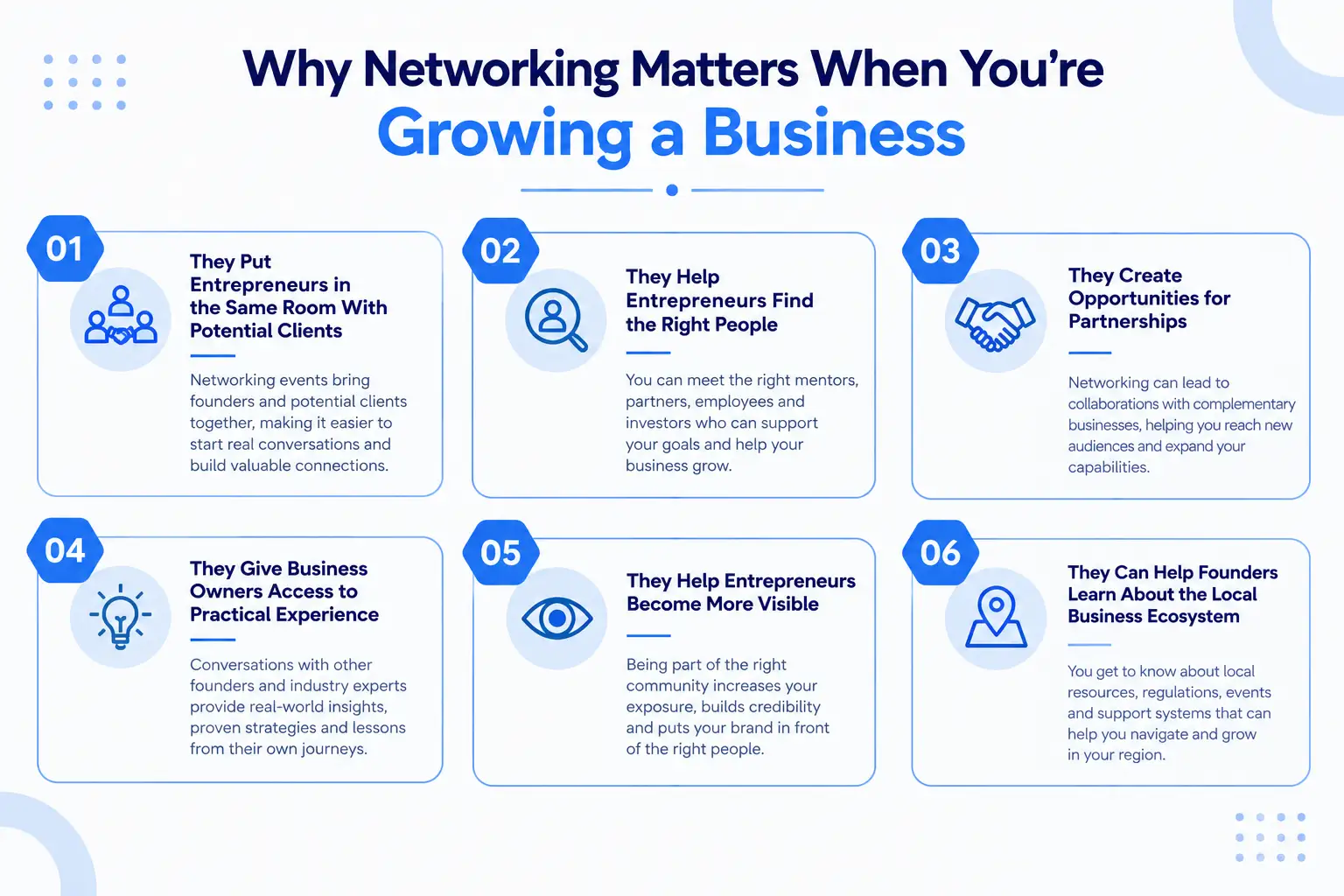
Why Networking Matters When You're Growing a Business
Entrepreneurs often focus heavily on customers, revenue, marketing, and operations. Networking can seem less urgent because its results are not always immediate.
But business relationships can influence several parts of growth.
A strong professional network can help you find people with relevant skills, learn from other business owners, discover opportunities, and get introductions that would otherwise take much longer.
Research also shows that professional networks can play an important role in entrepreneurship. The OECD, for example, has highlighted networking and connections as part of the wider entrepreneurial ecosystem that supports entrepreneurs and businesses.
The important point is not how many people you know. It is whether the relationships you build are relevant and genuine.
1. They Put Entrepreneurs in the Same Room With Potential Clients
One of the most practical reasons to attend networking events is simple: you get to meet people who may need what you offer.
Imagine a small accounting firm attending a business meetup. Instead of advertising to hundreds of random people online, the founder can speak directly with business owners who may already be dealing with accounting, tax, or financial management challenges.
There is still no guarantee of a sale.
But the conversation starts with context.
That can make it easier to understand what the other person needs and decide whether there is a genuine fit.
This is particularly useful for business networking events to find new clients, where the event audience is relevant to your target market.
Don't Turn Every Conversation Into a Pitch
A common mistake is trying to sell immediately.
Instead of saying, “Here are all my services,” ask questions about the other person’s business.
What are they working on?
What kind of customers do they serve?
What challenge are they trying to solve?
A useful conversation is much easier to remember than a long sales pitch.
Over time, that approach can lead to referrals and repeat conversations.
2. They Help Entrepreneurs Find the Right People
Business owners cannot do everything themselves.
At different stages, you may need a designer, lawyer, accountant, marketer, technology partner, recruiter, consultant, or supplier.
Finding these people through a random online search is possible, but a recommendation from someone you trust can make the process easier.
This is one of the less obvious benefits of attending business networking events.
You are not only looking for customers. You are also building a pool of people you can turn to when a business need comes up.
For example, a founder may meet a lawyer at an event and not need legal help that month. Six months later, when the company is preparing a new agreement, that existing connection can become useful.
The relationship was built before the need appeared.
3. They Create Opportunities for Partnerships
Not every business opportunity involves selling directly to a customer.
Sometimes another business can become a partner.
Consider two companies serving different parts of the same market. A digital marketing agency works with startups, while a video production company creates product videos for startups. Their services do not directly compete, but their audiences overlap.
A conversation at a networking event could lead to referrals between the two businesses.
This is where business networking events for building professional connections can have long-term value.
Partnerships may involve:
- referrals
- joint workshops
- co-marketing
- service bundles
- event collaborations
- introductions to customers
The best partnerships usually start with a clear understanding of what both sides can offer.
4. They Give Business Owners Access to Practical Experience
Google can answer many questions.
But it cannot replace a conversation with someone who has actually dealt with a similar business problem.
A founder who has already hired their first ten employees may have practical advice for another founder preparing to hire their first employee.
A business owner who has expanded into a new city may share lessons that are not obvious from a blog post.
That exchange of experience is one reason professional networking remains useful.
At business networking events for entrepreneurs in India, for example, founders can meet people who understand the local market, customer behaviour, hiring environment, and challenges of running a business in the country.
The advice you receive may not always be right for your situation. But hearing different experiences gives you more information to consider before making a decision.
5. They Help Entrepreneurs Become More Visible
Being good at what you do is important. Being known for what you do can also matter.
Regularly attending relevant events can make your name and business more familiar within a professional circle.
Suppose a business owner meets you three times over several months and understands the type of work you provide. They may not need your service today.
Later, someone in their network asks for a recommendation.
Your name may come to mind because they have already met you.
That is a very different process from trying to convince a complete stranger to trust your business.
Visibility grows through repeated, useful interactions.
6. They Can Help Founders Learn About the Local Business Ecosystem
Entrepreneurs do not operate separately from their local business environment.
Local customers, suppliers, investors, professionals, startup groups, educational institutions, and business communities all form part of the ecosystem around a company.
Attending local events can help entrepreneurs understand who is active in their area and what other businesses are working on.
This is especially relevant for founders searching for business networking events in India.
Different cities and regions have their own business communities, industries, founder groups, and events. A local networking event can sometimes provide connections that are much more relevant than a large online group with members spread across the world.
Online vs. In-Person Networking Events
Networking is no longer limited to physical meetings.
Entrepreneurs can now join online sessions, virtual communities, founder groups, webinars, and professional networking platforms.
Both formats have their place.
Factor | In-Person Events | Online Events |
Personal interaction | Strong | Moderate |
Geographic reach | Usually local/regional | Much wider |
Informal conversations | Easier | More limited |
Convenience | Requires travel | Easier to attend |
Local connections | Strong | Depends on audience |
Follow-up | Face-to-face connection | Digital communication |
For someone looking for online business networking events for entrepreneurs, virtual sessions can be a practical starting point.
However, online networking should not become passive participation. Joining an event and leaving without speaking to anyone is unlikely to create much value.
How to Find Business Networking Events That Fit You
You do not need to attend every event you find.
Start by deciding what you actually want from networking.
If your goal is finding customers, look for events attended by your target audience.
If you want partnerships, look for businesses with complementary services.
If you want founder advice, search for entrepreneur or startup-focused communities.
If you want local connections, focus on events in your city or region.
You can also check business communities, startup groups, local chambers, professional associations, workshops, and event platforms when looking for how to find business networking events.
Before registering, check the event’s audience, topic, format, previous activities, and organiser.
The right event is usually more valuable than attending a large number of unrelated events.
What Should You Do Before, During, and After an Event?
Networking does not begin when you walk into the venue.
Before the Event
Know what you want from the event.
Prepare a short introduction that explains what you do without sounding like a sales pitch.
Also, research the event and its attendees when that information is available.
During the Event
Don’t spend the entire evening talking to one person you already know.
Have a few meaningful conversations.
Listen carefully and ask questions. If you meet someone who could genuinely benefit from knowing another person in your network, make an introduction.
After the Event
This step is often forgotten.
Send a short follow-up message to people you genuinely connected with.
Mention something specific from your conversation instead of sending the same generic message to everyone.
For example:
“Great speaking with you about your expansion plans yesterday. I’d be happy to stay connected.”
It takes very little time, but it keeps the conversation alive.
DIY Networking vs. Business Community Events
Entrepreneurs can build networks independently, but organised communities can make the process easier.
Approach | Advantages | Limitations |
Networking alone | Flexible and low cost | Requires finding contacts yourself |
Online groups | Large reach | Relationships can remain superficial |
Professional events | Focused audience | May have attendance costs |
Business communities | Ongoing relationships | Requires regular participation |
Founder meetups | Relevant peer discussions | May be location-specific |
A business community can be particularly useful because networking is not limited to a single evening.
Members can meet repeatedly through workshops, events, discussions, and other activities.
For entrepreneurs who want to build relationships over time, that continuity can matter.
What Makes a Networking Event Worth Attending?
A large crowd does not automatically mean a valuable event.
Before attending, consider:
Who will be there?
Are the attendees relevant to your business?
Why are people attending?
Are they there to learn, find customers, build partnerships, or simply promote themselves?
Is there meaningful interaction?
Does the format give people enough time to actually talk?
Does the community continue after the event?
Can you stay connected with people you meet?
Does the event match your stage of business?
A new founder may benefit from a different event than an established enterprise owner.
These questions can help you avoid spending time on events that do not match your goals.
How Business Networking Events Support Long-Term Growth
Networking rarely works like an advertisement where you spend money today and immediately see a fixed return tomorrow.
A useful connection may take weeks or months to become an opportunity.
You might meet a founder today, exchange ideas, and reconnect later when both businesses have grown. Another person may refer a customer to you six months after your first conversation.
This is why how business networking events help businesses grow should be viewed from a longer-term perspective.
Networking can expand the number of people who know your business, understand what you offer, and can potentially connect you with relevant opportunities.
The outcome still depends on the quality of your offer, your follow-up, and how consistently you build relationships.
A Better Way to Approach Networking
If you attend an event only thinking, “How many leads can I get today?”, you may miss the bigger opportunity.
Try a different approach.
Go in with three simple goals:
Meet: Have a few genuine conversations with people you would like to know.
Learn: Leave with at least one useful idea, insight, or perspective.
Contribute: Find at least one way to help someone else.
That approach takes some pressure out of networking.
And ironically, it can make business conversations feel much more natural.
Where eRoof Community Fits In
For entrepreneurs who want to build relationships beyond a single networking event, an ongoing business community can provide more opportunities to stay connected.
eRoof Community can be positioned around relevant founder activities such as networking, workshops, startup events, and business discussions. Instead of treating every interaction as a one-time meeting, the focus can be on creating opportunities for entrepreneurs to keep meeting and learning from one another.
Looking to meet other entrepreneurs and build meaningful business connections?
Explore eRoof’s community activities and find upcoming opportunities that match your business goals.
[Internal CTA: Explore eRoof Community →]
Conclusion
For entrepreneurs, networking is not simply about collecting contacts.
It is about knowing more people who understand business, finding people you can learn from, discovering potential partners, and creating relationships that may become valuable over time.
The most useful business networking events are usually the ones where people have a reason to talk, learn, and stay connected after the event ends.
So, before choosing your next event, think about what you actually need. Maybe it is a new client.
Maybe it is a business partner. Maybe you need advice from someone who has already faced the problem in front of you.
Choose events around that goal, participate properly, and follow up afterwards.
A single conversation may not change your business.
But consistently building the right network can change the number of opportunities you have access to.
FAQs
What are business networking events?
Business networking events are gatherings where entrepreneurs, business owners, professionals, founders, and other business stakeholders meet to exchange ideas, build professional relationships, and explore opportunities.
What are the benefits of attending business networking events?
They can help entrepreneurs meet potential clients, find partners, learn from other business owners, increase professional visibility, and develop long-term business relationships.
Are business networking events useful for startups?
Yes. Startups can use networking events to meet potential customers, mentors, partners, investors, service providers, and other founders who understand the early stages of business building.
How can I find business networking events?
You can look through local business communities, startup groups, professional associations, workshops, chambers of commerce, event platforms, and entrepreneur networks. Online searches can also help you find events in your area.
Are online business networking events worth attending?
They can be useful when the attendees and topic are relevant to your business. Online events can also help entrepreneurs connect with people outside their local area.