

Two founders launch in the same week with the same product idea. One lives in a city buzzing with meetups, mentors, and investors who know each other by first name.The other builds quietly in a place where nobody has heard the phrase “product-market fit.”
A year later, only one of them has a funded round, a first big customer, and a team of five. The idea didn’t make the difference. The surroundings did.
Those surroundings, a web of people, programs, and capital, are what we call a startup ecosystem. It’s the reason certain cities punch far above their weight, and it’s the reason your next big break will probably come from a conversation rather than a cold email.
In this guide, we’ll break down what a startup ecosystem really is, who the key players are, what separates a thriving one from a struggling one, and how networking helps you grow inside it. Whether you’re a first-time founder or a seasoned operator, you’ll finish with practical steps you can use this month.
What Is a Startup Ecosystem?
A startup ecosystem is a connected network of founders, investors, mentors, support organizations, institutions, and customers that work together to help new companies start, survive, and scale.
Think of it as a living system rather than a list of companies. Every part depends on the others, and the health of the whole decides how well each startup performs.
You’ll often hear related terms such as entrepreneurial ecosystem, innovation ecosystem, and startup landscape. They overlap heavily.
An entrepreneurial ecosystem leans toward people and mindset, an innovation ecosystem leans toward research and technology, and the startup landscape usually describes the map of companies operating in a region.In everyday conversation, a startup ecosystem covers all of it.
Most ecosystems also have a centre of gravity, usually a startup hub where talent, capital, and ideas cluster. Silicon Valley is the famous example, but strong hubs now exist in cities all over the world, including many that were barely on the map a decade ago.
The lesson is encouraging: a startup hub isn’t born; it’s built, one relationship at a time.
Why a Startup Ecosystem Matters for Founders
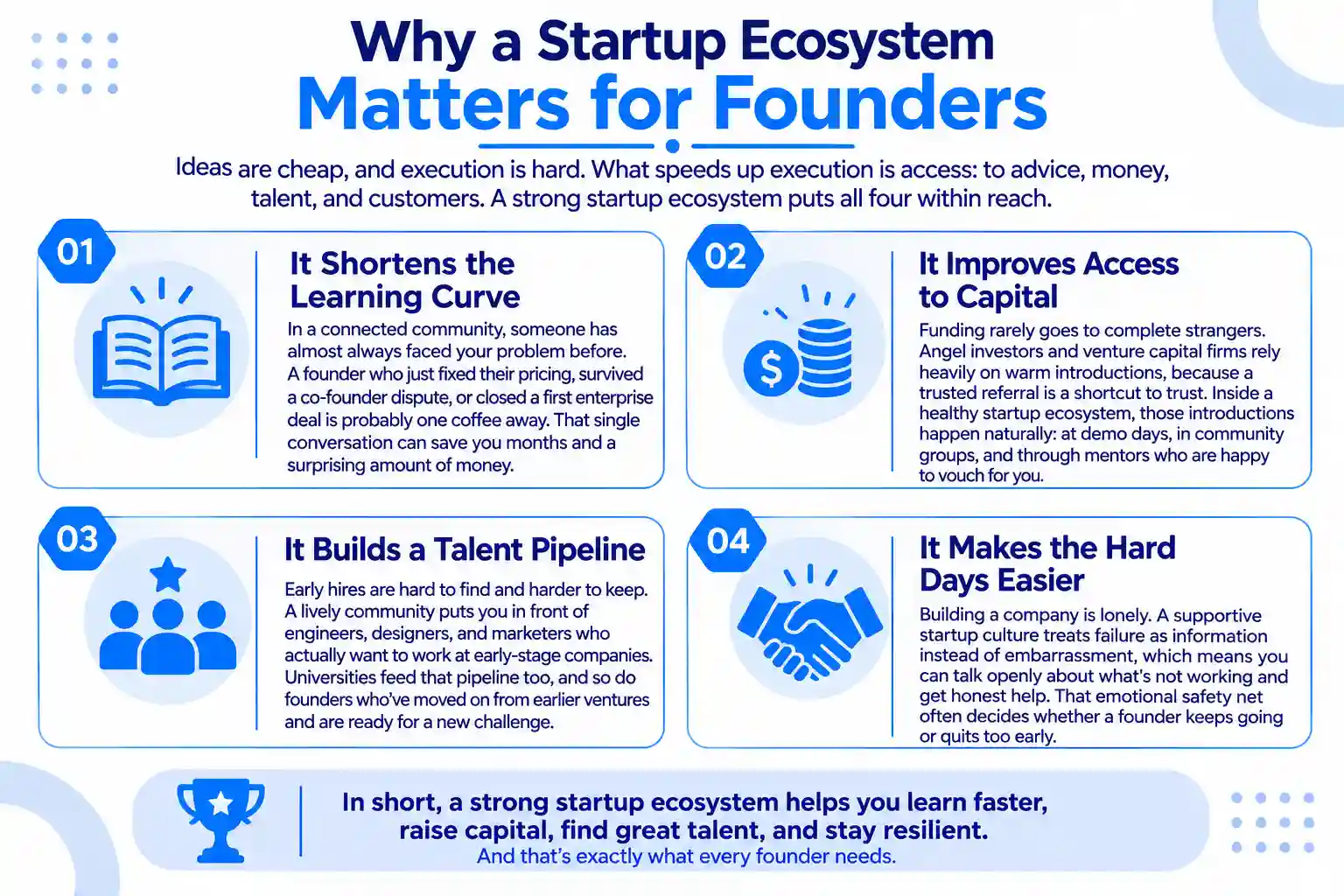
It Shortens the Learning Curve
In a connected community, someone has almost always faced your problem before. A founder who just fixed their pricing, survived a co-founder dispute, or closed a first enterprise deal is probably one coffee away. That single conversation can save you months and a surprising amount of money.
It Improves Access to Capital
Funding rarely goes to complete strangers. Angel investors and venture capital firms rely heavily on warm introductions, because a trusted referral is a shortcut to trust. Inside a healthy startup ecosystem, those introductions happen naturally: at demo days, in community groups, and through mentors who are happy to vouch for you.
It Builds a Talent Pipeline
Early hires are hard to find and harder to keep. A lively community puts you in front of engineers, designers, and marketers who actually want to work at early-stage companies. Universities feed that pipeline too, and so do founders who’ve moved on from earlier ventures and are ready for a new challenge.
It Makes the Hard Days Easier
Building a company is lonely. A supportive startup culture treats failure as information instead of embarrassment, which means you can talk openly about what’s not working and get honest help. That emotional safety net often decides whether a founder keeps going or quits too early.
The Key Players in a Startup Ecosystem
No two ecosystems are identical, but most share the same cast of characters. Knowing who does what helps you decide where to spend your limited time.
Founders and Entrepreneurs
Founders and entrepreneurs are the engine of everything. They create the companies, jobs, and demand that attract every other player. The best of them also give back, mentoring newcomers, angel investing after an exit, and hiring from the community. That recycling of experience and money is how an ecosystem compounds over time.
Angel Investors and Venture Capital
Angel investors usually write the first cheques, often backing people before products. Venture capital firms come in later with larger amounts and expect rapid growth. Understanding the difference matters: pitching a venture capital fund too early wastes everyone’s time, while ignoring angels can leave you without a bridge to your first real round.
Mentors and Advisors
Mentors and advisors give you pattern recognition. They’ve seen what happens when founders hire too fast, price too low, or raise from the wrong people. The best mentor relationships grow slowly from useful conversations, not from a single awkward “will you be my mentor?” message.
Startup Accelerators and Incubators
Startup accelerators and incubators bundle structure, mentorship, and a ready-made cohort of peers. Incubators tend to support very early ideas over a longer period, while accelerators run short, intense programs that often end in a demo day. Either way, the cohort is the hidden prize: the founders beside you today may become your customers, referrers, or co-founders tomorrow.
Universities and Research Institutions
Universities and research institutions supply talent, labs, and deep technology that commercial companies rarely develop alone. Many startups begin as research projects or student ventures, and campus incubation programs give them space and credibility to take the first step.
Government Support for Startups
Government support for startups comes in many forms: grants, tax benefits, startup-friendly regulation, incubation funding, and public infrastructure. When policy makes it easy to register, hire, and raise money, the whole startup ecosystem becomes faster and more attractive to outside capital.
Corporate Partners
Corporate partners offer something money alone can’t: distribution. A large company can become a pilot customer, a channel partner, or an eventual acquirer. A mature ecosystem creates clear paths for these partnerships, with programs and events where startups and established companies meet on purpose.
What Makes a Healthy Startup Ecosystem?
Not every city with a coworking space has a real ecosystem. A few traits separate the thriving ones from the rest.
A Startup Culture That Celebrates Builders
A healthy startup culture rewards experimentation and openly shares lessons. People answer messages from strangers, make introductions without asking for anything, and celebrate other founders’ wins. When generosity becomes the norm, everyone moves faster.
Density and Easy Access
In strong communities, you can meet the right person within a week, not a year. Regular meetups, shared spaces, and active online groups keep people close. Density turns a scattered startup landscape into a place where chance encounters happen daily.
Diverse Funding and Support
A good startup environment offers more than one route to capital: angel networks, venture capital, grants, and revenue-based options. It also provides legal, accounting, and mentoring support at a price early-stage teams can afford.
Role Models Who Reinvest
When successful founders reinvest time and money, the cycle repeats. Today’s first-time founder becomes tomorrow’s angel investor or mentor, and the innovation ecosystem gets stronger every year. Look for this pattern when you’re deciding where to build.
How Networking Fuels Founder Growth Inside a Startup Ecosystem
Here’s the part most founders underestimate: an ecosystem doesn’t help you automatically. It rewards people who participate. Networking is the bridge between living near opportunity and actually reaching it.
Consider how a typical opportunity travels. An investor mentions they’re looking for a certain kind of company. A mentor hears it and remembers you. A founder friend vouches for your traction. By the time you send a message, you’re no longer a stranger. This chain of trust is the real currency of any startup ecosystem.
Networking also compounds. Each good conversation makes the next one easier, because your reputation arrives before you do. Founders who attend, help, and follow up consistently become known as reliable, and reliable people get the introductions. Over a year, that quietly outperforms any single pitch deck.
Finally, networking keeps you honest. Talking regularly to other founders and customers exposes blind spots early, before they get expensive. Inside a thriving startup ecosystem, feedback is available constantly, if you’re willing to show up and ask.
How to Plug Into Your Local Startup Ecosystem: 6 Steps
1. Map Who's Around You
Start by listing the founders and entrepreneurs, investors, mentors, programs, and institutions near you. Note which ones match your stage and goals. A simple map of your corner of the startup ecosystem tells you where to invest your time.
2. Show Up Regularly
One event rarely changes anything. Pick two or three recurring meetups or sessions and attend consistently, so people begin to recognize you. Familiar faces get introductions; strangers rarely do.
3. Contribute Before You Ask
Share a lesson, make an introduction, or volunteer to speak. Generosity builds a reputation faster than self-promotion. When you eventually need help, you’ll be asking someone who already thinks of you as useful.
4. Build Relationships With Mentors and Advisors
Look for mentors and advisors who’ve solved your next problem, not just impressive names. Ask specific questions, apply the advice, and report back on the results. People help more when they see their advice put to work.
5. Blend Online and Offline
Online groups and LinkedIn are great for discovery, but trust builds fastest in person. Use online channels to find people, and in-person meetings to deepen the relationship.
6. Review and Adjust Every Quarter
Every three months, ask which connections led to real outcomes: customers, hires, advice, or funding. Do more of what works and drop what doesn’t. Treat your participation in the startup ecosystem like any growth channel: test, measure, and improve.
How eRoof Community Strengthens the Startup Ecosystem
eRoof is a non-profit startup community based in Indore, bringing together founders, creators, and builders who want to connect, collaborate, learn, and grow. In a startup ecosystem like this, the goal isn’t just events. It’s turning connections into real opportunities.
The Networking initiative connects founders, creators, and professionals to unlock referrals, partnerships, and business growth. Regular meetups and sessions put people in the same room, while the annual event gathers the wider community at once.
If you’re after structured learning, workshops and Skilling offer expert-led, practical sessions.
Early-stage founders can use the LaunchPad to showcase their product, present their idea, and gather feedback and early traction. eRoof Talks share stories from builders making real impact, and eRoof’s chapters help the community grow beyond a single room.
To see how the approach plays out, read the success stories or learn why smart founders never skip entrepreneur meetups. And if you’re ready to start building relationships, become a member of eRoof.
Mistakes Founders Make in a Startup Ecosystem
Collecting contacts, not relationships. A stack of business cards means nothing without follow-up. Send a thoughtful message within two days and suggest a next step.
Asking too soon. Requesting funding or an introduction from someone you’ve just met feels transactional. Build trust first.
Staying in one circle. If you only meet other founders in your niche, you’ll hear the same opinions repeated. Meet investors, corporate partners, academics, and operators from other fields.
Ignoring local strengths. Every startup ecosystem has its own strengths. Some have deep research, others have strong manufacturing or services talent. Build around what your region does best.
Waiting until you need help. The best time to build a network is before you need it. Start while things are calm.
Conclusion
No startup ecosystem appears overnight. It grows when founders keep showing up, investors keep backing early ideas, mentors keep sharing, and institutions keep opening doors. You don’t need permission to contribute. You only need to start.
So pick one goal, choose two places to show up, and send one follow-up this week. The relationships you build today shape the startup environment you’ll work in tomorrow. If you’re looking for a community to begin with, join eRoof and meet people who are building real businesses.
Frequently Asked Questions
What is a startup ecosystem?
A startup ecosystem is a connected network of founders, investors, mentors, accelerators, universities, governments, and corporate partners that supports the creation and growth of new companies.
Why is a startup ecosystem important?
It gives founders faster access to knowledge, funding, talent, and customers. Because many opportunities come through referrals, being part of a strong network often accelerates growth and reduces risk.
Who are the key players in a startup ecosystem?
Key players include founders and entrepreneurs, angel investors, venture capital firms, mentors and advisors, startup accelerators and incubators, universities and research institutions, government agencies, and corporate partners.
What makes a startup ecosystem healthy?
A healthy one has an open startup culture, easy access to people and capital, diverse funding options, supportive institutions, and successful founders who reinvest in the community.
How can a founder join a startup ecosystem?
Start by mapping local players, attending recurring meetups, contributing helpful ideas, and following up consistently. Joining a community such as eRoof also gives you a ready-made group of founders and builders.