


There is an old saying in the business world: It’s not what you know, but who you know. But when you are trying to scale a company to a large level, the importance of this increases even more. Business expansion is not just about spending money on digital advertisements or blindly sending cold emails.
Real, sustainable, and fast growth always comes from a network of strong, trusted, and strategic relationships, and this is exactly how strategic Networking Events Help Business Expansion.
Whether it is an early-stage startup, a small business, an MSME, or a large corporate (Large Enterprise), networking events serve as a primary catalyst for growing the business for everyone.
If you want to step into a new regional market, secure large-scale partnerships, or take your business to a new milestone of revenue, sitting in the right place and among the right people can shorten your business expansion journey by months or years.
In this comprehensive guide, we will understand in depth how corporate networking, industry conferences, and B2B meetups help in growing a business, and how you can get the maximum benefit (ROI) out of it.
1. The Real Mechanics of Business Expansion and Networking
When most people think about networking, a picture comes to their mind of a place where people are making forced small talk and distributing visiting cards to each other. But this traditional model of networking has now completely changed. Today’s corporate networking is a highly strategic process called Ecosystem Building.
For any business desiring expansion, networking events shorten the long paths of the traditional sales funnel. Instead of tangling with gatekeepers through cold outreach, you get a chance to directly meet those decision-makers who themselves have come to discuss partnerships, supply chain optimization, and market expansion.
Growth Vectors
The expansion of any business mainly happens in three ways, and networking directly supports all three:
- Geographic Expansion: Stepping into new cities, states, or international markets. Local events familiarize you with the rules and culture there.
- Market Penetration: Further strengthening your hold among your existing customers.
- Product or Service Diversification: Launching new products or targeting large enterprises (Enterprise Clients).
By establishing direct contact with local distributors, legal experts, potential co-founders, and large clients, these events remove that loneliness and uncertainty that often harms business expansion.
2. Strategic Benefits of Networking for Different Business Sizes
The impact of any business meetup or trade show depends on the level your company is at. The strategy with which an MSME goes into an event is completely different from the strategy of a Fortune 500 company.
Startups: Credibility & Validation
For early-stage startups, building their identity and credibility in the market is the biggest challenge. When you do not have a marketing budget of millions, networking events are the exact places where you mark your presence.
- Founder-Led Selling: In the early days, people trust your vision and your personality before your product. Meetups give you the opportunity to express your story directly and effectively.
- Feedback Loops: Discussing your product with industry veterans and mentors provides you with immediate and unbiased market feedback, allowing you to improve your product in time.
Small Businesses and MSMEs: Stepping Out of the Local Scope
Small businesses and MSMEs often face a major problem: revenue stagnation. When you depend only on a limited region or a few old customers, growth stops after a certain period.
- Supply Chain Optimization: B2B matchmaking events introduce MSMEs to large vendors and manufacturers, helping to reduce their cost of goods sold (COGS) or services.
- Peer-to-Peer Learning: Connecting with those business owners who have already moved past your current revenue milestone provides a clear and practical roadmap for your own business.
Large Enterprises: Maintaining Market Dominance and Agility
Even very large companies continuously need new ideas to remain relevant in the market. For them, networking events are not for increasing immediate sales, but for maintaining market intelligence and strategic positioning.
- Ecosystem-Led Growth (ELG): Large companies use these events to find small innovative partners, new software tools, and integration partners so that they can provide better services to their customers and prevent them from leaving (Churn).
- Mergers and Acquisitions (M&A Pipelines): Many large corporate acquisitions, takeovers, and joint ventures begin from a casual conversation in the VIP lounge of a major industry conference.
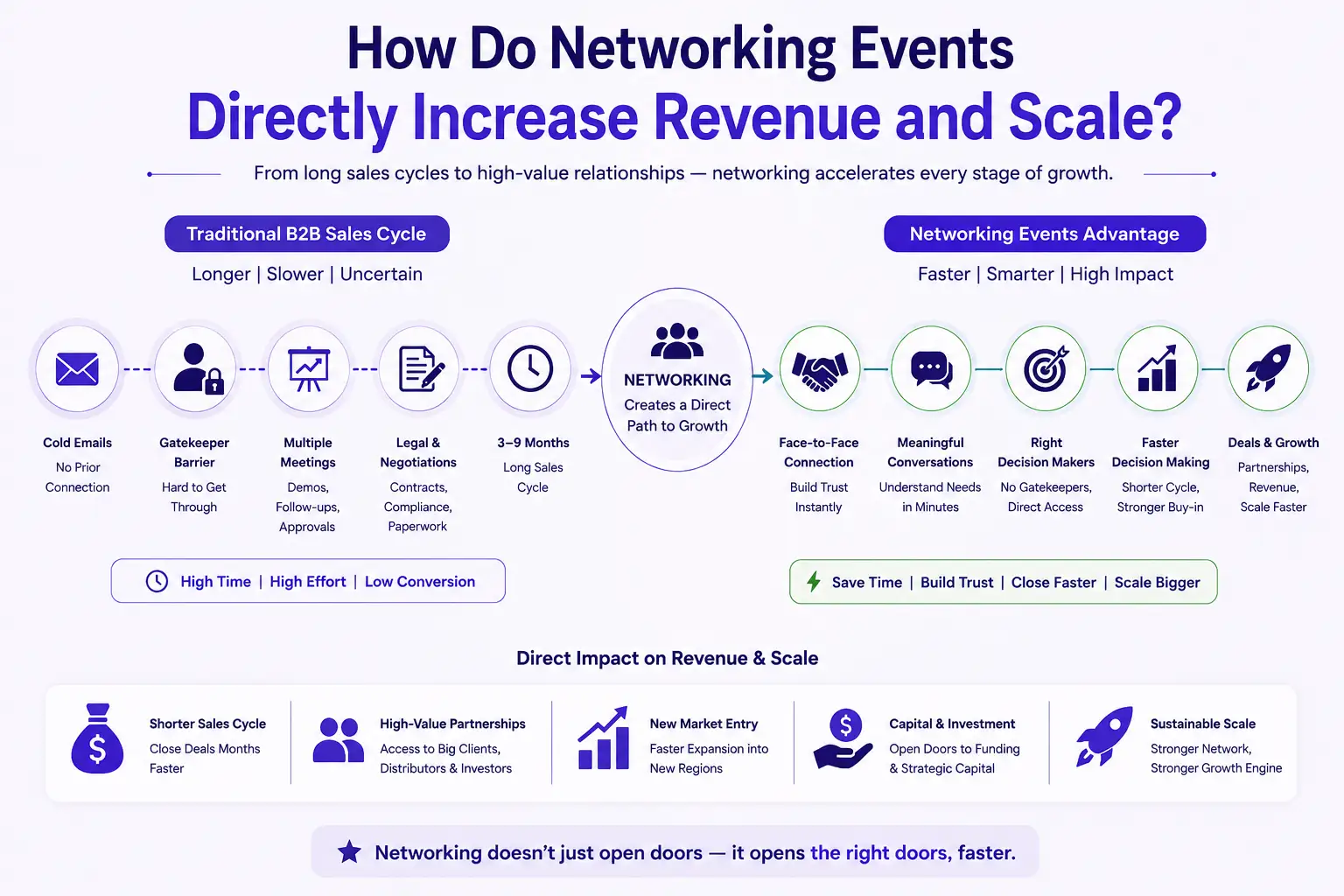
3. How Do Networking Events Directly Increase Revenue and Scale?
Let’s take a look at those concrete ways and metrics through which shaking hands at business events directly translates into your bank balance and successful business expansion.
Shortening the B2B Sales Cycle
The traditional B2B sales process takes a lot of time, first sending cold emails or making calls, then getting past the gatekeeper, giving a product demo, then convincing stakeholders, and completing legal formalities. This entire process easily takes 3 to 9 months.
But in a major industry event or summit, you completely skip this initial cold introduction phase. A 15-minute face-to-face conversation over coffee can generate far more trust than 20 cold emails. After this, when you email them, you are not an unknown vendor but a familiar face, which closes the deal much faster.
Opening Paths for New Capital & Investment
Whether you need Angel Investment for your startup, Venture Capital (Series A Fund), or an asset-based loan for your new warehouse, investors always go where the business hustle is. Venture Capitalists (VCs) and angel investors constantly participate in pitching events, panel discussions, and business community launches to find the next great company.
4. The Blueprint of High-ROI Networking: A Step-by-Step Strategy
Going to an event without any solid strategy is a waste of time, energy, and money. If you want your networking to truly translate into business expansion, you must create a robust plan for it.
Step 1: Pre-Event Target Mapping
Never go to an event unprepared. Nowadays, almost every major conference has its own app, or the list of speakers, sponsors, and attendees is already present on their website.
- Identify the Top 10: Shortlist 10 specific people, investors, or companies that directly align with your business expansion goals.
- Schedule Meetings in Advance: Contact them 1 or 2 weeks before the event via LinkedIn or the event app. Send a short and clean message: Hello [Name], I noticed that you are coming to the upcoming business summit. We are expanding our business in this sector and would love to have a short 10-minute meeting (over coffee) with you to discuss market trends.
Step 2: Preparing a Value-First Elevator Pitch
When someone asks you, What do you do?, do not give them a cliché or boring job title. Say your piece in such a way that the other person immediately understands what problem of theirs you can solve and how you are different from others.
- Weak Pitch: We are a digital marketing agency that writes content and does SEO.
- Strong and Effective Pitch: We help B2B and software companies boost their stagnant revenue through data-driven SEO and content strategies, delivering them directly to their high-intent buyers.
Step 3: Timely and Contextual Follow-up
The real work begins after the event ends. The biggest mistake people make is waiting for a week to follow up, by which time the other person has forgotten you due to meeting hundreds of people.
- The 24-Hour Rule: Make sure to send a connection request on LinkedIn or a personalized email within 24 hours of the event ending.
- Reference the Conversation: Do not send a generic message. Mention a specific point from your conversation: It was great learning your thoughts on ecosystem-led growth during the panel discussion yesterday, Amit. Connecting to take that discussion forward.
Conclusion
Business expansion is never accidental; it is the deliberate outcome of strategic relationships forged at the right place and time. Networking events are far more than mere card-exchanging rituals; they are the master keys that unlock new geographic markets, high-value corporate partnerships, and vital funding channels.
Whether you are an early-stage startup seeking market validation or a large enterprise looking to dominate a new territory, ecosystem building accelerates your scaling journey.
The formula for maximum ROI rests on proactive pre-event mapping, a value-driven elevator pitch, and swift, contextual follow-ups. Stop looking at your next industry conference as a casual event, and start treating it as the launchpad for your next phase of business growth.
FAQs
1. How do networking events help business expansion?
Networking events help businesses expand by connecting founders, decision-makers, investors, distributors, and potential clients. These relationships can lead to partnerships, new customers, funding opportunities, and faster market expansion.
2. Why are networking events important for startups?
Networking events help startups build credibility, validate business ideas, meet investors, gain mentorship, find co-founders, and attract early customers without spending heavily on marketing.
3. What is the best networking strategy for business growth?
The best strategy includes researching attendees before the event, scheduling meetings in advance, delivering a value-focused elevator pitch, and following up within 24 hours after the event.
4. How do networking events help attract investors?
Networking events bring together angel investors, venture capitalists, accelerators, and startup founders, making it easier to pitch ideas, receive feedback, and secure funding opportunities.
5. How do networking events support market expansion?
Networking events help businesses understand local markets, connect with regional partners, identify distributors, and build relationships that simplify expansion into new locations.