

Starting a business rarely happens in isolation. A founder may have a strong product idea, but building the right team, finding reliable partners, reaching customers, and learning from other business owners can be much easier with the right connections.
That is where startup networking events can make a difference.
Unlike a simple social gathering, a well-organized startup event brings founders, entrepreneurs, investors, marketers, professionals, and potential partners into the same environment. A short conversation can turn into a useful introduction. An exchange of ideas can lead to a partnership. Even a casual discussion can help a founder see a business problem from a different perspective.
According to HubSpot and The Hustle’s entrepreneurship research, 61% of entrepreneurs reported finding customers through word-of-mouth referrals. This shows why relationships can become an important part of business growth.
But how exactly do startup networking events encourage collaboration?
Collaboration Starts With the Right People in the Room
The first advantage is simple: networking events bring people together who may have complementary skills, goals, or resources.
Imagine a startup founder building a SaaS product. The founder may understand the product extremely well but need help with marketing. At the same event, there could be a digital marketer looking for a promising product to work with.
They may not have met through their normal professional circles.
A conversation at a startup networking event can create that first connection.
The same can happen between:
- A startup and a potential technology partner
- A founder and a business mentor
- A small business and a marketing agency
- Two startups with complementary products
- An entrepreneur and a potential investor
- A new founder and an experienced business ownerhttps://neilpatel.com/blog/co-marketing/
The value is not simply in meeting more people. It is in meeting people with whom there is a reason to work together.
From Conversation to Collaboration
Not every conversation becomes a partnership, and that is completely normal.
The real opportunity is the possibility of moving through a simple journey:
Meet → Understand → Share → Collaborate → Follow Up
For example, two founders might discover during a conversation that they serve similar audiences. Instead of competing, they could explore a joint webinar, referral arrangement, product integration, or co-marketing campaign.
This is one reason startup networking opportunities are more valuable when events encourage meaningful conversations instead of simply exchanging business cards.
The U.S. Small Business Administration has also highlighted collaboration as an important part of entrepreneurship ecosystems because it can improve access to knowledge, relationships, resources, and capital.
Different Skills Create Better Ideas
Collaboration becomes particularly useful when people bring different experiences to the same discussion.
A founder may know the customer problem.
A developer may know how to build the solution.
A marketer may know how to communicate it.
A sales professional may know how to reach the right buyers.
Put these people together and a simple conversation can become a brainstorming session.
This is why startup networking is not only about finding customers. It can also expose entrepreneurs to new approaches, tools, industries, and ways of solving problems.
Sometimes the most useful connection is not someone who can immediately buy your product. It may be someone who helps you understand how to improve it.
Startup Events Can Turn Competitors Into Partners
Competition does not always mean businesses have to work separately.
Two companies targeting the same broad market may have different strengths. One might specialize in software development while another provides implementation or consulting.
Instead of competing for every opportunity, they may discover situations where working together creates more value for the customer.
For example:
Company A: Develops accounting software
Company B: Provides financial consulting
A networking conversation could lead to a referral partnership where both businesses introduce relevant customers to each other.
This kind of relationship is difficult to create through cold outreach alone because collaboration usually requires some level of trust.
Meeting face-to-face through startup meetups or other business gatherings can provide a more natural starting point.
What Makes a Networking Event Good for Collaboration?
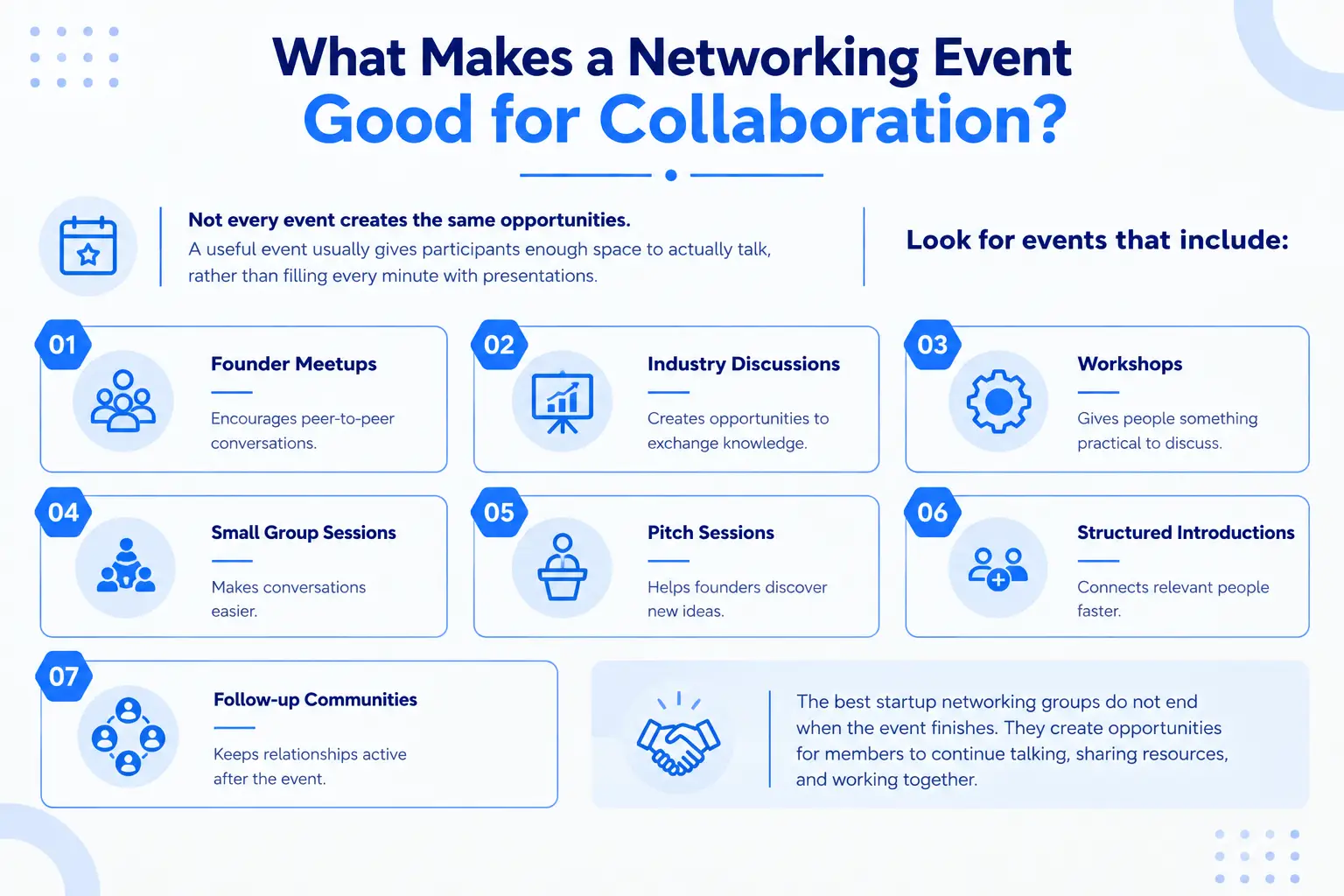
Not every event creates the same opportunities.
A useful event usually gives participants enough space to actually talk, rather than filling every minute with presentations.
Look for events that include:
Event Feature | Why It Helps |
Encourages peer-to-peer conversations | |
Industry discussions | Creates opportunities to exchange knowledge |
Gives people something practical to discuss | |
Small group sessions | Makes conversations easier |
Pitch sessions | Helps founders discover new ideas |
Structured introductions | Connects relevant people faster |
Follow-up communities | Keeps relationships active after the event |
The best startup networking groups do not end when the event finishes. They create opportunities for members to continue talking, sharing resources, and working together.
Collaboration Is Easier When You Attend With a Goal
Walking into an event with the goal of “meeting everyone” can actually make networking harder.
A better approach is to decide what you want from the event before attending.
Your goal could be:
- Find a technology partner
- Meet potential clients
- Learn about a new market
- Find a mentor
- Meet other founders
- Explore co-marketing opportunities
- Discover potential investors
- Find people with complementary skills
For example, a new entrepreneur may attend several networking events for entrepreneurs but focus on meeting three people who understand the same customer segment.
That makes the event more purposeful.
How to Turn One Meeting Into a Real Partnership
The event itself is only the beginning.
A common networking mistake is having a good conversation and then never contacting the person again.
Instead, follow a simple three-step process.
1. Continue the Conversation
Send a short message after the event and mention something specific you discussed.
This is much more natural than sending a generic “Nice meeting you” message.
2. Offer Something Useful
Share an article, introduce them to someone, recommend a tool, or provide a useful suggestion related to your conversation.
Collaboration grows faster when both sides see value.
3. Suggest a Small Next Step
Do not immediately propose a huge partnership.
Start small.
You could suggest a short call, a joint discussion, a referral, a product demonstration, or a small pilot project.
If that works well, the relationship can develop naturally.
Online and Offline Networking Can Work Together
Today, entrepreneurs do not have to choose between physical events and digital communities.
Online startup networking events can make it easier to connect with people outside your city, while local events can create stronger face-to-face relationships.
Online Networking | Offline Networking |
Wider geographic reach | More personal interaction |
Easier for busy founders | Faster relationship building |
Useful for niche industries | Strong local connections |
Lower travel requirements | Better for spontaneous conversations |
Good for regular communities | Useful for deeper introductions |
For someone searching for startup networking events in India, combining online communities with local events can provide a wider network.
A founder in Indore, for example, may participate in local startup meetups while also joining online communities that connect entrepreneurs across Mumbai, Delhi, Bangalore, and other startup hubs.
The Right Event Can Help Small Businesses Too
Networking is not only for venture-backed startups.
Startup networking events for small businesses and local entrepreneurs can be equally valuable.
A small business owner may be looking for:
- Local suppliers
- Marketing partners
- New customers
- Referral relationships
- Technology solutions
- Business mentors
- Other local entrepreneurs
This makes local startup and business networking events especially useful for business owners who want to build relationships within their regional market.
For new entrepreneurs, the experience can also reduce the feeling of building a business alone.
Why Collaboration Matters for the Startup Ecosystem
When entrepreneurs share knowledge and resources, the benefit can extend beyond individual businesses.
One founder introduces another to a customer.
A business owner recommends a service provider.
A mentor shares experience with a new entrepreneur.
Two startups build something together.
Over time, these individual relationships create a stronger startup community.
The U.S. Small Business Administration has described entrepreneurship ecosystems as networks where collaboration can help strengthen access to knowledge, relationships, resources, and capital.
That is why startup community events can play a role beyond networking. They can help create an environment where entrepreneurs learn from each other and discover opportunities that may not have appeared independently.
How eRoof Community Can Support Meaningful Connections
A strong business community should give entrepreneurs more than a place to exchange contact details.
eRoof Community focuses on creating opportunities for entrepreneurs, startups, and businesses to connect, learn, and build meaningful professional relationships.
Whether someone is looking for local connections, startup events, workshops, or people with complementary business interests, being part of an active community can make networking more consistent.
Instead of treating networking as a one-time activity, founders can approach it as a long-term business habit.
Explore eRoof Community’s networking opportunities and find conversations that can lead to meaningful business relationships.
Conclusion
The biggest value of startup networking events is not the number of people you meet.
It is what happens after the introduction.
A conversation can lead to an idea.
An idea can lead to a collaboration.
A collaboration can lead to a partnership.
And a partnership can eventually create new opportunities for both businesses.
That is why founders should approach networking with curiosity rather than simply trying to collect contacts.
The right event can put the right people in the same room. What happens next depends on how those relationships are developed.
FAQs
1. What are startup networking events?
Startup networking events are gatherings where founders, entrepreneurs, investors, professionals, and business owners meet to exchange ideas, build relationships, and explore potential business opportunities.
2. How do startup networking events encourage collaboration?
They bring people with different skills, experiences, and business goals together. These conversations can lead to partnerships, referrals, joint projects, mentorships, and other forms of collaboration.
3. Who should attend startup networking events?
Founders, entrepreneurs, startup employees, small business owners, investors, mentors, freelancers, and professionals looking for business relationships can benefit from these events.
4. Are startup networking events useful for new entrepreneurs?
Yes. New entrepreneurs can use these events to meet experienced founders, learn from others, find potential partners, and build a professional network.
5. How can I find startup networking events in India?
Look for startup communities, entrepreneur groups, coworking spaces, business organizations, workshops, and local event platforms. You can also join online communities to discover upcoming events.