

Imagine you have an excellent product or service.. Your team is amazing, your website is fantastic, and your vision is also very big. But if you keep sitting inside the closed room of your office or behind your laptop screen, how will the world get to know about you? There is a simple truth in the business world: success is not only about what you know but also about who you know.
Strong professional relationships often create opportunities that marketing alone cannot.
Whether you run a startup, manage an MSME, or lead a large enterprise, networking events can help you expand your business, build meaningful relationships, and discover new opportunities.In this guide, you will learn what networking events are, why they matter, and how they can contribute to long-term business growth.
1. What are Networking Events?
Business networking events are professional gatherings where entrepreneurs, investors, mentors, founders, and industry experts come together to build meaningful business relationships.
These events are much more than exchanging business cards over tea or coffee. Instead, participants attend with the goal of creating valuable professional connections.
People join networking events for several reasons:
• Entrepreneurs exchange new ideas and business experiences.
• Many professionals connect with potential clients and investors.
• Participants also discover emerging industry trends.
• Most importantly, these events help build long-term professional relationships.
2. How Networking Events Grow Your Business (Benefits of Networking)
As an entrepreneur, your time is extremely valuable. In such a situation, you might think, Why should I leave my work and go to an event? Let’s find out what these events can give to your business:
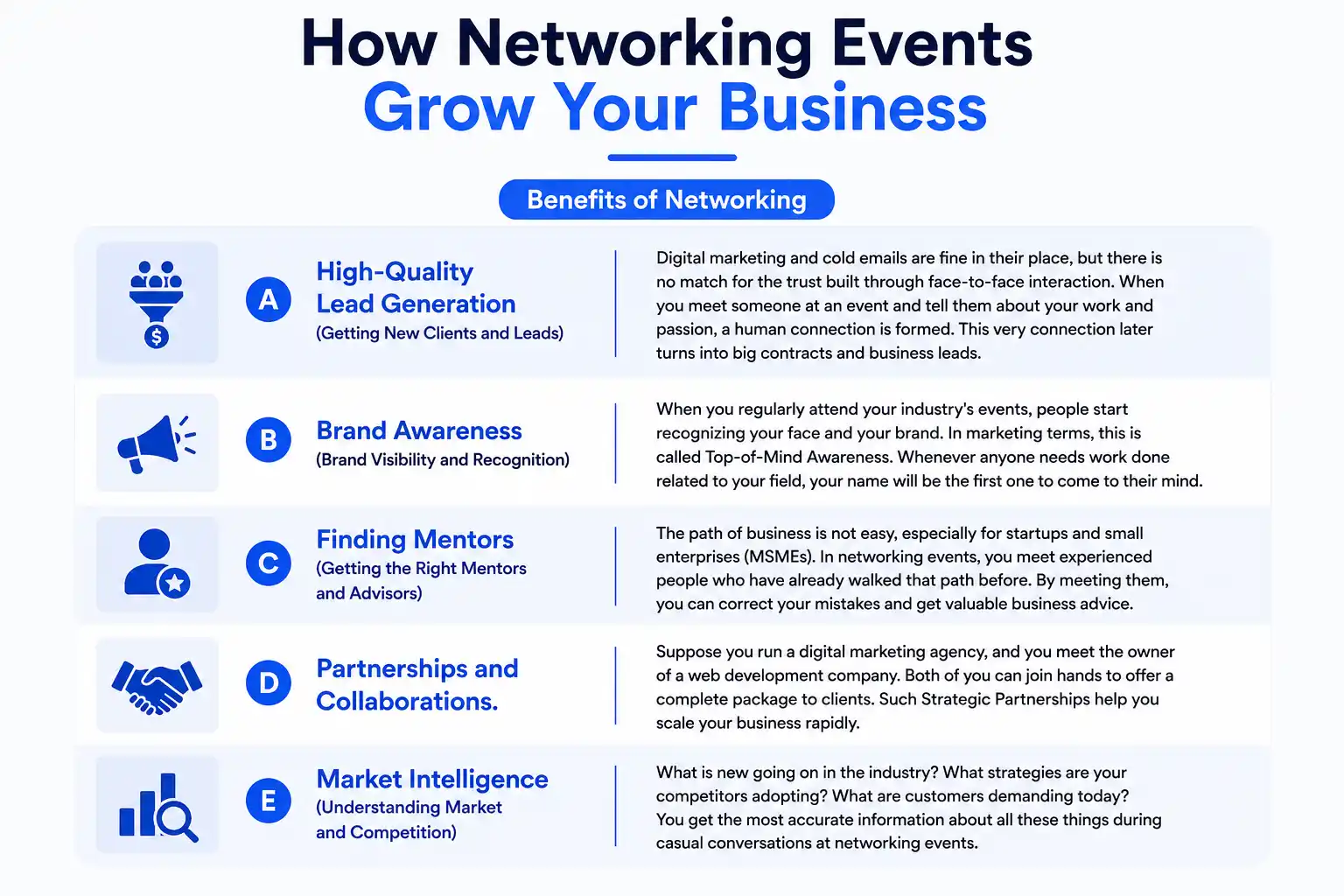
A) High-Quality Lead Generation (Getting New Clients and Leads)
Although digital marketing and cold emails are effective, there is no match for the trust built through face-to-face interaction. When you meet someone at an event and tell them about your work and passion, a human connection is formed. This very connection later turns into big contracts and business leads.
B) Brand Awareness (Brand Visibility and Recognition)
Furthermore, when you regularly attend your industry’s events, people start recognizing your face and your brand.In marketing terms, this concept is known as Top-of-Mind Awareness. Whenever anyone needs work done related to your field, your name will be the first one to come to their mind.
C) Finding Mentors (Getting the Right Mentors and Advisors)
However, the path of business is not easy, especially for startups and small enterprises (MSMEs). At networking events, you meet experienced people who have already walked that path before. By meeting them, you can correct your mistakes and get valuable business advice.
D) Partnerships and Collaborations
Suppose you run a digital marketing agency, and you meet the owner of a web development company. Both of you can join hands to offer a complete package to clients. Such Strategic Partnerships help you scale your business rapidly.
E) Market Intelligence (Understanding Market and Competition)
You can discover what is new happening in the industry.
Additionally, you can understand the strategies your competitors are adopting.
Moreover, networking conversations reveal what customers are demanding today.
You get the most accurate information about all these things during casual conversations at networking events.
3. Importance of Networking for Every Business Size
The benefit of networking does not belong to just one category. It has a different importance for every type of business:
Business Type | Primary Goal | Key Benefit |
Startups | Funding, mentorship, and building the initial team | Opportunity to connect directly with investors (Angel Investors/VCs) |
Small Businesses & MSMEs | Building local clients and community support | Finding reliable suppliers and partners |
Enterprises (Large) | Finding new markets and industry authority | Paths for new talent (Recruitment) and Mergers & Acquisitions (M&A) |
4. Step-by-Step Guide to Becoming a Successful Networker
Before the Event
If you go to an event without preparation, you will probably return with only a few visiting cards and empty hands. To get the maximum benefit of networking, adopt this process:
1. Pre-Event Preparation:
Research and Goal Setting
Before attending the event, research the expected participants. Set a clear networking goal for yourself, such as speaking with at least three potential partners or clients. In addition, prepare a 30-second elevator pitch that introduces your business in a clear and attractive way.
2. During the Event:
Focus on Listening (Active Listening) – Quality over Quantity
Most people at networking events want to talk about themselves. However, successful networkers focus on listening carefully. Ask thoughtful questions, understand the other person’s business challenges, and show genuine interest in their work. As a result, people are more likely to trust you and continue the relationship after the event.
3. Go Digital:
Modern Alternative to Visiting Cards
Nowadays, paper business cards are often misplaced. Therefore, connect with people on LinkedIn immediately after the conversation or exchange a digital business card through a QR code. This makes it easier to continue the relationship after the event.
4. The Fortune is in the Follow-up:
The 48-Hour Rule
Within 24 to 48 hours after the event, send a short and personalized message to the people with whom you had a meaningful conversation. For example, you can write: It was great meeting you, and I found your thoughts on [Topic] very interesting. This simple follow-up helps keep the relationship active and professional.
5. 3 Big Mistakes to Avoid During Networking (And How to Prevent Them)
If you want people to remember you as a professional, avoid these common mistakes:
- Hard Selling (Trying to sell immediately): Networking events are not places to sell goods. Here, relationships are made, not transactions. Do not start pitching your product in the very first meeting.
- Thinking only about your benefit: Networking is a two-way street. Therefore, focus on asking yourself: How can I help this person? By maintaining a giving attitude, you can build stronger professional relationships.
- Not following up: This is the biggest mistake. Not contacting after the event throws cold water on all your hard work.
Conclusion
Ultimately, growing a business is not only about operations, marketing, or technology; it is also about building strong relationships with people. Networking events provide a platform where entrepreneurs can expand their reach, discover new opportunities, and learn from experienced professionals.
Finally, start making a list of upcoming networking events in your industry, prepare your pitch, and step out with confidence. Your next client, investor, mentor, or business partner may be waiting at the next event you attend.
FAQ
1. What are networking events in business?
Answer: Business networking events are professional gatherings where entrepreneurs, business owners, investors, mentors, and industry experts connect to build relationships, exchange ideas, generate leads, and explore partnerships that support business growth.
2. How do networking events help grow a business?
Answer: Networking events help businesses generate qualified leads, increase brand awareness, find strategic partners, gain industry insights, connect with mentors, and build long-term professional relationships that can lead to new opportunities.
3. How should you prepare before attending a networking event?
Answer: Before attending a networking event, research the attendees, define clear networking goals, prepare a 30-second elevator pitch, carry digital contact information, and identify the people you want to meet.
4. What should you do during a networking event?
Answer: During a networking event, focus on active listening, ask meaningful questions, build genuine relationships, exchange contact details, and avoid aggressively promoting your products or services.
5. Why is follow-up important after networking events?
Answer: Following up within 24 to 48 hours helps strengthen new relationships, keeps conversations fresh, increases trust, and improves the chances of converting contacts into business opportunities.