


In today’s competitive business environment, a common misconception has become widespread: the company with the best product will always win. However, product quality alone is no longer enough to guarantee long-term success.Many businesses spend months chasing product-market fit, investing heavily in paid advertising, and continuously optimizing conversion funnels. However, these efforts alone rarely create sustainable business growth.
In reality, the biggest driver of business success often comes from an area that cannot be measured on a digital dashboard. Instead, the strongest growth engine is built through meaningful conversations, trusted relationships, and effective business networking.
Whether you run an MSME, lead a fast-growing startup, or manage a large enterprise, building a strong professional network is no longer optional. Instead, it has become one of the most powerful drivers of business growth.
Moreover, in an era dominated by digital noise, changing algorithms, and artificial intelligence (AI), trust and genuine human relationships have become your greatest competitive advantage.
Whether you are searching for your first ten beta users or solving supply chain challenges, one principle remains true: your network is your net worth.
In this guide, you’ll learn why business networking is essential for modern business growth. Additionally, you’ll discover practical strategies for building a high-ROI networking system that transforms everyday conversations into long-term business opportunities.
1. What is Business Networking in the Modern Era?
If you still believe networking is only about exchanging business cards and making small talk at formal events, it’s time to rethink that approach. Today, business networking is far more strategic and relationship-driven.
In today’s B2B environment, business networking means creating long-term, mutually beneficial relationships built on trust, shared value, and genuine collaboration.
Current Table
Traditional Networking (Old Way) | Modern Networking (New Way) |
Transactional mindset | Relationship-Driven |
“What can I get right now?” | $\rightarrow$ How can we create value together? |
One-way pitch | Multi-directional collaboration |
Isolated events | Continuously running digital ecosystem |
2. Why Are Traditional Advertisements Failing? (The Decline of Paid Ads)
For many years, businesses followed a simple formula for growth: run advertisements on platforms like Google and Facebook, attract traffic, and generate sales. However, rising competition and changing market conditions have made this strategy far less effective, especially for startups and MSMEs.
Rising Customer Acquisition Costs (CAC)
Today, stricter privacy regulations and intense competition have significantly increased digital advertising costs. As a result, many startups and MSMEs struggle to maintain profitable paid marketing campaigns.
Therefore, business networking has become a cost-effective alternative that generates high-quality referrals without requiring a massive advertising budget.
Why Community Trust Matters More Than Advertising
Nowadays, buyers rarely make decisions based only on advertisements. Instead, they rely on recommendations, customer reviews, and trusted professional networks.
In fact, referrals from trusted peers often influence purchasing decisions more than traditional advertising campaigns. Consequently, a single referral from the right networking connection can save weeks of cold outreach while improving your conversion rate.
3. Benefits of Business Networking for MSMEs and Startups
While large companies network to maintain their dominance in the market, for small businesses and startups, it is a matter of Survival and Speed.
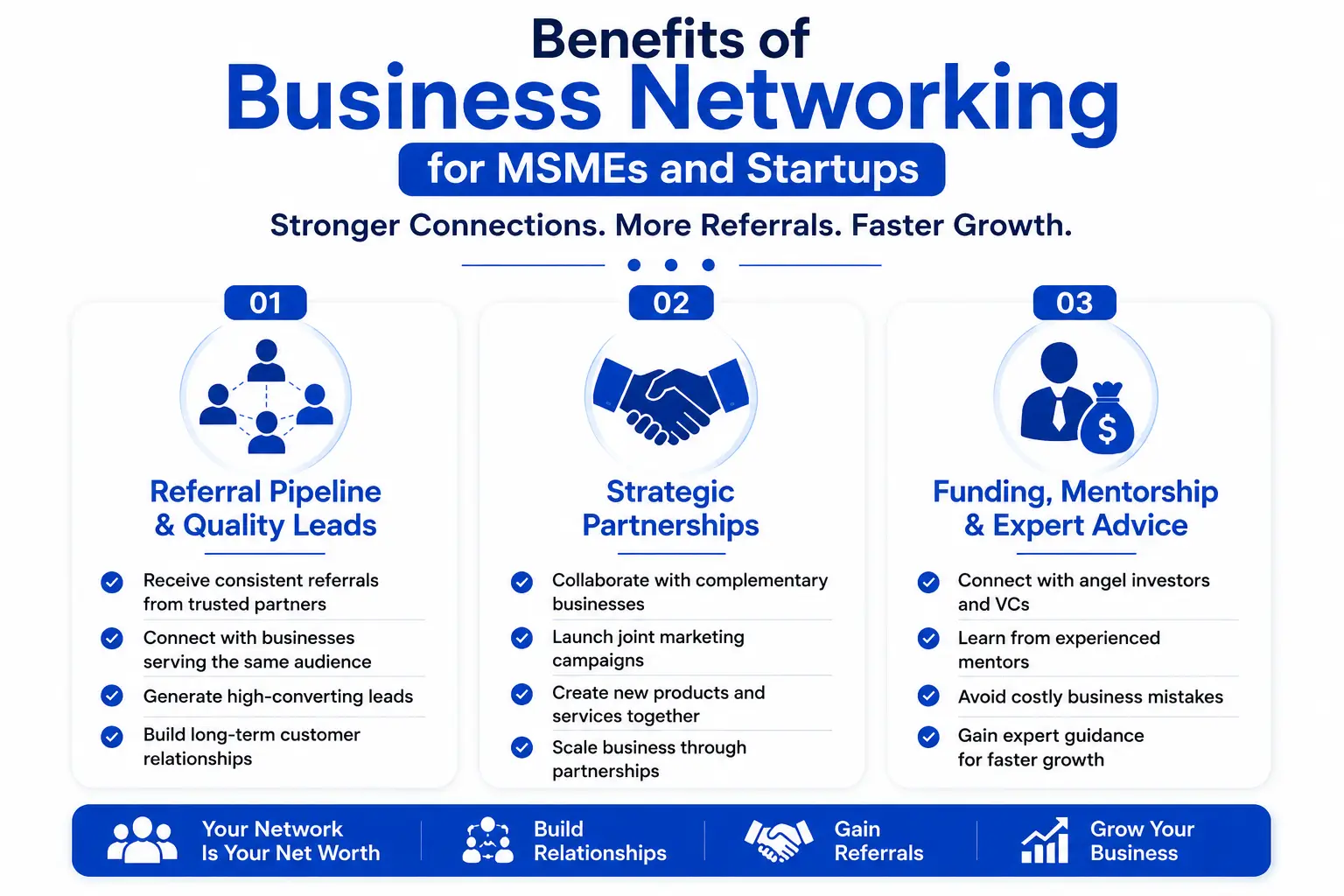
Referral Pipeline and a Flood of New Customers
The biggest benefit of a strong network is that you start getting continuous referrals. When you connect with other non-competitive business owners like yourself who serve the same target audience, an excellent ecosystem is formed.
Illustratively, a website developer and an SEO content expert share the same client base. Through networking, they can refer clients to each other. These referral leads close very quickly and stay with you for a long time.
Strategic Partnerships
Growth does not always happen gradually; sometimes the right partnership scales your business 10x overnight. Through networking, you can find co-marketing opportunities, do joint ventures, or launch a combined product that appeals to the customers of both companies.
Fundraising, Mentorship, and the Right Advice
For startups, networking means the path to funding. Angel investors or venture capitalists rarely invest money just by looking at a cold email. They bet on founders who reach them through their trusted network. Apart from this, advice received from an experienced mentor saves you from initial business shocks and legal hassles.
4. Enterprise Level Networking: Corporate Alliances and Market Leadership
For large companies (Enterprises), networking is not just a lead generation tool, but it is a Macro Strategic Tool.
The Foundation of Mergers and Acquisitions (M&A)
Big corporate deals or mergers of companies often begin at a large industry roundtable, the World Economic Forum, or a private mastermind event. Long before the paperwork and investment bankers come in, top executives of both companies establish mutual alignment and trust through networking.
Regulatory and Compliance Management
Large companies have to operate within various government regulations and legal frameworks. By being part of industry associations and corporate networks, enterprise leaders anticipate upcoming new laws, policies, and collective industry challenges in advance and find solutions together.
5. How to Build a High-ROI Networking Strategy?
Networking is not a coincidence; it is a systematic science. If you want to turn your contacts into actual revenue, you must follow this 3-step framework:
The 'Give-First' Framework (The Law of Reciprocity)
The biggest mistake in networking is that people start trying to sell their product in the very first meeting. Doing this ends the relationship before it even begins.
Instead, adopt a value-first approach. Whenever you meet someone, think: how can I help this person?
- Can I introduce them to a new client?
- Can I share a useful tool or case study with them?
- Can I invite them to a specific professional workshop or community?
When you help the other person first, you earn trust in their heart. Later, when you need help, they will step forward to help you.
Choosing the Right Networking Hubs
You cannot be everywhere. Therefore, research where your target people (Potential Clients/Partners) spend time:
- For Local MSMEs: Local Chambers of Commerce, trade associations, and regional business hubs.
- For Tech Startups: Founder communities, Slack/Discord groups, startup incubators, and practical workshops.
- For B2B Enterprises: LinkedIn thought leadership, select industry roundtables, and global executive forums.
The Right Way to Follow-Up (The Follow-Up Architecture)
Just taking someone’s business card or sending a connection request on LinkedIn is not networking. The real game begins after the meeting.
- 1. First Digital Touchpoint: Within 24 hours of the meeting.
Send them a personalized message on LinkedIn or email. Do not make a sales pitch. Just say it was nice meeting them and mention a specific part of your conversation so they remember you. - 2. Giving Value Without Selfishness: After 4 to 7 days.
Share an article, report, or resource that can help them solve an existing problem. This proves that you were listening to them carefully. - 3. Low-Pressure Meeting or Sync: Within 14 days.
Invite them for a virtual coffee, a practical workshop, or a local event. Keep the conversation focused on how you both can collaborate and support each other in the future.
6. How to Overcome Networking Obstacles?
Many people hesitate despite knowing the benefits of networking. Let’s overcome these mental blocks:
Social Anxiety and the Fear of Pitching
If going into a room full of strangers makes you nervous, change your perspective. You are not going there to sell anything. Your only job is to ask questions and listen carefully. Start the conversation with these simple questions:
- What is the biggest project your team is working on this quarter?
- What is the biggest challenge currently coming up in your industry?
- How did you start your career in this field?
If you are an introvert, you don’t need to talk to 50 people. Just target 2 or 3 right people in a room and have a deep, meaningful conversation with them. Quality always beats quantity in networking.
Conclusion
In a digital landscape crowded with automated outreach and fluctuating ad costs, business networking is no longer just a soft skill; it is a core economic driver. From a startup seeking its first breakthrough to an enterprise orchestrating high-stakes market alliances, your professional ecosystem determines your trajectory.
Ultimately, sustainable business growth is built on the speed of trust. By shifting from a transactional mindset to a value-first strategy, choosing the right community hubs, and implementing a disciplined follow-up architecture, you convert brief encounters into long-term revenue assets.
Stop relying entirely on shifting algorithms to find your next opportunity; instead, invest in the human relationships that have always anchored resilient business empires. Your next major growth milestone is just one meaningful conversation away.
FAQs
1. What is business networking?
Business networking is the process of building professional relationships with entrepreneurs, business owners, industry experts, and potential clients to create long-term opportunities for growth, referrals, partnerships, and knowledge sharing.
2. Why is business networking important for business growth?
Business networking helps businesses generate referrals, build trust, find strategic partners, attract investors, gain industry insights, and create long-term revenue opportunities that paid advertising alone cannot provide.
3. What are the biggest benefits of business networking?
Some of the biggest benefits include:
- More qualified referrals
- New business partnerships
- Increased brand credibility
- Access to mentors
- Better hiring opportunities
- Industry knowledge
- Long-term business growth
4. Why is networking important for small businesses and MSMEs?
Networking enables MSMEs to generate referrals, reduce customer acquisition costs, build local partnerships, and compete more effectively without relying solely on expensive advertising.
5. What is the best networking strategy for business owners?
The most effective networking strategy is a value-first approach focus on helping others, building trust, maintaining regular communication, and creating mutually beneficial relationships over time.