

Inside the Story
At just 9, the loss of his father forced him to understand responsibility much earlier than most.
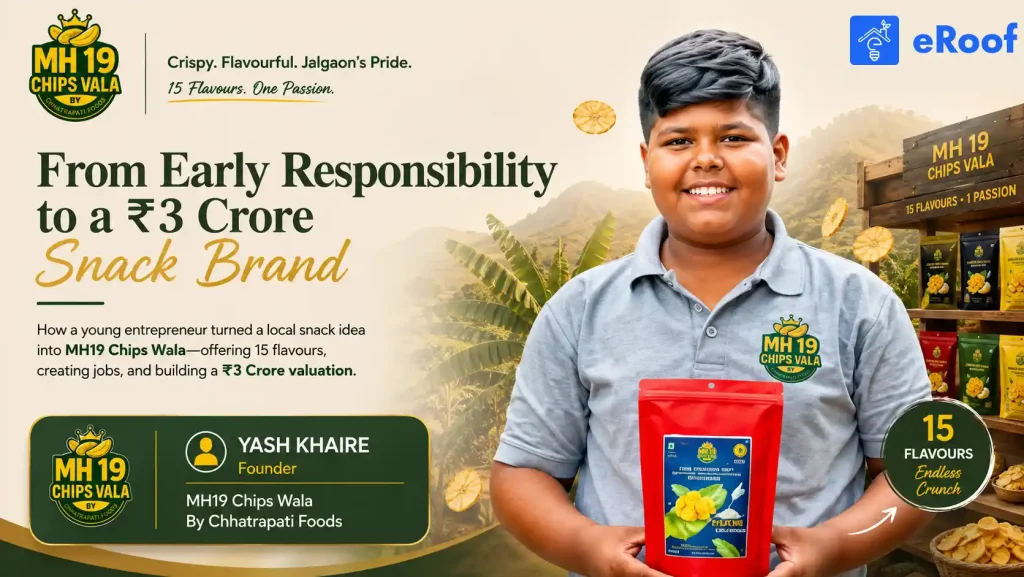
By 17, that responsibility had evolved into entrepreneurship, beginning with small sales and eventually leading to the creation of MH19 Chips Wala.
Seeing an opportunity in Jalgaon’s strong banana-growing identity, he noticed that the banana chips market had room for more variety—and built a brand around 15 flavours.
What started with survival and hustle has grown into a youth-driven snack business, reportedly reaching nearly ₹5 lakh in monthly sales and a ₹3 crore valuation deal.
The Bigger Picture
Entrepreneurship is often associated with business degrees, funding, established networks and years of professional experience.
But some businesses begin somewhere very different.
They begin with necessity.
For the young founder behind MH19 Chips Wala, entrepreneurship started with circumstances that demanded responsibility early in life. After losing his father at nine, he began finding ways to contribute to his family, including selling phenyl bottles.
Years later, the same instinct to observe, adapt and find opportunities led him toward food entrepreneurship.
The opportunity wasn’t hidden inside a revolutionary technology.
It was sitting inside something familiar: banana chips.
Jalgaon already had a strong association with bananas. Instead of trying to create an entirely new category, he looked at an existing product and asked a simple question:
How can this be made more interesting for today’s customers?
That thinking became the foundation for MH19 Chips Wala.
In This Story
- When Responsibility Became the First Teacher
- Finding Opportunity in an Everyday Snack
- Turning Banana Chips Into a Brand
- Building Young Through Hustle, Not Funding
- From Local Roots to a ₹3 Crore Valuation
- What Comes Next for MH19 Chips Wala
When Responsibility Became the First Teacher
Some entrepreneurial journeys begin with ambition.
This one began with responsibility.
After losing his father at just nine years old, the founder had to experience circumstances that most children never encounter at that age.
Instead of allowing those circumstances to define his future, he gradually developed an instinct that would later become central to his entrepreneurial journey: find an opportunity, start small and keep moving.
His early entrepreneurial experience included selling phenyl bottles to support his family.
There was no business school.
No large team.
No major funding round.
Just the need to earn, learn and create something better.
That early experience became an unconventional education in selling, understanding customers and taking responsibility.
And eventually, it led him toward a much bigger opportunity.
Founder’s Perspective
You don’t always start a business because everything is perfect. Sometimes, you start because life teaches you to take responsibility.
Finding Opportunity in an Everyday Snack
The idea behind MH19 Chips Wala didn’t begin with the ambition to disrupt the global snack industry.
It began with observation.
Jalgaon is widely associated with bananas, creating a natural connection between the region and banana-based products.
But the founder noticed something interesting.
Banana chips were familiar.
The category was established.
But the experience could still be made more exciting.
Instead of competing purely on an existing product, MH19 Chips Wala experimented with flavours and variety.
The brand reportedly launched 15 different flavours, turning an everyday snack into a more contemporary and youth-oriented product experience.
The lesson was simple:
Innovation doesn’t always mean inventing something new. Sometimes, it means making something familiar better.
Turning Banana Chips Into a Brand
Food businesses can easily become commodity businesses.
One seller offers chips.
Another offers the same chips.
Customers compare primarily on price.
MH19 Chips Wala attempted to move beyond that equation by focusing on variety, flavour and branding.
The idea was to take a familiar regional product and give younger consumers more reasons to try it.
Public references to the brand describe its offering around banana chips and other Indian snacks, including bhakarwadi. Business listings also identify MH19 Chips Wala as a food manufacturer/supplier.
That shift—from simply selling a snack to building a recognisable snack brand—is an important part of the company’s journey.
The brand’s identity also carries a strong regional connection through the MH19 reference, giving it a local-rooted identity while aiming for a wider market.
Building Young Through Hustle, Not Funding
One of the most striking aspects of the MH19 Chips Wala story is the age at which this journey has unfolded.
Public coverage describes the founder as still studying in Class 12, while simultaneously running the business alongside his younger brother.
That creates a very different picture of entrepreneurship.
There was no long corporate career before starting the company.
Instead, the founder learned through doing.
Selling taught him customers.
Small experiments taught him markets.
Challenges taught him resilience.
And building the brand taught him that entrepreneurship is less about age and more about the willingness to take responsibility and execute.
The journey also highlights an important reality of India’s emerging entrepreneurial ecosystem:
The next generation of founders may not always come from traditional startup backgrounds.
Sometimes they are already building while they are still learning.
From Local Roots to a ₹3 Crore Valuation
The business has since moved beyond its early-stage beginnings.
According to recent public coverage, MH19 Chips Wala has reached approximately ₹5 lakh in monthly sales, while the founder reportedly closed a ₹3 crore valuation deal on Bharat Ke Founders.
These numbers are significant not simply because of their size, but because of the journey behind them.
The business reportedly started from very small-scale selling and evolved into a branded food venture built around a familiar local product.
That progression reflects a broader entrepreneurial principle:
Start with what you have. Understand the market. Improve the product. And let consistency compound.
The brand’s story has also attracted attention because it represents a very different version of startup entrepreneurship—one rooted in a local opportunity rather than a technology platform.
More Than Just a Chips Business
What makes MH19 Chips Wala interesting is not only the product.
It is the journey behind the product.
A young founder turned an everyday snack into an opportunity for experimentation, branding and business building.
The company represents a larger shift happening across India’s emerging entrepreneurial landscape, where founders are increasingly building businesses around regional products, local strengths and everyday consumer needs.
The story also demonstrates that a business does not necessarily have to begin with a massive market thesis.
It can begin with one observation.
One customer.
One product.
And one decision to start.
What Comes Next for MH19 Chips Wala
The next chapter will be about whether the brand can take its regional identity and build a larger consumer footprint.
The opportunity is significant.
India’s snack market is highly competitive, but it is also deeply diverse. Consumers are increasingly open to new flavours, regional products and differentiated food brands.
For MH19 Chips Wala, the opportunity lies in continuing to build beyond the product itself—through stronger branding, distribution, flavour innovation and wider market reach.
The foundation, however, remains the same:
Take something familiar. Make it better. And make people remember it.
Closing Note
The story of MH19 Chips Wala isn’t simply about chips.
It is about what can happen when responsibility turns into resilience, and resilience turns into entrepreneurship.
A nine-year-old who experienced loss early in life eventually became a teenager building a consumer brand.
A simple snack became a business opportunity.
A local identity became a brand.
And an unconventional beginning became a journey toward a reported ₹3 crore valuation.
Perhaps the biggest lesson isn’t about how to build a snack company.
It is this:
You don’t have to wait for the perfect age, perfect opportunity or perfect circumstances to begin building something of your own.
Sometimes, you simply need to look at what is already around you—and see the possibility that others missed.