


Imagine this. You have spent six months sending cold emails to investors and heard almost nothing back. Then you walk into one of the right startup events, and in a single afternoon, you meet two angel investors, one seed-stage VC, and a fellow founder who offers to introduce you to her lead investor.
That is not luck. It is exactly how startup events compress months of outreach into a few hours.
In this guide, we will break down why startup events are still the fastest route to funding, which formats deserve your time, and how to turn a handshake into a term sheet. Whether you are pre-seed or preparing for a Series A, consider this your practical playbook.
Why Are Startup Events the Fastest Way to Get Funded?
Short answer: Startup events put founders, angel investors, venture capitalists, and mentors in the same room with the same intent, which is to find and back promising companies. Instead of waiting weeks for a reply to a cold email, you get warm, face-to-face conversations, instant pitch feedback, and direct introductions.
That is why founders who attend the right startup events often reach a first investor meeting in days rather than months.
Think of it as the difference between mailing a resume and shaking the hiring manager’s hand. Trust, the most valuable currency in early-stage investing, is built far faster in person.
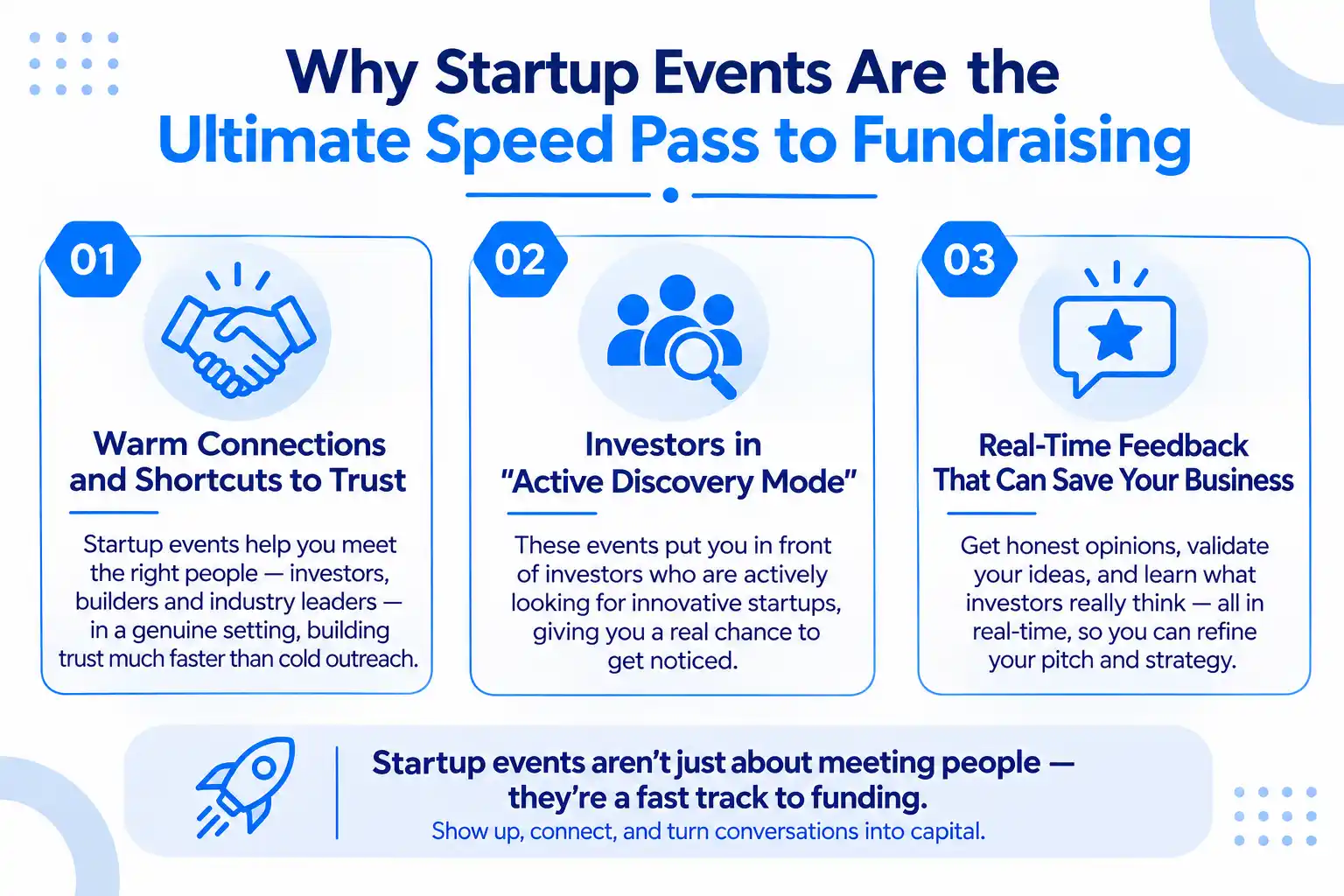
Part 1: Why Startup Events Are the Ultimate Speed Pass to Fundraising
In the world of funding, the most valuable currency is not money, but trust. When you send a cold email, you are just one of thousands of strangers on the internet. An investor’s inbox is already overflowing with unread messages, meaning the chances of your email being opened, read, and positively answered are slim to none.
In contrast, startup events create a physical or concentrated digital ecosystem where everyone gathers with a single purpose to discover new ideas, invest in them, and help each other out.
1. Warm Connections and Shortcuts to Trust
At a startup event, you are not communicating with an email address; you are talking to a human being. Your body language, your confidence, the spark in your eyes, and your passion for your startup impact the person sitting across from you in seconds.
Even if you cannot reach a top-tier investor directly, a mentor, incubator manager, or fellow founder present there can provide a “warm introduction” that would otherwise be impossible to secure after months of effort.
2. Investors in "Active Discovery Mode"
When an investor attends an event, they are in discovery mode. They are there to solve problems, scout new startups, and fill their deal pipeline. Therefore, when you present your idea, they listen with an open mind and a positive perspective rather than sitting in a defensive posture.
3. Real-Time Feedback That Can Save Your Business
When you sit alone making a pitch deck, you operate inside an echo chamber where your flaws remain invisible. When you pitch in front of diverse people at an event, you receive immediate reactions, whether through facial expressions, sharp questions, or valuable suggestions.
This feedback loop is the fastest way to refine your business model and pitch.
Part 2: Key Types of Startup Events and How to Choose Them
Not all startup events are created equal. Depending on your company’s current stage (Pre-seed, Seed, or Series A), you must choose the right event. Time is limited, so investing your energy in the right place is smart.
1. Pitch Competitions
These competitions are nothing short of a trial by fire for founders. Here, you must present your case in front of a jury consisting of well-known investors and successful entrepreneurs. Even if you do not win, the visibility you gain on stage and catching the attention of other investors sitting in the audience proves immensely beneficial.
Lorem ipsum dolor sit amet, consectetur adipiscing elit. Ut elit tellus, luctus nec ullamcorper mattis, pulvinar dapibus leo.
2. Demo Days
If you are part of a prestigious accelerator (like Y Combinator, Techstars, or local startup accelerator programs), “Demo Day” is the biggest day of your journey. It is a stage where an elite group of selected investors gathers specifically to evaluate your startup alongside your peers. The likelihood of securing funding here is at its highest.
3. Investor Meetups and Networking Mixers
Compared to large conferences, these are smaller and more informal gatherings. There is no formal stage or grand platform; people mingle over coffee or dinner.
These events feature low stress levels, making long and deep business conversations much more likely. You can build personal relationships with investors here without any pressure.
4. Industry-Specific Conferences and Summits
If your startup operates in a specialized sector like fintech, healthcare, AI, or agritech, national or international conferences tied to that specific industry are gold mines. Not only do you find investors, but you also discover potential enterprise clients and strategic partners.
Part 3: The Pre-Game Strategy (How to Prepare Before the Event)
“Success never happens by coincidence; it happens when preparation meets opportunity.”
Founders who command the stage or master the hallways at events never arrive unprepared. A week before the event kicks off, you must complete the following homework:
- Review the Attendee and Speaker List: Event organizers typically release lists of speakers and attending guests in advance. Go through them thoroughly. List at least 10 investors or individuals whose investment thesis aligns with your startup. Check their LinkedIn profiles and understand their recent investments.
- Sharpen Your 30-Second Elevator Pitch: You have barely 30 to 45 seconds to grab a busy investor’s attention. During that window, you must clearly state:
- What major problem are you solving?
- What is your unique solution?
- What traction have you achieved so far?
- What is your current ask?
- Keep Mobile-Friendly Assets Ready: Unfolding a heavy laptop everywhere is cumbersome. Keep a short, visually appealing pitch deck (5–7 slides) and a one-page PDF ready to be easily opened and read on a smartphone. Also, keep your digital business card or LinkedIn QR code handy.
- Set Clear and Measurable Goals: Going to an event does not mean you are just hanging out to see what happens. Your goal must be precise; for instance: My goal today is to have meaningful conversations with at least 5 new investors and secure follow-up meeting commitments from at least 2 of them.
Part 4: Working the Room During the Event
When you walk into the event hall, confidence must be your greatest asset. However, confidence does not mean pushing your speech onto everyone you see.
- Master the Art of Listening: Never start a conversation by talking about yourself. Ask the other person what they expect from today’s event or what sectors they are excited about investing in right now. When they speak, listen with full attention and connect their priorities back to your startup.
- Make Smart Use of Breaks and Coffee Areas: The informal conversations happening at the coffee counter, during lunch, or along the hallway are far more valuable than the speeches on the main stage. Make the most of these moments.
- Do Not Forget to Take Notes: When you meet 10 to 15 people in a single day, names and faces start blurring together. Right after every critical conversation, jot down two lines in your phone’s notes app, for example: Amit (XYZ Ventures) – interested in healthcare, send data room next Tuesday. This tiny habit proves immensely useful later.
Part 5: The Real Game—The 48-Hour Follow-Up Window
Most founders make a massive mistake. They perform brilliantly at the event, collect dozens of cards and contacts, and go home to sleep, assuming the investor will reach out on their own. This is pure foolishness.
Investors are extremely busy people. They meet dozens of individuals in a single day. If you do not contact them within 24 to 48 hours of the event ending, your hard work goes to waste.
Send a short, personal follow-up that mentions something specific from your chat. Connect on LinkedIn, share a useful resource, and suggest coffee.
Conclusion: Accelerate Your Funding Journey
Funding is never a game of luck or chance. It is entirely the result of a well-planned strategy, being in the right place at the right time, and pitching your vision with strength. Startup events provide the platform where you can compress weeks and months of struggle into a few days of intense dialogue.
And if you want to connect with the right network, experienced mentors, investors, and fellow entrepreneurs, join the eRoof Community today. Here, you will find the opportunity to scale your business, discover new paths, and build meaningful relationships on your startup journey.
Remember, your next lead investor might just be standing right ahead of you in the coffee line at the very next event!
FAQs
1. How Do Startup Events Help Founders Get Funding Faster?
Startup events connect founders directly with angel investors, venture capitalists, mentors, and potential partners. They create opportunities for face-to-face conversations, warm introductions, instant pitch feedback, and faster investor meetings.
2. Which Startup Events Are Best for Raising Funds?
Pitch competitions, Demo Days, investor meetups, networking mixers, and industry-specific conferences are among the best startup events for raising funds. The right choice depends on your startup’s funding stage and industry.
3. What Should Founders Prepare Before Attending a Startup Event?
Founders should prepare a 30-second elevator pitch, a short pitch deck, a digital business card, a LinkedIn QR code, investor research, and clear networking goals before attending an event.
4. How Do You Pitch Your Startup to Investors in 30 Seconds?
A strong 30-second pitch should explain the problem you solve, your unique solution, current business traction, and funding requirements. Keep your message simple, specific, and focused on business value.
5. When Should Founders Follow Up with Investors After an Event?
Founders should follow up within 24–48 hours after meeting investors. A personalized message mentioning their conversation, sharing relevant information, and suggesting a meeting can help maintain interest.