


In this hyper-competitive and AI-driven market of 2026, note down a bitter truth in your diary: the era of scaling a startup by sitting alone in a room, cutting yourself off from the world, is gone forever. The biggest reason for the failure of solo-founders, MSME owners, and small business creators is not that their idea is bad, but that they break down mentally, physically, and operationally in the battle of loneliness.
That is exactly why building or joining a strong startup tribe has become a business necessity, not a luxury. Business is a marathon, and trying to sprint it alone is directly inviting failure. In this comprehensive, no-nonsense masterclass, we will talk directly about the structural reasons why solo-founders struggle and how a startup tribe (a community of founders) can save your small business from dying and turn it into a high-speed revenue machine without any textbook theory.
The Solo-Founder Bottleneck
Business books and social media influencers have sold the word solopreneur as a very fashionable thing. They show a picture where a person is sitting on a beach in Bali and running a million-dollar company from a laptop. But the ground reality is completely different and ruthless. A solo-founder does not just run a business; he is the entire business himself.
When you do not have a complementary team, you have to wear five different executive masks every day:
[CEO – Vision] ➔ [CMO – Marketing] ➔ [CTO – Tech] ➔ [CFO – Accounts] ➔ [Sales – Cold Calling]
When the same person tries to do all these jobs simultaneously without any external team support, the operational friction of the business increases many times over. Context-switching, meaning fixing a major coding problem one minute and talking on a cold sales call the very next minute, destroys your cognitive bandwidth.
Three big silent killers are born from this multi-tasking trap, which hollow out solo-startups and MSMEs from the inside, especially in today’s Fastest Growing Community of Builders & Founders.
1. The 'Echo Chamber' Effect (The Cage of One's Own Opinion)
When you are alone, you do not have another brain to test and validate your ideas. You thought of a new software feature or a new service, and you found it very revolutionary because it sounded very right in your mind. You wasted 2 months of coding and thousands of rupees on it, and when you launched it in the market, you found out that your Ideal Customer Profile (ICP) did not need it at all.
A solo-founder often gets trapped in the cage of his own thinking. He has no cross-functional partner to stop him, correct him, or show him the mirror upon his mistake. The result is that instead of solving the customers’ problem, you start making a product of your own choice, which is the fastest way to burn your capital.
2. Operational Paralysis and Constant Firefighting
Since you have no core team or co-founders to distribute work, your entire daily life gets limited to only ‘Firefighting’ mode (immediately extinguishing the troubles that come in front). Today, handling client delivery; tomorrow, looking at coding if the website server goes down; the day after tomorrow, wandering around the CA for tax filing; and next week, fixing broken automated emails.
The result of this is operational paralysis. You are never able to work on the business because you are grinding like a donkey twenty-four hours a day in the business. Your strategic vision, big joint ventures, funding preparation, and long-term scaling plans come to a complete standstill. Instead of actually building a scalable asset, you have created a very stressful and low-paying job for yourself.
3. Mental Burnout and Emotional Isolation
Running a business is a very volatile and psychologically exhausting roller-coaster ride. Today, a big enterprise deal closed, so you are on cloud nine; tomorrow morning, an old client leaves the work, so you will come directly down to financial rock bottom. Bearing these terrible mental ups and downs alone sucks out your mental strength.
When you do not have a partner to share this psychological burden, stress takes the form of depression, anxiety, imposter syndrome, and decision fatigue. Your mental balance breaks, your decision-making ability drops, and the moment the founder becomes a victim of burnout, the startup dies at that very moment.
2. What is a Startup Tribe and How Does It Work?
Here enters the startup tribe, which completely changes the way of doing business. First, clear a misconception: tribe does not mean a random WhatsApp group, a casual local meetup, or a Facebook community where people just drop links of their LinkedIn posts to beg for fake engagement.
Startup Tribe means a curated and vetted peer ecosystem of growth-mindset founders, mentors, and industry experts, where people share their expertise, resources, and network with each other to push each other forward. In 2026, sustainable scaling for small businesses cannot happen on the back of expensive and mindless advertisements or spam cold emails; the conversion rate of these channels has completely dropped.
Instead, modern growth is happening on the back of Ecosystem-Led Growth. When you make your business a part of an elite and vetted ecosystem, the operational leverage your business gets increases many times over overnight. You stop working like an isolated island and become a big, interconnected market force.
3. 4 Solid Revenue and Operational Benefits of a Startup Tribe
Why does the failure rate of solo-founders or small businesses suddenly decrease upon joining a peer-community? This happens directly due to the benefit of business metrics. Let us understand these 4 benefits closely:
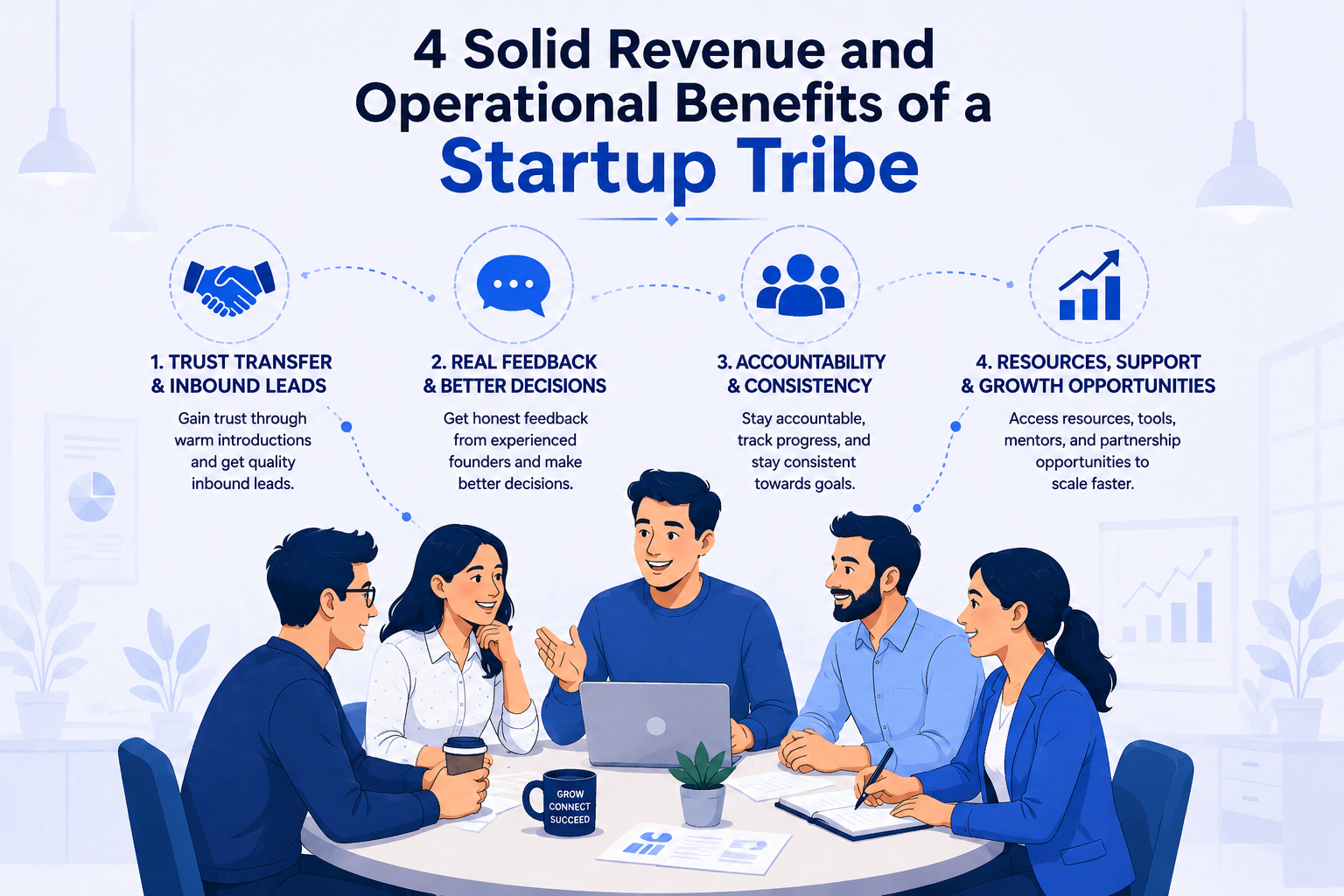
1. Trust Transfer and Ready-Made Inbound Leads
The straight rule of marketing is: in today’s era, trust is the most expensive currency of the market. An unknown solo-founder or small MSME takes a huge budget, a huge amount of content, and months of time to win the trust of a cold client. But inside a tribe, fellow founders are watching your work, your values, and your expertise live.
The rule of Trust Transfer works here. Suppose there is a founder in your tribe who makes software for large enterprises, and you run an SEO and B2B content marketing agency. When his client needs content, he will directly recommend your name. His years of hard-earned trust instantly transfer to your brand. Without any ads or cold calling, your sales cycle shrinks from months to weeks.
- Traditional Cold Sales: High Buyer Skepticism ➔ 3-6 Month Sales Cycle ➔ Low Conversion
- Tribal Trust Transfer: Instant Credibility ➔ 1-Week Sales Cycle ➔ High Conversion
2. Bitter and True Market Community Validation (No-BS Feedback)
The founders sitting inside a curated tribe are either passing through the same path where you are, or have crossed it. They know market trends and investors’ thinking very well, so they do not keep you in illusion by praising you falsely.
When you put your new pricing model, landing page, or pitch deck in a closed-door roundtable, you get raw and practical feedback. Your peers tell you the flaws of your funnel right on your face before burning money in the market, which saves you from losing lakhs and months of time.
3. Co-Learning and Resource Sharing (A Team of Experts Without Hiring)
A bootstrapped solo-founder or small MSME owner in India rarely has the financial runway to hire a ₹1–2 Lakh/month senior developer, a top-tier growth marketer, and a legal advisor all at once in the early stages. As a result, you remain bottlenecked by your own limited skill set, putting an artificial ceiling on your business growth.
A curated startup tribe acts as your outsourced, decentralized executive team. During peer sessions, you gain direct access to domain experts across tech, marketing, and finance.
For instance, if your website server crashes or you hit a major technical glitch, instead of bleeding money out to an expensive agency, a veteran CTO within the community can hop on a quick 20-minute call to diagnose the issue and guide you toward the exact solution. This friction-free exchange of knowledge and insights slashes your burn rate and doubles your execution speed.
4. Accountability Frameworks (Radical Accountability)
When you work alone and are accountable only to yourself, even if you postpone an important task today (like making 20 sales calls or updating the financial model) due to fatigue or laziness, you always have a logical excuse ready.
A tribe eliminates this carelessness. When you sit in weekly sprint reviews and meetings, you have to give an account of your growth goals in front of your peers. When you see other founders around you working day and night to close deals, a positive pressure is built. This pressure eliminates your inaction and keeps you constantly disciplined.
4. The 3-Step Playbook to Leverage an Elite Startup Tribe
There are thousands of such business networks in the business ecosystem today, which have become mere modern card-exchange clubs. If you do not want to waste your time in a time-pass group, follow this playbook:
1. Drop the Transactional Mindset
If you are going to an elite community, just thinking that you will stick your brochure to everyone on the very first day and run away with leads, people will ignore or directly blacklist you. Focus on building relational equity first.
2. Do Consistent High-Value Value Drops
The eternal rule of the tribe is to give value first without any selfishness, then expect to receive. Share the best knowledge of your field, a free audit, or a framework with fellow founders. When the community accepts your expertise, inbound monetization will happen on its own.
3. Choose a Curated and Closed Ecosystem
Stay away from such open-source groups where anyone can come and start spamming. Always prioritize platforms that screen members and maintain strict entry rules. The smaller and cleaner the room, the bigger the value of the deals happening there.
5. Strategic Blueprint for Growth-Minded Communities
To take full advantage of joining any community, your business should be ready to integrate into the workflow of that community. Communities always run on structured communication.
1. Centralized Communication Framework
A high-speed tribe always talks in a fixed time and manner (Cadence). Instead of random meetings, create micro-masterminds within your tribe. The entire focus of these groups should be on specific business bottlenecks like customer churn reduction, net revenue retention (NRR), or automated inbound lead generation.
2. The Shared Resource Pool
An elite tribe operates like a collective intelligence network. Instead of figuring out legal contracts, SaaS tech stacks, or marketing agency SOPs (Standard Operating Procedures) from scratch, tap into the community’s shared asset library.This includes vetted vendor lists, proven cold outreach templates, and pitch decks that have successfully raised capital. By utilizing these pre-verified, community-tested resources, you eliminate expensive trial-and-error and fast-track your operational setup.
Conclusion
If your ultimate objective is to make your startup a sustainable, scalable, and cash-flow positive business in 2026, stop torturing yourself alone in a room. Entrepreneurship is not a journey of renunciation where you have to conquer Everest alone. It is a collective and high-stakes team sport.
Steve Jobs needed Steve Wozniak to make Apple; Bill Gates needed Paul Allen to scale Microsoft; Larry Page wanted the company of Sergey Brin to set up Google. When the biggest giants of the world could do nothing alone, why are you committing this cruelty on yourself?
Throw away the cloak of the lone wolf. Come out of isolation, find your right startup tribe, sit at the table, become a part of premium network meetings and closed-door roundtables, share your knowledge, and use others’ shoulders to scale your business. Remember, alone you can perhaps walk fast, but only with a strong tribe can your business go very far!
FAQs
1. Why do solo founders struggle to scale their startups?
Solo founders often struggle because they handle multiple roles alone, leading to burnout, poor decision-making, and operational bottlenecks.
2. What is a startup tribe?
A startup tribe is a curated community of founders, mentors, and business experts who collaborate, share resources, and help each other grow faster.
3. How does a startup tribe help small businesses grow?
A startup tribe provides networking opportunities, trusted referrals, market feedback, accountability, and resource sharing that accelerate business growth.
4. Why is collaboration better than building a business alone?
Collaboration increases execution speed, reduces stress, improves decision-making, and opens access to resources, partnerships, and growth opportunities.
5. How does a startup tribe generate inbound leads?
Members of a startup tribe refer trusted businesses within the community, creating warm inbound leads without heavy advertising costs.