

Building a business is rarely a one-person journey. Founders may have a strong idea, a clear vision, and the motivation to succeed, but they still need the right people around them. Finding customers, learning from experienced business owners, discovering potential partners, and solving unexpected challenges can become easier when entrepreneurs have access to a supportive professional network.
Consider a founder who has developed a promising product but struggles to reach potential customers. Another business owner may already have relationships with the target audience. A marketing professional might understand how to communicate the product’s value, while an experienced entrepreneur could offer advice on pricing or business development. When these people connect, a simple conversation can open the door to new possibilities.
This is one reason entrepreneur groups can be valuable. They bring people with different experiences, skills, and business goals into a shared environment where they can exchange knowledge and build relationships.
But the real benefit goes beyond meeting new people. The right group can help entrepreneurs turn professional connections into meaningful conversations, collaborations, referrals, and long-term business opportunities.
1. Why Entrepreneurs Need More Than Individual Effort
Running a business requires more than developing a product or offering a service. Entrepreneurs also need to understand customers, manage finances, make marketing decisions, and respond to changes in their industries.
When founders work in isolation, they may have fewer opportunities to discuss their challenges with people who understand the realities of running a business. They might spend weeks testing an approach that another entrepreneur has already tried, or miss a potential partnership simply because they do not know the right person.
Being part of a relevant business network can help address this gap.
For example, a small business owner trying to improve customer acquisition might meet someone who has successfully built a referral strategy. Instead of starting entirely from scratch, the owner can learn from that person’s experience and decide which ideas are suitable for their own business.
The U.S. Small Business Administration recommends setting networking goals and identifying relevant organisations and events rather than approaching networking without a clear plan. Read the SBA’s guidance on building a business through networking.
The important point is that networking does not guarantee success. It creates access to people and perspectives that can help entrepreneurs make more informed decisions.
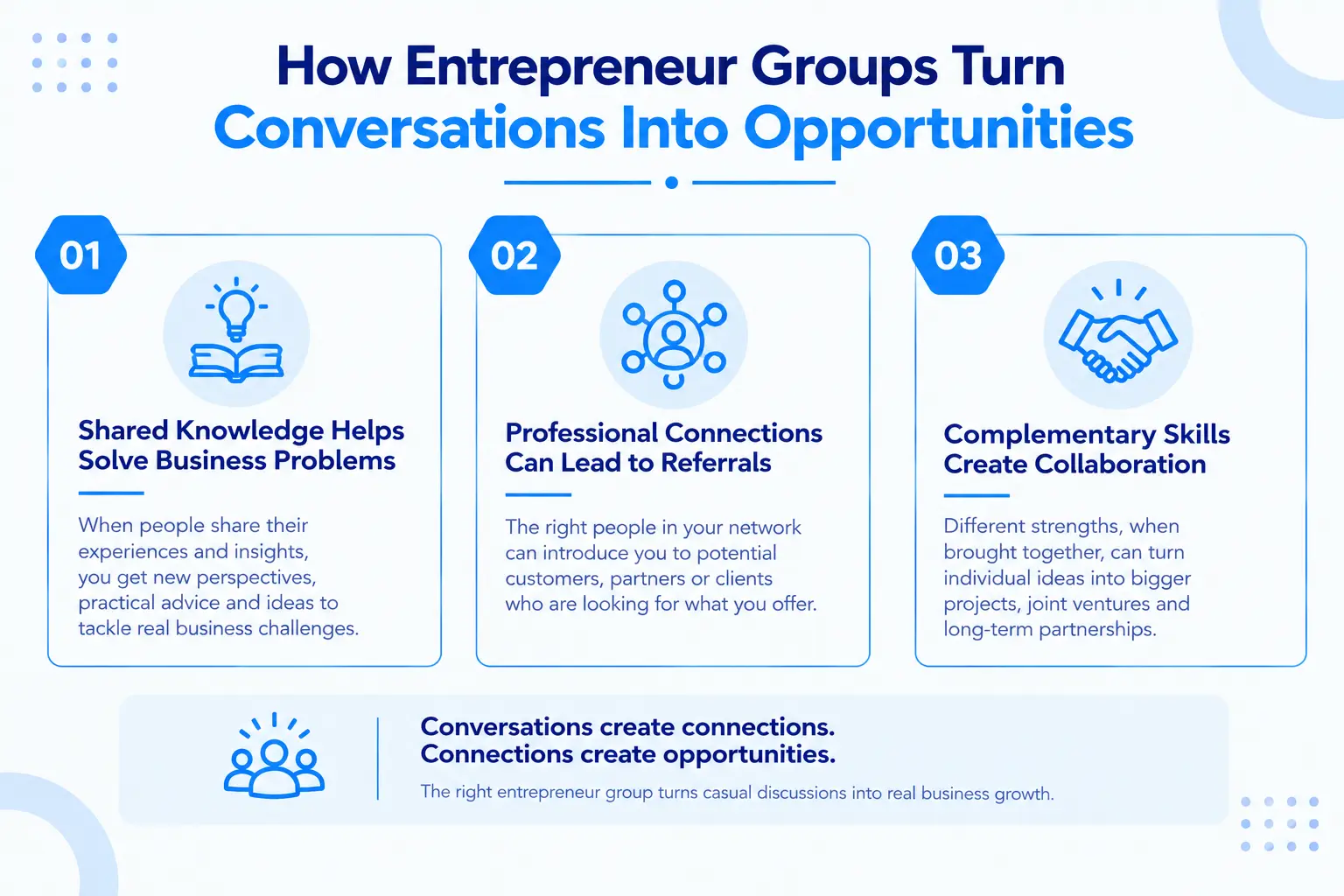
2. How Entrepreneur Groups Turn Conversations Into Opportunities
A professional connection becomes valuable when there is a reason for the people involved to continue interacting. Entrepreneur groups can make these interactions more natural because members often share similar challenges, interests, or ambitions.
Imagine three people attending a business community meeting:
- A startup founder who needs help reaching new customers.
- A digital marketing consultant who works with growing businesses.
- A business owner who knows companies that may need the founder’s product.
A conversation between these individuals could lead to a customer introduction, a referral arrangement, or a discussion about working together. None of these outcomes is automatic, but the group creates an environment where such connections can begin.
There are several ways this can happen.
1. Shared Knowledge Helps Solve Business Problems
Entrepreneurs regularly face questions about pricing, hiring, marketing, customer retention, and operations. Discussions with other business owners can introduce alternative approaches and practical lessons.
A founder might discover a more effective way to explain a product, while a service provider could learn how another business manages client expectations.
2. Professional Connections Can Lead to Referrals
When members understand each other’s businesses, they may recognise situations where an introduction would be useful.
For example, a branding agency could recommend a web development company to a client who needs a new website. The web development company might later refer a suitable branding project back to the agency.
These relationships work best when recommendations are based on genuine trust and the quality of the service.
3. Complementary Skills Create Collaboration
Not every group will suit every business owner. Some communities focus on startup founders, while others bring together established companies, independent professionals, or people from a particular industry.
Before joining a group, consider what you want to achieve and whether the community can help you work toward that goal.
Factor | What to look for |
Relevant members | People whose industries, experience, or goals relate to your business |
Active participation | Members who contribute ideas and take part in discussions |
Knowledge sharing | Opportunities to learn from real business experiences |
Collaboration | A culture that encourages useful introductions and shared projects |
Consistency | Regular opportunities to build familiarity and trust |
Clear purpose | A group that explains its audience, activities, and expected benefits |
A group with thousands of members is not necessarily better than a smaller community. If the members are relevant and actively involved, a more focused network may create stronger professional relationships.
It is also worth checking the group’s rules, membership fees, privacy practices, and time commitments. A suitable group should align with your business goals rather than create unnecessary obligations.
4. Which Entrepreneur Groups Are Right for Your Business?
The most useful community depends on your current stage, industry, and networking objectives. Instead of joining every group you discover, focus on those that offer the most relevant opportunities.
1. Entrepreneur Groups for Startups
Early-stage founders often need feedback, industry knowledge, potential collaborators, and introductions to customers or mentors.
Entrepreneur groups for startups can offer opportunities to discuss early business challenges with people who understand the uncertainty of launching a company.
For example, a founder testing a new software product might connect with another startup that has already developed its customer onboarding process. The discussion could help identify questions to investigate before investing more time or money.
2. Entrepreneur Groups for Small Business Owners
Small business owners may benefit from connections with local service providers, suppliers, potential customers, and complementary businesses.
Entrepreneur groups for small business owners can be particularly useful when members serve overlapping audiences without directly competing with one another.
A local accountant, marketing consultant, and website designer, for instance, may discover opportunities to exchange relevant referrals while continuing to operate independently.
3. Entrepreneur Groups for Founders and Professionals
Founders may want strategic advice, while independent professionals may be looking for clients, collaborators, or industry contacts.
Entrepreneur groups for founders can encourage peer learning, while broader professional communities may introduce members to people outside their usual business circles.
The best fit depends on whether your priority is solving a current challenge, finding customers, building expertise, or exploring new partnerships.
4. Entrepreneur Groups for Women Entrepreneurs
Women entrepreneurs may also explore communities and professional networks designed to support women-owned businesses. Depending on the organisation, these groups may offer peer connections, mentoring, educational sessions, and business development opportunities.
Before joining, check the community’s actual programmes and membership criteria to ensure they match your needs.
5. Online Entrepreneur Groups vs. Local Communities
Entrepreneurs no longer need to rely entirely on face-to-face meetings to build professional relationships. Online communities make it possible to participate in discussions, exchange resources, and connect with people beyond a local business area.
However, online and local groups can serve different purposes.
Community type | Main advantage | Possible limitation |
Local entrepreneur groups | Easier to build regional relationships and meet in person | Smaller pool of members |
Online entrepreneur groups | Access to people from different locations and industries | Requires active participation to build trust |
Industry-specific groups | Relevant knowledge and specialised connections | May offer fewer contacts outside the industry |
General business communities | Exposure to different business models and perspectives | Some discussions may be less relevant |
Online entrepreneur groups can be useful for founders who want to learn from people outside their city or participate around a busy schedule. Local groups may be better suited to entrepreneurs who depend on regional customers, suppliers, or in-person collaboration.
Many entrepreneurs can benefit from a combination of both. The key is to participate consistently instead of joining multiple communities and remaining inactive.
6. How to Find the Best Entrepreneur Group in India
Searching for the best entrepreneur group in India can produce many options, including business associations, startup communities, professional networks, online forums, and local founder groups.
Rather than choosing based on popularity alone, use a few practical checks.
Start with your goal. Decide whether you want customer referrals, startup advice, professional connections, or collaboration opportunities. A clear objective helps you narrow the options.
Check the audience. Look at the types of members, industries represented, and business stages the group serves. The right audience is more important than a large membership number.
Review the activities. Look for relevant discussions, workshops, networking meetings, peer-learning sessions, or other activities that genuinely take place.
Understand the commitment. Some groups require regular attendance or paid membership. Others allow people to participate in selected events or online discussions.
Try before making a commitment. Where possible, attend an open event, join a public discussion, or speak with an existing member before deciding whether the group is a good fit.
The SBA’s article on referral groups also explains how structured networking groups can help members exchange referrals and expand their customer base. Explore its guidance on business referral groups.
Remember that no group can guarantee leads, partnerships, or revenue. Evaluate the community based on the quality of its interactions and how well it matches your objectives.
7. How to Get Real Value From Entrepreneur Groups
Joining a community is only the first step. What you contribute and how you maintain relationships will influence the value you receive.
1. Introduce Your Business Clearly
Explain what your business does, who it serves, and the problem it solves. A straightforward introduction helps other members recognise when your product or service may be relevant.
2. Ask Questions and Listen
Use discussions to understand how other businesses operate. Ask thoughtful questions, listen to different experiences, and remain open to ideas that challenge your assumptions.
3. Offer Help Before Asking for Favours
Share a useful resource, provide feedback when appropriate, or introduce two people who could benefit from knowing each other. Genuine contributions help build trust without making every interaction feel like a sales pitch.
4. Follow Up With Relevant Contacts
If you have a useful conversation, send a short message afterwards. Mention what you discussed and suggest a reasonable next step, such as sharing a resource or arranging a brief call.
5. Stay Consistent
Meaningful business relationships usually require time. Participate regularly, contribute to discussions, and check in with relevant contacts when you have something useful to share.
This approach makes networking more than a list of names. It helps create relationships that can support future learning and collaboration.
8. How eRoof Community Can Support Entrepreneur Networking
Finding the right people is an important part of business growth, but maintaining useful connections also matters. Entrepreneurs need opportunities to share ideas, understand other businesses, and explore common interests beyond a single meeting.
eRoof Community is relevant to this broader goal of connecting entrepreneurs and business owners. Founders researching an entrepreneur community in India can explore the platform to understand its focus and whether it suits their networking needs.
For entrepreneurs, the value of a community depends on its actual activities, members, and opportunities for participation. Before joining or relying on a platform, review the available information and identify how it fits your business objectives.
A useful community should make it easier to discover relevant conversations, learn from other professionals, and build relationships over time. Members can contribute by sharing their experiences, asking meaningful questions, and looking for opportunities to create mutual value.
Want to explore a business community? Visit eRoof Community to learn more about the platform and decide whether it aligns with your networking goals.
Before publishing, confirm the current features, events, and membership options offered by eRoof. Avoid promising specific leads, introductions, or business results unless those benefits are verified.
9. How to Measure Whether Your Network Is Growing
The number of people in a group is not the only measure of its value. A better approach is to examine whether participation is helping you build useful relationships and make progress toward your business goals.
You can review your networking efforts every month using a simple framework.
Metric | What it helps you understand |
Relevant contacts made | Whether you are meeting people who match your goals |
Follow-up conversations | Whether initial connections are developing further |
Useful introductions | Whether members are connecting you with relevant people |
Knowledge gained | Whether discussions help you make better-informed decisions |
Collaboration opportunities | Whether relationships are creating potential projects or partnerships |
Qualified leads | Whether networking contributes to potential business opportunities |
These measures do not guarantee results, but they help you decide whether to continue participating, change your approach, or explore another community.
If a group provides little value after a reasonable period of active participation, review whether its audience and activities suit your needs. Sometimes the issue is the group itself; in other cases, clearer goals and more consistent follow-up may help.
Conclusion
Entrepreneurship involves constant learning, decision-making, and problem-solving. While individual effort remains essential, the right professional relationships can introduce new perspectives and help business owners discover opportunities they might not find on their own.
That is why entrepreneur groups can create meaningful networking opportunities. They bring people together around shared interests and provide a starting point for knowledge sharing, referrals, collaboration, and long-term professional relationships.
The most valuable group is not necessarily the biggest or most popular one. It is the community that connects you with relevant people, encourages genuine participation, and supports your business goals.
Start by identifying what you need, explore communities that match those needs, and contribute consistently once you join. When networking is based on trust and mutual value, it can become a practical part of building and growing a business.
Frequently Asked Questions
1. What are entrepreneur groups?
Entrepreneur groups are communities where business owners, startup founders, and professionals connect to exchange knowledge, discuss business challenges, build relationships, and explore collaboration opportunities.
2. How do entrepreneur groups help with networking?
They create opportunities to meet relevant people, learn from other businesses, exchange referrals, and discover potential collaborators. The value depends on the group’s relevance and the member’s participation.
3. How can I find entrepreneur groups in India?
Explore startup communities, local business associations, industry organisations, professional networks, online forums, and entrepreneur events. Review the group’s audience, activities, costs, and rules before joining.
4. Are online entrepreneur groups useful?
Yes. Online communities can help entrepreneurs connect across locations, exchange resources, and learn from different industries. Active participation and follow-up are important for developing meaningful relationships.
5. Which entrepreneur groups are best for startups?
The best group depends on the startup’s stage and goals. Founders may look for communities offering relevant peer discussions, mentorship, industry connections, or opportunities to meet potential customers and collaborators.