


Here is another 45-minute webinar running. The speaker is flashing shiny PPT slides, throwing around jargon like lead generation and funnel optimisation. You sit there, optimistic that your lack of incoming leads will finally be solved. But the moment it ends, you shut your laptop and wonder: How do I actually bring live leads to my channels today?
Theory gives you inspiration, but it doesn’t give you traction. To bridge this gap, you don’t need another lecture; you need practical workshops where you build functioning systems in real-time. Let’s cut the fluff and automate your growth.
This is what we call The Theory Trap. Today, the internet is flooded with generic knowledge on how to get leads. Yet, when your pipeline is bone-dry and there isn’t a single qualified inquiry dropping into your inbox, this theoretical wisdom completely falls apart. Startups do not need more lectures on lead generation theory; they need a live execution framework.
This is precisely why the world’s most successful founders are abandoning passive webinars and courses to pivot toward Practical Workshops. In this detailed guide, we will unpack why hands-on workshops are the only actionable cure for lead stagnation in your business, and how combining them with high-leverage networking habits can help you build a powerful Startup Tribe.
The Core Problem: The Dreaded Lead Stagnation Trap
Leads are the oxygen of any business. If your website, LinkedIn page, or ad campaigns are failing to capture a consistent stream of qualified prospects, your startup is essentially on life support.
Why Theoretical Courses Fail to Deliver
When you buy a traditional online course or read a book on marketing, you are handed broad, sweeping generalities: Build a high-converting landing page, embed a contact form, and drive paid traffic to it.
What they fail to tell you is:
- Which specific hook or lead magnet actually resonates with your niche audience (e.g., in a complex B2B market)?
- Exactly why visitors bounce off your landing page without filling out your form.
- What critical psychological elements are missing from your ad copy that are killing your click-through rates?
Theory can hand you a textbook on how to swim, but you will never learn until you jump into the water. Similarly, until you work live on your actual business assets, your lead pipeline will remain empty.
The Solution: Why Practical Workshops Are the Ultimate Growth Engine
A hands-on, practical workshop operates on a fundamentally different blueprint than a standard lecture. There are no long-winded monologues. You do not show up just to listen; you show up to build a live lead generation system for your business on the spot.
1. Live Funnel Optimization & Audits
In a practical workshop, you bring your actual company setup to the table. If the session covers Lead Generation and Content Strategy, you don’t just memorize SEO terms. Under the direct supervision of a mentor, you map out your lead magnet and engineer your conversion landing page right there in the room.
2. Instant Feedback and Validation
When you build an ad campaign or write a cold email sequence alone in your office, you have no baseline to know if it will convert. In a live workshop environment, you present your newly drafted copy to an expert mentor.
They catch flaws immediately: Your hook is weak here, swap it out for a data-driven stat. This real-time optimization means your chances of capturing live leads skyrocket the second the session concludes.
3. Cultivating an 'Action-Oriented' Mindset
Workshops are a brutal cure for procrastination. When you are surrounded by a room full of founders actively opening their laptops and grinding out their marketing pipelines, a powerful wave of positive peer pressure takes over. You are forced to stop overthinking and start executing.
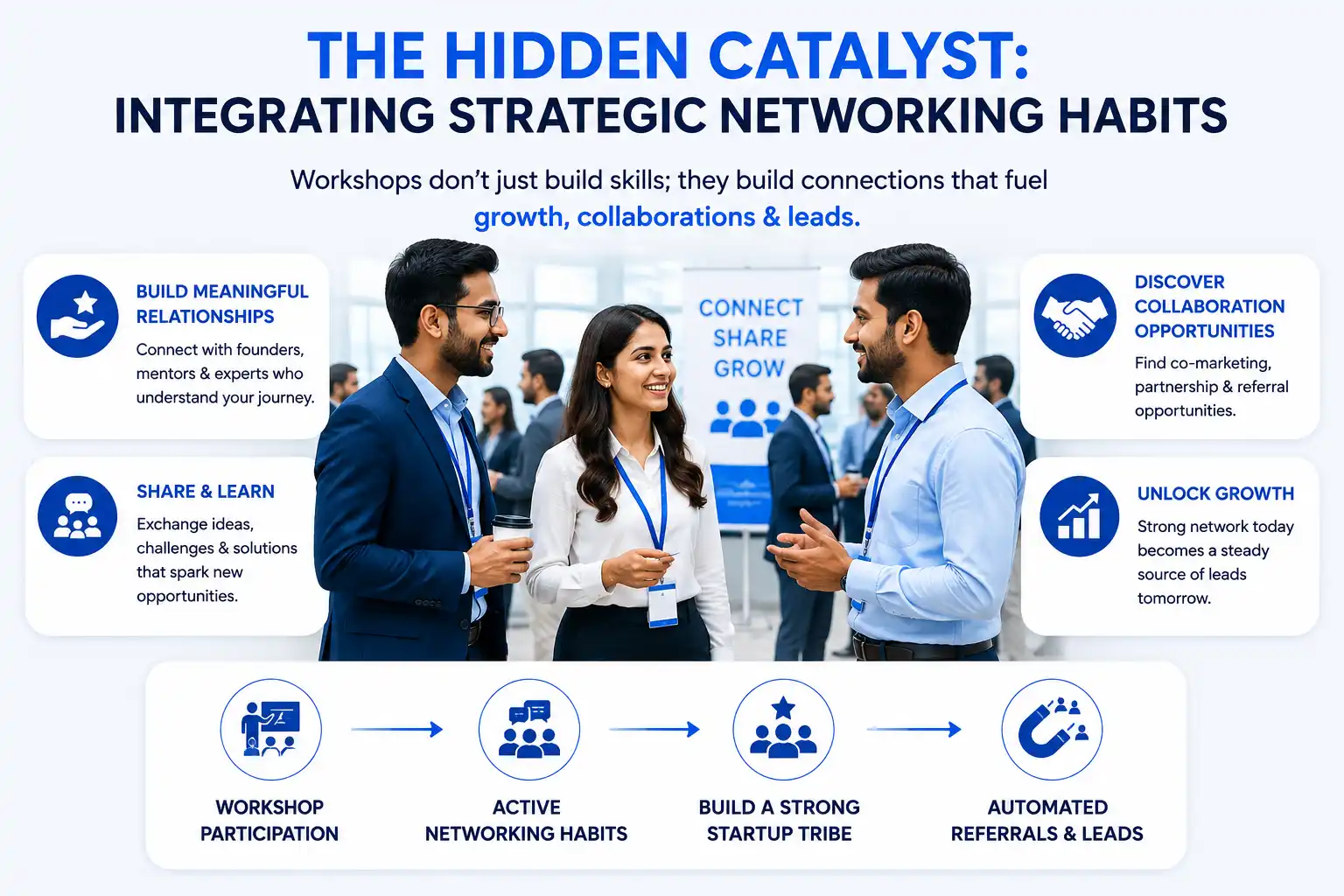
The Hidden Catalyst: Integrating Strategic Networking Habits
Most professionals assume workshops are purely for upskilling. But skill development is only 50% of the equation. The other half, the far more potent half, is strategic networking. Solving a lead drought doesn’t always happen through software; often, the solution is sitting right next to you. Practical workshops act as a natural, highly authentic filter to meet experienced industry peers, potential partners, and non-competing founders.
If you deliberately activate intentional networking habits during these sessions, you won’t just leave with a functional lead-gen system; you will walk away with an aligned Startup Tribe capable of feeding you direct clients and enterprise referrals.
[Workshop Participation > Active Networking Habits > Build a Startup Tribe > Automated Referrals & Leads
Here are the actionable networking habits you should deploy to uncover leads and strategic partners during a live session:
1. Adopt a Value-First Giver’s Approach
When you sit next to a fellow founder, resist the urge to immediately launch into a cold sales pitch. It is a counterproductive networking habit. Instead, ask about their bottlenecks.
If they are struggling with a workshop task, like optimizing their signup forms, offer an insightful tool or a fresh creative perspective. When you lead with value, you build instant rapport, making them highly eager to return the favor or refer business to you down the line.
2. Turn Break-Time into Co-Marketing Audits
Chai, coffee, and lunch breaks are not just intermission periods; they are where high-value alliances are forged. Approach peers with simple, high-intent questions: What industry are you catering to, and what channel brings you your highest-quality leads?
You might discover that the founder sitting across from you possesses an active audience that perfectly aligns with your ideal customer profile (ICP). This opens the door for profitable Co-Marketing partnerships.
3. Transition Your Startup Tribe Beyond the Room
A workshop shouldn’t be a one-off interaction. Before leaving, round up 4 or 5 action-takers and form a tight-knit mastermind group on WhatsApp or Slack.Set up a simple ritual: Why don’t we sync on a quick 20-minute Zoom call every Friday to track how many new leads our updated funnels captured this week? This establishes a hyper-focused Startup Tribe that holds your growth metrics accountable.
Internal Resource Alert: If you want to pair your newfound community network with a technical framework that routes leads automatically, read our comprehensive guide on how to automate your sales funnel to secure highly qualified business opportunities without manual friction.
The Anatomy of a High-Converting Lead-Gen Workshop
If you are looking to join a truly practical workshop, ensure it features these three non-negotiable structural phases:
Workshop Phase | Core Objective | Live Activity |
1. Framework Deconstruction | Uncovering Funnel Leaks | The mentor spends 15 minutes detailing why traditional lead acquisition fails and introduces an actionable structural framework. |
2. The Sandbox Session | Real-Time Funnel Creation | Every participant opens their laptop to build, design, and script their live lead-capture machines (landing pages, ad copies, or email drips). |
3. Peer & Mentor Review | Live Audits & Networking | The room reviews each other’s live setups, identifies blind spots, and forms immediate strategic partnerships. |
Stop Consuming, Start Converting: A 3-Step Action Plan
It is time to close out the endless loop of passive webinars. Use this roadmap to pivot toward real-world execution:
Step 1: Diagnose Your Absolute Biggest Funnel Leak
Look directly at your sales data. Where is the drop-off happening? Are people landing on your site but refusing to fill out your form? Or are your social media posts getting views but zero link clicks? Isolate this single roadblock.
Step 2: Source a Highly Targeted, Practical Workshop
Find a community-led session or professional ecosystem workshop that zeroes in exclusively on your core issue (e.g., a dedicated B2B Lead Generation Intensive or a Cold Email Outbound Workshop). Avoid broad, multi-month generic business courses.
Step 3: Activate Your Networking Protocol
Go into the workshop with a clear goal: you aren’t just solving a software issue; you are there to intentionally connect with at least 5 professionals who can form the foundation of your Startup Tribe. Keep your networking habits sharp and value-focused from the opening minute.
Conclusion
The business ecosystem does not reward those who simply accumulate information; it rewards those who execute. While theoretical advice can offer a brief burst of motivation, it lacks the operational power to fill an empty sales pipeline.
The moment you step inside a practical workshop, you shed the role of a passive spectator and become a builder. You fix your funnel leaks with your own hands, validate your strategies with real-time expert feedback, and utilize intentional networking habits to secure the partners, resources, and referrals needed to scale.
The next time your business encounters a growth plateau or a dry spell in leads, bypass the generic webinars. Find a practical workshop, open your laptop, gather with your tribe, and build your way to the next level of growth.
FAQs
1. What are practical workshops for startups?
Practical workshops are hands-on learning sessions where founders and teams actively build, test, and optimize real business systems instead of only learning theories.
2. Why are practical workshops more effective than webinars?
Practical workshops focus on execution, real-time feedback, and problem-solving, whereas webinars often focus only on concepts and theory.
3. What is the biggest advantage of hands-on startup workshops?
The biggest advantage is immediate implementation. Participants leave with actionable assets and systems rather than just notes and ideas.
4. How do practical workshops improve conversion rates?
They identify funnel leaks, optimize messaging, and provide expert feedback that helps businesses convert more visitors into leads.
5. How do practical workshops help build a strong sales pipeline?
They provide hands-on strategies for lead capture, nurturing, conversion optimization, and ongoing pipeline development.