

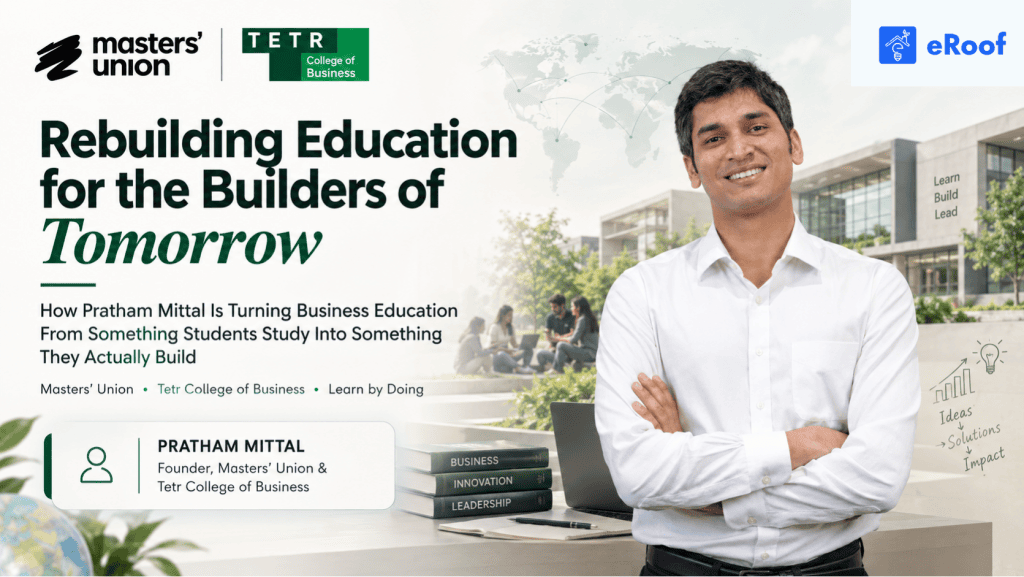
Inside the Story
- From Wharton and entrepreneurship to questioning the traditional classroom
- Building Masters’ Union around practitioners, real businesses and execution
- Taking experiential education global with Tetr College of Business
- Creating a new model where students build companies while they learn
The Bigger Picture
For decades, business education has largely followed a familiar formula: classrooms, case studies, examinations, degrees and then the real world.
But entrepreneurship rarely works that way.
Building a company requires making decisions without complete information, convincing customers, managing people, understanding markets and learning from failure.
Pratham Mittal built his career around this gap.
After studying at the University of Pennsylvania’s Wharton School and experiencing entrepreneurship firsthand, he began questioning whether students could truly learn business without actually doing it.
That question eventually became the foundation for two ambitious education ventures — Masters’ Union in India and Tetr College of Business, a global undergraduate business school.
Together, they represent a larger idea:
Business is not something you learn only by studying it. You learn it by building.
When Education Became a Question
Pratham Mittal’s entrepreneurial journey began before Masters’ Union.
A graduate of the University of Pennsylvania, he studied at Wharton and became involved in entrepreneurship early. He later co-founded Outgrow, an interactive content platform used by businesses and publishers globally.
Building companies exposed him to something that classrooms could not fully replicate.
Business was messy.
Customers did not behave like textbook examples. Decisions rarely came with perfect information. Products had to be built, tested and sold. Teams had to execute. And mistakes often became the fastest teachers.
Over time, Pratham began seeing the same gap among young graduates entering the workforce.
They could understand concepts.
But could they execute?
That question became the starting point for his next chapter.
From Entrepreneur to Education Builder
In 2020, Pratham launched Masters’ Union with an ambitious proposition: business education should be much closer to the realities of business itself.
The institution positioned itself around practitioner-led learning, bringing experienced business leaders into the classroom and pushing students toward real-world projects and execution.
The beginning was anything but conventional.
When Masters’ Union’s website went live in 2020, more than 12,000 people visited within 12 hours, while 72 early students chose to take a bet on an institution that was so new it did not even exist on Google Maps.
It was a reminder that there was already an appetite for something different.
Pratham wasn’t simply building another business school.
He was attempting to challenge the assumptions behind business education itself.
Building Masters’ Union From Scratch
The philosophy was simple:
Don’t just teach business. Let students experience it.
Masters’ Union built its model around practitioners, industry leaders and real-world challenges rather than relying entirely on conventional academic instruction.
Today, the institution highlights access to 200+ CXOs, CMOs, CFOs and MDs, alongside practical projects designed around how startups, businesses and finance teams actually operate.
The approach also began producing measurable outcomes.
The institution’s placement information reports average CTCs of approximately ₹29 lakh to ₹34 lakh across multiple cohorts, with placement reports audited by Brickworks Analytics.
But perhaps more important than placement numbers was the culture being created around entrepreneurship.
Students were encouraged to launch ventures, work on real problems and treat business as something to be practiced rather than memorized.
Founder’s Perspective
“The only way to learn business is by doing business.” That philosophy has remained central to Pratham Mittal’s approach to education and entrepreneurship.
Creating a Business School That Operates Differently
The real challenge was not simply introducing new subjects.
It was changing the relationship between student and classroom.
At Masters’ Union, students work on practical challenges ranging from building online businesses to launching startups and working through real-world business problems. The institution describes its model as teaching business by doing business — with students building ventures, running funds and shipping products alongside industry mentors.
That philosophy also influenced how Pratham approached talent.
Instead of treating industry as something students encounter after graduation, Masters’ Union brought industry into the learning environment itself.
The result was a business school built around a different question:
What if students didn’t have to wait until graduation to start building?
That question would eventually lead Pratham to think even bigger.
Taking the Model Beyond India
Masters’ Union established the foundation.
Tetr College of Business became the global experiment.
Founded by Pratham in 2024, Tetr was designed around an even more radical interpretation of experiential education: students don’t simply travel abroad for exposure — the world becomes part of the curriculum.
Tetr’s undergraduate model takes students across seven countries, where they build businesses and adapt to different markets throughout their degree.
The idea is powerful because geography itself becomes a teacher.
A business strategy that works in one country may fail in another.
A consumer behaves differently.
A market operates differently.
A product needs to change.
And students learn these lessons not through a PowerPoint presentation, but through actual experience.
Tetr has since raised $18 million from Owl Ventures and Bertelsmann, according to Pratham’s profile and recent coverage, signalling investor confidence in this alternative approach to higher education.
Building the Next Generation of Entrepreneurs
For Pratham, the larger ambition appears to go beyond creating successful graduates.
It is about changing when people start building.
His philosophy is that students shouldn’t necessarily wait until they have years of professional experience before attempting entrepreneurship.
That belief is visible across both institutions.
At Masters’ Union, students build businesses and work with industry practitioners.
At Tetr, students operate across international markets and build ventures during their undergraduate journey.
And increasingly, the ecosystem around these institutions is also moving toward early-stage capital.
Pratham has spoken about the difficulty of raising the first ₹10 lakh — the capital that can allow an early founder to validate an idea and make the leap from “what if?” to execution. He has also described MU Ventures, a ₹100 crore fund designed to back early-stage founders.
The philosophy is becoming broader:
Education should not just prepare entrepreneurs. It should help create the environment in which they can actually become entrepreneurs.
Charting the Future of Education
Today, Pratham Mittal sits at the intersection of entrepreneurship, education and investment.
Masters’ Union has evolved from a young, unconventional business school into a larger education institution, while Tetr is taking the same learn-by-doing philosophy into a global undergraduate model.
In 2026, Masters’ Union also reached another significant milestone, with the institution moving toward university status — opening the possibility of building programmes across disciplines beyond traditional business education.
That evolution captures the larger arc of Pratham’s journey.
He didn’t begin by trying to change an entire education system.
He began with a question:
Can people really learn business without doing business?
Then he built an institution to test the answer.
And when that idea proved powerful enough to scale, he took it across borders.
The Bigger Vision
Pratham Mittal’s story isn’t simply about building two education companies.
It is about challenging a deeply established assumption:
That education has to come before experience.
His model reverses that relationship.
Students learn by launching.
They understand markets by entering them.
They learn leadership by taking responsibility.
They understand failure by experiencing it.
And they develop entrepreneurial thinking by actually trying to build something.
From Masters’ Union in Gurugram to Tetr across seven countries, Pratham is building an education ecosystem designed for a world where the ability to execute may matter just as much as the ability to know.
And perhaps that is the most interesting part of his journey:
He isn’t just preparing students for the future of business.
He is experimenting with what business education itself could look like in that future.