

Inside the Story
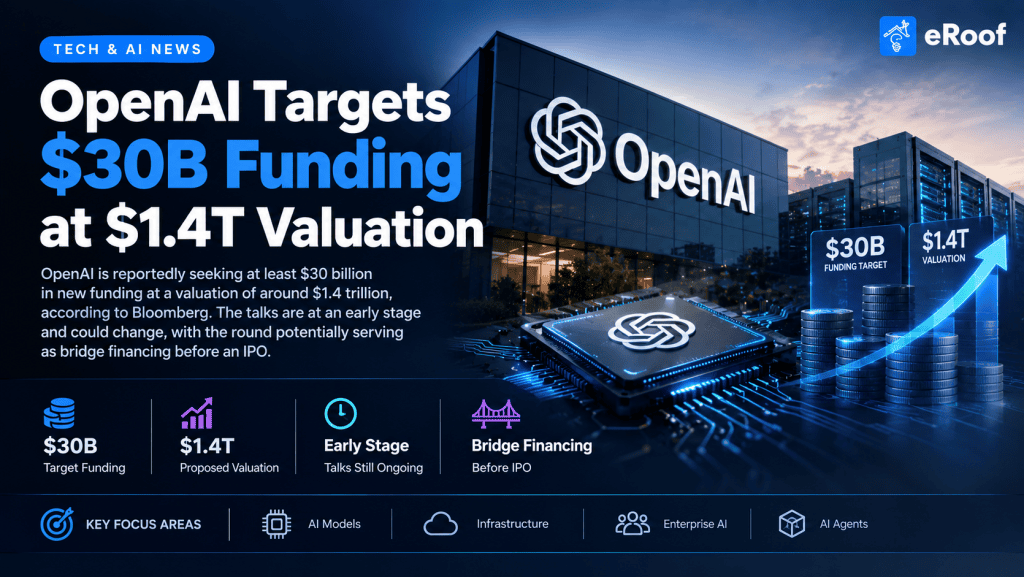
OpenAI reportedly targets at least $30B in new funding.
Proposed valuation is around $1.4T.
Talks are still at an early stage.
Funding could serve as bridge financing before an IPO.
The Story
Introduction
OpenAI is reportedly seeking at least $30 billion in new funding at a valuation of about $1.4 trillion, according to Bloomberg News reporting cited by Reuters. The discussions are still at an early stage, meaning the size, valuation and other terms could change before any agreement is completed. OpenAI has not publicly confirmed the proposed round.
The potential fundraising comes after OpenAI delayed its plans for an initial public offering (IPO). According to the reported discussions, the proposed financing could act as bridge financing, giving the company additional private capital instead of relying on an immediate public-market listing.
If completed at the reported terms, the round would represent a significant increase from OpenAI’s previous reported valuation. In March 2026, OpenAI officially announced that it had closed a funding round with $122 billion in committed capital at an $852 billion post-money valuation.
Background
OpenAI is an artificial intelligence company best known for developing ChatGPT, along with AI models and developer products such as its API and Codex. Its business has expanded from consumer-facing chatbot services into enterprise software, developer tools and AI agents.
The company has been investing heavily in computing infrastructure and AI development. In its March funding announcement, OpenAI said sustained access to computing capacity was an important part of its strategy and highlighted demand from consumers, businesses and developers.
The March financing was a major milestone for OpenAI. The company said the round brought $122 billion of committed capital and a post-money valuation of $852 billion. The new reported funding discussions would therefore come only months after that financing.
OpenAI’s capital requirements are linked to the cost of developing and operating increasingly capable AI systems. Training and serving advanced models require large amounts of computing power, data-centre infrastructure and specialised hardware.
The company is also expanding the range of products built around its AI models. At its September 29, 2026 developer event, OpenAI introduced Dots, described by the company as always-on AI agents designed to work across applications and help users complete tasks.
OpenAI says Dots can operate through ChatGPT, Slack and Teams and connect with more than 4,000 applications through its ecosystem of plugins.
Main Development
The latest development concerns a potential $30 billion-or-more funding round. Bloomberg, citing people familiar with the matter, reported that OpenAI is seeking a valuation of approximately $1.4 trillion, excluding the new money being raised. Reuters independently reported the same figures while noting that the talks remain preliminary.
The proposed valuation is substantially higher than OpenAI’s $852 billion post-money valuation from its March financing. However, the $1.4 trillion figure should not be described as OpenAI’s current confirmed valuation, because it is a target valuation associated with a potential future funding round.
The proposed financing is also reportedly designed as a bridge round. Bridge financing is capital raised to provide a company with additional funding between major financing events, such as private fundraising rounds and an eventual IPO.
For OpenAI, the reported structure would provide additional capital while the company remains privately held. Reuters reported that CEO Sam Altman had said OpenAI would not go public in 2026, while the reported funding discussions could provide an alternative source of capital in the meantime.
OpenAI declined to comment to Reuters about the reported fundraising discussions. That makes the distinction between reported plans and confirmed corporate actions important for coverage of the story.
The potential financing also follows OpenAI’s continued product expansion. Its latest developer event included Dots and other developer-focused announcements, showing the company’s effort to broaden the ways businesses and developers can use its AI technology.
OpenAI’s own announcement describes Dots as AI agents designed to work continuously on user goals, with built-in permissions, safeguards and review mechanisms.
Industry Impact
The reported funding discussions highlight the enormous amount of capital being directed toward advanced AI companies.
AI development requires significant spending on compute infrastructure, including processors, data centres, networking equipment and energy. As models become more capable and are used by larger numbers of people and businesses, the infrastructure required to train and operate them also becomes increasingly important.
For investors, a potential $1.4 trillion valuation would place a very large value on OpenAI’s expected future business. However, because the reported funding discussions are preliminary, investors have not yet formally agreed to the reported valuation and funding amount.
The development is also relevant to AI competition. OpenAI is competing with companies such as Anthropic, Google, Meta and other AI developers across consumer AI, enterprise software, coding and AI-agent markets.
The capital could give OpenAI additional resources for computing infrastructure, research and product development if the reported financing is completed. At the same time, the size of the proposed round demonstrates the industry’s high capital requirements.
For startups and businesses building on AI, continued investment by large AI companies could mean faster development of models, APIs and developer platforms. It could also increase competition for computing resources, specialised talent and enterprise customers.
The funding story therefore extends beyond OpenAI itself. It reflects a broader shift in the technology industry toward AI infrastructure and software as major areas of corporate investment.
Future Outlook
The next important step is whether OpenAI and potential investors reach an agreement on the reported financing. Because the discussions are at an early stage, the $30 billion target, $1.4 trillion valuation and other terms may change.
If the round is completed, the new capital could provide OpenAI with additional resources while it continues developing AI models, agents and enterprise products.
The company’s March financing provides a useful reference point. OpenAI officially reported $122 billion in committed capital at an $852 billion post-money valuation at that time. A completed round around the currently reported terms would represent a significant change in the company’s private-market valuation within the same year.
For now, the key fact is that OpenAI is reportedly pursuing the funding rather than having already raised it. eRoof coverage should therefore use terms such as “targets,” “seeks” or “reportedly plans” until the company or investors formally announce a completed transaction.
The development will remain closely watched as OpenAI expands its AI products, develops new agent-based services and continues to determine its longer-term path toward the public markets.
Technical Terms Explained
- Funding Round — A financing event in which investors provide capital to a company in exchange for equity or another agreed financial interest.
- Valuation — The estimated financial value assigned to a company, often based on its latest investment round.
- IPO — Initial Public Offering. It is the process through which a private company offers shares to the public and becomes publicly traded.
- Bridge Financing — Temporary funding that provides capital between major financing events, such as private fundraising and an IPO.
- Post-Money Valuation — The company’s estimated value after new investment has been added to the business.
- AI Agent — An AI system designed to perform tasks or take actions on a user’s behalf rather than only responding to individual prompts.
- Compute Infrastructure — The processors, servers, data centres, networking systems and other resources required to develop and operate AI systems.
- Enterprise AI — Artificial intelligence tools designed for use by businesses and organisations for tasks such as software development, analysis, automation and customer support.