

Inside the Story
Indian tech firms raise $10.3B in 9M 2026
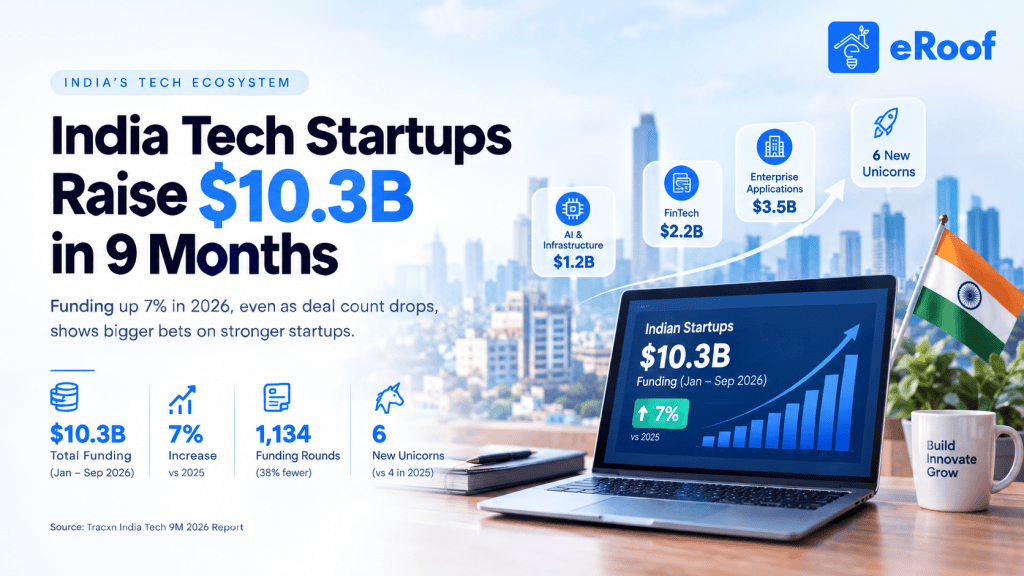
Funding rises 7% despite 38% fewer rounds
AI infrastructure attracts $1.2B
Six new unicorns emerge during the period
The story
Introduction
India’s technology ecosystem raised $10.3 billion in equity funding during the first nine months of 2026, marking a 7% increase from the $9.7 billion raised during the same period in 2025.
The increase came even as the number of funding rounds dropped sharply, indicating that a larger share of available capital went into fewer, bigger transactions. The figures come from Tracxn Technologies’ India Tech 9M 2026 Report, which covers funding, exits and unicorn activity from January 1 through September 21, 2026.
The ecosystem recorded 1,134 funding rounds, down 38% from 1,838 rounds during the corresponding period of 2025. At the same time, India recorded 18 funding rounds worth at least $100 million, helping push total capital higher. The largest deals included Nxtra’s $1 billion private-equity round, Neysa’s $600 million Series B and CRED’s $540 million Series H.
The data presents a mixed picture. Total funding has increased, but fewer startups are receiving investment, particularly at the earliest stages.
Background
India has developed into one of the world’s major technology startup markets, with companies operating across fintech, enterprise software, artificial intelligence, digital commerce, infrastructure and other technology segments.
Venture capital and private equity funding play an important role in this ecosystem. Startups generally move through several funding stages, beginning with seed investment and progressing through early-stage and later-stage rounds as their businesses grow.
The 2026 funding data shows that these stages are behaving differently.
Seed-stage funding fell 37% to $698 million, while early-stage funding increased 27% to $4.2 billion. Late-stage funding remained broadly stable at approximately $5.4 billion. The number of companies receiving funding for the first time also declined 30% to 338.
This means the increase in overall funding does not represent a broad increase across every part of the startup market. Instead, the available data shows stronger capital flows toward selected companies and larger transactions.
Main Development
One of the clearest features of India’s technology funding market in 2026 is the rise of large transactions.
There were 18 funding rounds of $100 million or more during the first nine months. Nxtra’s $1 billion private-equity transaction was the largest, followed by Neysa’s $600 million Series B and CRED’s $540 million Series H.
Private equity refers to investment in companies that is generally made outside public stock markets. Investors provide capital in exchange for an ownership interest or other financial rights.
The sector data also shows where investors have been directing capital.
Enterprise Infrastructure recorded the fastest growth, with funding rising 436% to $1.6 billion, compared with $292 million a year earlier.
Enterprise Applications funding increased 49% to $3.5 billion, while FinTech funding rose 13% to $2.2 billion.
Within specific technology themes, AI Infrastructure attracted the largest amount at $1.2 billion. Digital Lending received $799 million, while Payments attracted $773 million.
AI infrastructure includes the computing systems, data-centre capacity, specialised processors, networking and software required to develop and operate artificial intelligence systems.
The ecosystem also added six new unicorns during the first nine months of 2026, compared with four in the same period in 2025. A unicorn is a privately held startup valued at $1 billion or more.
According to Tracxn’s data, these new unicorns had raised an average of $101 million before their unicorn round, compared with $205 million for new unicorns during the corresponding period of 2025. The average time from Series A to unicorn status also declined to 4.9 years from 6.6 years.
The funding market was not limited to private investment. India recorded 29 technology IPOs during the period, unchanged from the corresponding periods of 2025 and 2024.
Fractal Analytics had the largest IPO market capitalisation among the reported technology listings at $1.7 billion, followed by Molbio Diagnostics at $973 million and Amagi at $858 million.
Industry Impact
The funding numbers provide important information about how India’s startup investment environment is changing.
For early-stage founders, the decline in seed funding and first-time funded companies suggests that raising initial capital has become more difficult compared with the previous year. Tracxn recorded 338 first-time funded companies in the first nine months, 30% fewer than the year-earlier period.
For companies that have already demonstrated traction, however, the funding environment has remained active. The increase in early-stage funding and the presence of multiple $100 million-plus transactions show that substantial capital continues to be available for businesses that attract large institutional investments.
The growth in enterprise technology funding is another notable development.
Enterprise applications are software products designed to solve business needs such as finance, customer management, operations, collaboration and data analysis. Their 49% increase in funding to $3.5 billion indicates continued investor interest in technology designed for business customers.
Future Outlook
The remaining months of 2026 will show whether the concentration of capital in larger transactions continues.
The current data indicates that India’s technology ecosystem is still attracting significant investment, but the distribution of that capital has changed. Total funding is higher than last year, while the number of transactions and first-time funded companies is lower.
For startups, this creates a funding environment where business fundamentals, technology differentiation and demonstrated market demand can become particularly important when seeking institutional capital.
AI infrastructure is likely to remain an important area to watch because it has already attracted $1.2 billion during the period. Enterprise applications, fintech and enterprise infrastructure are also among the sectors showing significant funding activity.
The IPO data provides another part of the picture. With 29 technology companies going public during the first nine months, the public markets continue to provide an exit route for mature technology businesses. Meanwhile, acquisitions declined to 91 from 131 a year earlier.
Overall, the Tracxn data shows that India’s technology ecosystem raised more money in the first nine months of 2026 than during the same period a year earlier, but that growth came alongside a substantial decline in deal volume.
The combination of $10.3 billion in funding, 18 mega-rounds, six new unicorns and stronger investment in AI and enterprise infrastructure points to a market where capital is increasingly concentrated in selected technology businesses.
For India’s startup ecosystem, the next phase will depend on whether this concentration continues or whether funding activity broadens again toward more early-stage companies.
Technical Terms
- Equity Funding — Money invested in a company in exchange for an ownership stake or shares in the business.
- Seed Funding — Early investment used by startups to develop products, build teams and establish their initial business.
- Early-Stage Funding — Investment provided after a startup has developed its initial product or business and is working toward growth.
- Late-Stage Funding — Capital raised by more established startups that have already demonstrated significant business activity and are preparing for larger expansion or an exit.
- Private Equity — Investment in companies made outside public stock markets, generally in exchange for an ownership interest.
- AI Infrastructure — Computing hardware, data centres, specialised processors, networking and software used to build and operate AI systems.
- Unicorn — A privately held startup valued at $1 billion or more.
- IPO — Initial Public Offering, when a private company offers its shares to the public and becomes listed on a stock exchange.