

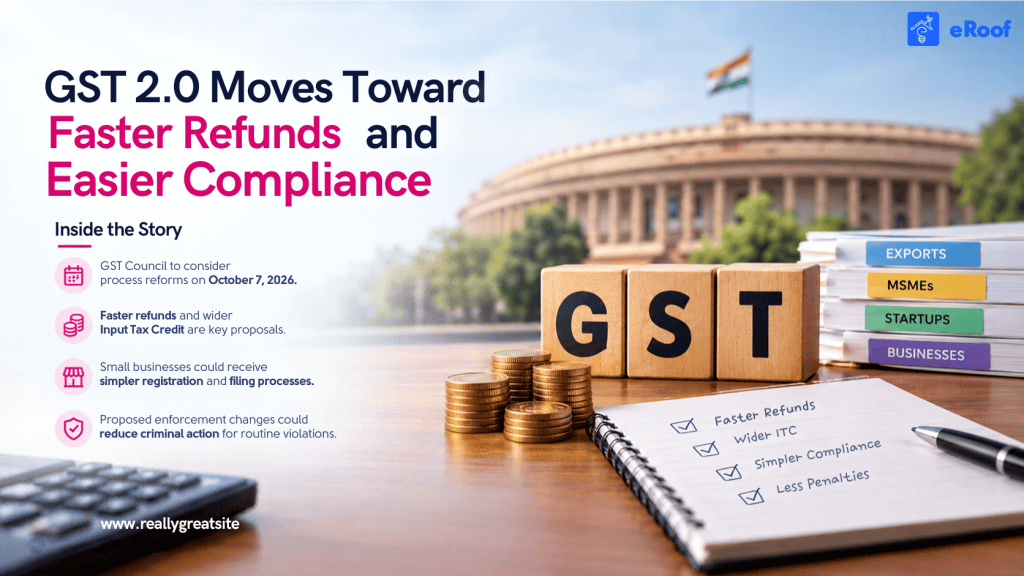
Inside the Story
- GST Council to consider process reforms on October 7, 2026.
- Faster refunds and wider Input Tax Credit are key proposals.
- Small businesses could receive simpler registration and filing processes.
- Proposed enforcement changes could reduce criminal action for routine violations.
The Story
Introduction
India is preparing for another major phase of Goods and Services Tax reform, with the 57th GST Council meeting scheduled for October 7, 2026. Unlike the earlier GST 2.0 changes that focused heavily on tax-rate rationalisation, the upcoming phase is expected to concentrate on making the GST system easier to use for businesses.
The proposals under consideration include faster GST refunds, broader Input Tax Credit (ITC), simpler registration and compliance procedures, and changes to penalties and enforcement. The objective is to reduce paperwork, unlock working capital and minimise disputes between taxpayers and authorities.
Importantly, these are proposals awaiting consideration by the GST Council, not rules that have already come into force.
Background: From GST 2.0 to Process Reform
India introduced GST in 2017 to create a unified indirect-tax system and reduce the cascading effect of multiple taxes. In September 2025, the government introduced the next-generation GST reforms, popularly described as GST 2.0, with a simplified tax structure primarily based on 5% and 18% rates, alongside a 40% rate for certain luxury and sin goods.
The government has now shifted attention toward the operational side of GST. Finance Minister Nirmala Sitharaman previously confirmed that the October Council meeting would focus on process reforms involving areas such as e-invoicing and Input Tax Credit rules.
This means the next stage is less about changing tax rates and more about improving how businesses interact with the GST system.
Main Development: Faster Refunds and Wider Tax Credits
One of the most important areas under discussion is the GST refund mechanism.
For exporters and businesses operating under inverted-duty situations, delayed refunds can lock up significant amounts of working capital. Proposed reforms could streamline the process and increase automation, allowing eligible refunds to reach businesses more quickly.
Reports indicate that export-related reforms could include quicker provisional refunds following risk checks and greater electronic matching of export invoices with bank receipts.
Another major area is Input Tax Credit.
Businesses use ITC to offset GST paid on eligible purchases against GST liability on their sales. However, restrictions and disputes surrounding eligibility can leave substantial amounts of credit blocked or accumulated. The proposed reforms seek to address some of these long-standing issues and potentially widen eligibility in selected areas.
For businesses, the impact could be significant: more usable tax credit means less money tied up in the tax system and potentially better cash flow.
Easier Compliance for Small Businesses
Small businesses and MSMEs are expected to be among the major beneficiaries if the proposed reforms are approved.
The GST Council is considering measures relating to registration, returns and compliance requirements. Faster registration could allow new businesses to begin operations more quickly, while simpler filing procedures could reduce the administrative workload for smaller companies.
Reports also indicate proposals for a more relaxed compliance regime for businesses with turnover of up to ₹5 crore, although the exact framework will depend on the Council’s final decision.
For startups and MSMEs that often operate with limited accounting and compliance resources, reducing procedural complexity could allow owners to spend more time on customers, employees and business growth.
Enforcement and Decriminalisation
Another significant part of the proposed GST reforms concerns enforcement.
The Council is expected to consider changes to GST arrest powers and prosecution thresholds. One proposal would reduce the ability of tax officers to make arrests without judicial oversight, while another could raise the threshold for prosecution in serious tax-evasion cases.
The broader objective is to distinguish between genuine compliance mistakes and deliberate tax fraud.
This could provide greater certainty for businesses while allowing enforcement agencies to concentrate resources on serious cases.
However, these measures remain proposals. GST arrest powers have not been abolished as of October 5, 2026. The final position will depend on decisions taken by the GST Council and subsequent legal or administrative changes.
Industry Impact
The proposed reforms could have a broad impact across India’s business ecosystem.
MSMEs: Faster refunds and simpler compliance could improve working capital and reduce administrative costs.
Startups: Faster GST registration and simpler processes could make it easier for new companies to become operational.
Exporters: Quicker refunds could release funds that are otherwise locked up during the export cycle.
Manufacturers: Better access to eligible ITC could reduce tax-related working-capital pressure.
Large businesses: Greater automation and clearer rules could reduce disputes, manual intervention and compliance uncertainty.
Technology companies: Increased digitisation of GST administration could create greater demand for accounting, invoicing and tax-compliance technology.
The reforms could therefore contribute not only to tax administration but also to India’s broader Ease of Doing Business agenda.
What Businesses Should Watch
Businesses should not immediately change their GST processes based on media reports alone. The October 7 meeting is important because the Council will determine which proposals are accepted, modified or rejected.
Companies should particularly watch for announcements regarding:
- GST refund timelines and automation
- Input Tax Credit eligibility
- GST registration procedures
- Penalty and prosecution rules
- Arrest and enforcement provisions
- E-invoicing requirements
- Treatment of export transactions
- Compliance requirements for smaller businesses
Once official notifications and circulars are issued, businesses should review their accounting and compliance procedures accordingly.
Conclusion
GST 2.0 is entering a new phase in which process efficiency may become as important as tax-rate reform. The proposals expected before the GST Council on October 7 could make refunds faster, improve access to Input Tax Credit and reduce compliance complexity for businesses.
For India’s MSMEs, startups, exporters and larger enterprises, the biggest potential benefit is improved cash flow and greater certainty in tax administration.
But businesses should remember that most of the measures currently being discussed are proposals, not final rules. The GST Council’s decisions and subsequent government notifications will determine what actually changes.
If implemented effectively, the next phase of GST reform could move India closer to a more automated, transparent and business-friendly tax system.
Fact-check note: The October 7 GST Council meeting and the proposed process reforms are confirmed as matters under consideration, but individual proposals—including changes to arrest powers, ITC and refunds—should not be described as implemented until officially approved and notified. The Financial Express
Technical Terms Explained
- GST — Goods and Services Tax, India’s unified indirect tax on the supply of goods and services.
- Input Tax Credit (ITC) — Credit businesses can claim for eligible GST paid on purchases.
- GST Refund — Tax returned to an eligible taxpayer, such as an exporter, when GST has been paid in excess or is refundable.
- Inverted Duty Structure — A situation where the GST rate on inputs is higher than the rate on the finished product, potentially creating accumulated ITC.
- E-Invoicing — Electronic authentication and reporting of specified business invoices through the GST system.
- GST Council — The constitutional body responsible for recommending GST rates, rules and major policy changes.
- Provisional Refund — A refund released before completion of the full verification process, subject to applicable safeguards.
- Decriminalisation — Moving certain violations away from criminal prosecution toward civil or monetary penalties, particularly where there is no serious fraud or deliberate tax evasion.