

Inside the Story
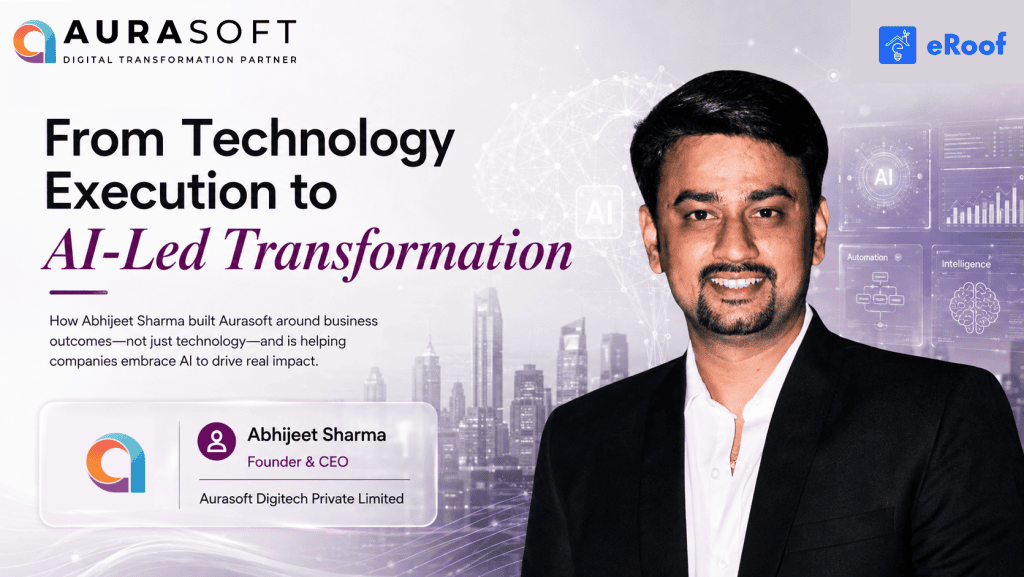
- An Electronics & Telecommunication engineer who moved from telecom into software, digital business, and eventually entrepreneurship.
- After seeing technology companies focus on execution rather than business outcomes, Abhijeet Sharma built Aurasoft to approach technology differently.
- What began as a technology consulting and product engineering company has evolved into an AI-first partner working across SaaS, Travel Tech, Ed-Tech, E-Commerce, CRM, and mobile platforms.
- Today, nearly 90% of Aurasoft’s business comes through referrals and repeat clients, reflecting the trust built through long-term client relationships.
The Bigger Picture
Businesses today are under pressure to adopt AI, automate operations, and build digital products faster than ever.
But for many founders and MSMEs, the challenge isn’t access to technology. It is knowing what technology they actually need, how to implement it, and whether it will create measurable business value.
That is the gap Abhijeet Sharma saw repeatedly during his professional journey.
Instead of building another company focused purely on development, he wanted to create a technology partner that could sit on the same side of the table as the client—understand the business first, challenge the brief when necessary, and then engineer the right solution.
That thinking became the foundation of Aurasoft Digitech.
In This Story
From Telecom to Technology Entrepreneurship
The Problem Behind the Product Brief
Building Aurasoft Around a Different Philosophy
From Product Engineering to AI-First Transformation
Why Trust Became the Strongest Growth Engine
Charting the Future of AI in Bharat
From Telecom to Technology Entrepreneurship
Abhijeet Sharma’s entrepreneurial journey did not begin with a startup idea.
It began with a career in Electronics & Telecommunication Engineering.
His early professional experience was rooted in telecom, but over time, his interests moved toward software, digital marketing, business development, and technology. He spent years learning across functions—developing technical skills during night shifts, understanding global communication, and contributing to business growth.
That cross-domain experience eventually became one of his biggest strengths.
He wasn’t looking at technology from only an engineering perspective. He was beginning to understand how technology, products, marketing, and business growth connected with each other.
And somewhere along the way, another realization became clear.
He was spending his best thinking helping build other people’s visions.
He wanted to build his own.
Founder’s Perspective
“I was spending my best thinking building other people’s visions. I wanted to build my own.”
The Problem Behind the Product Brief
Before Aurasoft, Sharma worked across telecom, software development, product companies, digital marketing, and business development.
The experience exposed him to a recurring problem.
Technology companies were often building what clients asked for—not necessarily what clients actually needed.
A product brief would arrive.
The development would begin.
The features would be delivered.
But the larger business question could sometimes get lost along the way.
What problem is this technology solving?
Will it actually improve the business?
Is there a better way to build it?
For Sharma, these questions mattered just as much as the technology itself.
He believed businesses needed a technology partner who could challenge assumptions, understand the commercial context, and then build around the actual outcome.
That belief became the starting point for Aurasoft.
Building Aurasoft Around a Different Philosophy
Aurasoft Digitech was built around a simple principle:
Ask why before asking how.
The company works with startups, ISVs, SaaS companies, and MSMEs across markets, helping them turn technology opportunities into scalable digital products and business solutions.
Its work spans SaaS development, AI enablement, Agentic AI, automation, RAG-powered knowledge systems, and digital transformation.
But technology capability alone isn’t what Sharma believes differentiates Aurasoft.
It is the way the company approaches a problem.
Instead of functioning purely as a development vendor, Aurasoft positions itself as a strategic technology partner—one that remains involved in the larger business conversation even after the product is delivered.
That approach has helped the company build relationships across industries including Travel Tech, Ed-Tech, E-Commerce, CRM, and mobile platforms.
Founder’s Perspective
“We ask why before we ask how. We push back when the brief is wrong.”
From Product Engineering to AI-First Transformation
The technology landscape has changed dramatically since Aurasoft began.
Artificial intelligence has moved from being an emerging technology to becoming a strategic priority for businesses.
For Sharma, the opportunity isn’t simply about adding AI to existing products.
It is about rethinking how businesses operate.
Aurasoft is increasingly focused on Agentic AI systems, automation workflows, RAG pipelines, and intelligent product engineering.
The company works with technologies including LangChain, MCP, OpenAI, Claude, and locally hosted AI models, selecting the approach based on the business requirement rather than following whatever technology happens to be trending.
Internally, AI has also become part of Aurasoft’s working culture.
The team uses AI for research, proposal creation, content, and knowledge management, allowing employees to work faster without simply increasing headcount.
For Sharma, the bigger goal is creating an AI-first workforce where people treat AI as a collaborator rather than merely a shortcut.
Why Trust Became the Strongest Growth Engine
Aurasoft’s growth story has not been built primarily around aggressive marketing.
It has been built around relationships.
Nearly 90% of the company’s business comes through referrals or repeat clients—a metric Sharma considers more meaningful than conventional growth numbers.
The company has built its visibility through LinkedIn, founder communities, industry relationships, and consistent sharing of insights around technology, AI, and business transformation.
But the strongest channel remains simple:
A satisfied client bringing another client.
That kind of growth is difficult to manufacture.
It comes from delivering something that clients believe is worth recommending.
For Aurasoft, the objective has always been to earn trust first and let business follow.
Founder’s Perspective
Happy clients talk. That is the most powerful marketing there is.
Charting the Future of AI in Bharat
Aurasoft’s next phase is increasingly centered around Agentic AI and practical AI adoption for businesses.
The company sees a significant opportunity among India’s MSMEs—businesses that are increasingly aware of AI but may not have the technical teams, resources, or clarity required to adopt it effectively.
Aurasoft aims to bridge that gap by developing accessible AI adoption frameworks that allow businesses to introduce AI without unnecessary complexity or excessive investment.
The larger ambition goes beyond building AI systems.
It is about helping businesses understand where AI can genuinely create value.
And for Sharma, India’s scale creates both the challenge and the opportunity.
If AI adoption can be made practical, accessible, and outcome-driven, thousands of businesses could potentially transform the way they operate.
Closing Note
Aurasoft Digitech’s story is ultimately not about moving from one technology to another.
It is about a shift in perspective.
From development to problem-solving.
From technology delivery to business outcomes.
And now, from digital transformation to AI-led transformation.
For Abhijeet Sharma, entrepreneurship began with the decision to stop building only other people’s visions.
Today, that decision has evolved into a larger mission—to build technology that businesses can actually use, trust, and grow with.
Because in a world where almost everyone is talking about AI, the real advantage may not belong to those who adopt it first.
It may belong to those who know what to build with it—and why.