

Building a startup in isolation is one of the fastest ways to kill your momentum. When you spend months behind a laptop screen refining your product roadmap without connecting to an active ecosystem, even the best ideas struggle to achieve early traction.
On the other hand, actively engaging with founder networking events and builder communities can meaningfully improve your growth trajectory, helping you build strategic partnerships, peer accountability, and early traction faster.
Startup ecosystems do not thrive solely on cold outreach; they thrive on trust, proximity, and shared context. When early-stage entrepreneurs, creators, and operators gather in the same room, whether it is an intimate founder meetup, a collaborative workshop, or a dedicated startup launchpad, barriers dissolve.
Let’s dive deep into how participating in high-signal networking environments accelerates your startup’s growth, how to extract concrete results from any community room you enter, and how to build lasting strategic value.
7 Ways Founder Networking Events Directly Accelerate Startup Growth
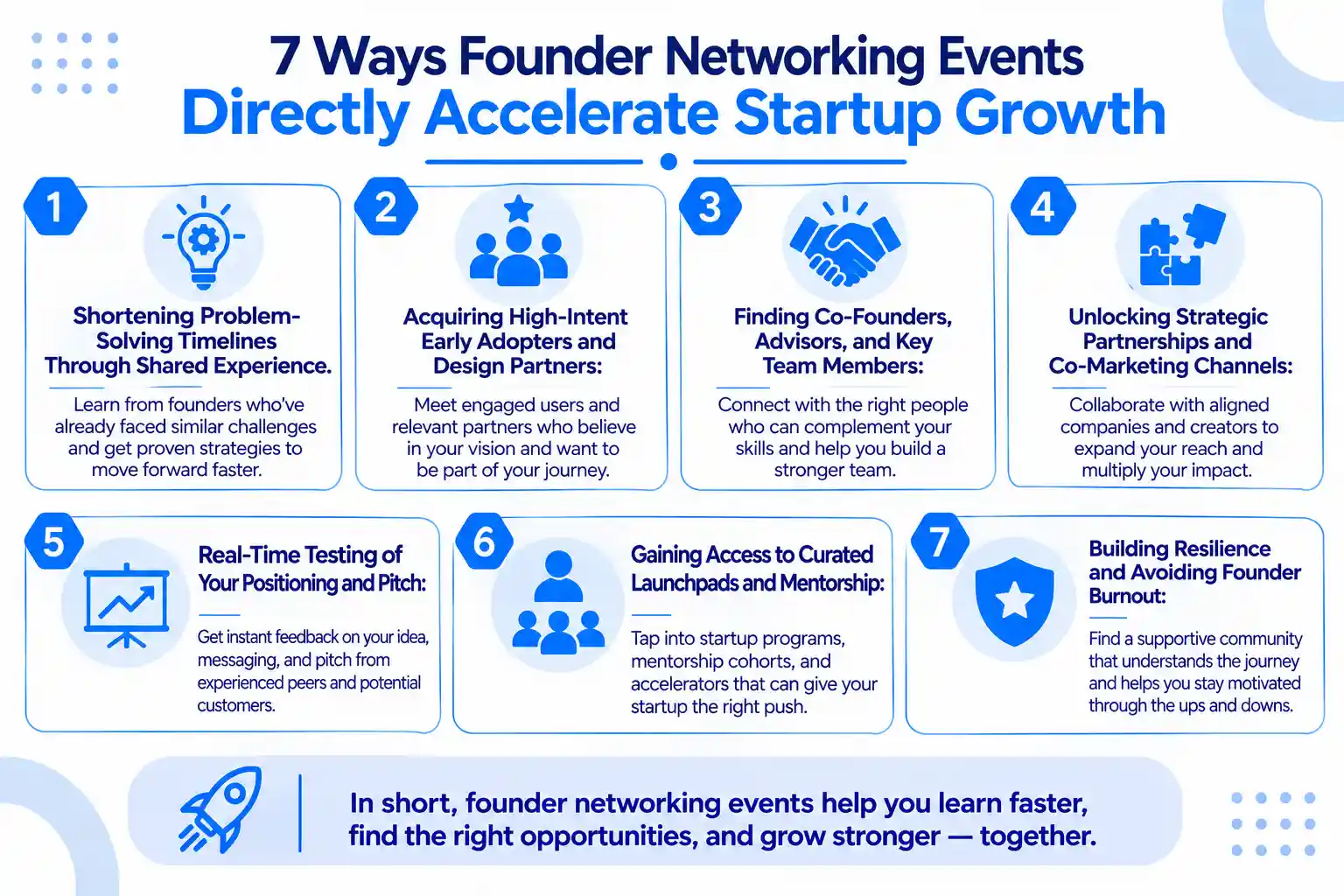
Participating in startup community meetups is not about collecting stacks of business cards or loitering near the snack table. When approached with a clear community purpose, a peer-to-peer founder ecosystem fuels growth across seven core pillars of your business:
- Shortening Problem-Solving Timelines Through Shared Experience. Every founder encounters roadblocks related to pricing models, customer churn, tech stacks, or hiring mistakes. Spending weeks searching for generic advice online pales in comparison to asking a peer who solved that exact problem six months ago.
Mastermind circles and community roundtables act as an informal advisory board, helping you sidestep costly operational mistakes.Furthermore, learning from experienced founders helps you avoid common mistakes and make better business decisions.
- Acquiring High-Intent Early Adopters and Design Partners: Your first customers rarely come from expensive paid channels; they come from direct relationships and trusted community recommendations.
At founder networking events, you are surrounded by fellow operators who are constantly testing new products and workflow services. Moreover, these connections can help you find early customers and receive valuable product feedback.Discussing the specific problem your product solves frequently leads to immediate beta sign-ups and clear user feedback.
- Finding Co-Founders, Advisors, and Key Team Members: Recruiting early-stage talent is extraordinarily difficult when you cannot compete with big corporate salaries.
Startup ecosystem gatherings attract builders, fractional executives, and experienced operators who thrive on equity, ownership, and the fast pace of the early stage.Additionally, these connections can help founders find the right people to support their growing teams.
- Unlocking Strategic Partnerships and Co-Marketing Channels: Customer acquisition costs (CAC) across digital channels continue to rise, making distribution partnerships one of the most effective growth vectors available.
Meeting founders who serve your exact Ideal Customer Profile (ICP) opens doors to co-hosted workshops, newsletter swaps, and shared community pipelines, doubling your reach without inflating ad spend.As a result, these partnerships can help startups reach more potential customers.
- Real-Time Testing of Your Positioning and Pitch: You can spend weeks internally debating your messaging copy, or you can spend a single evening explaining what your company does to twenty founders and watching their reactions.
Live conversations serve as an instant litmus test for your positioning, helping you see which value propositions spark genuine curiosity before spending a dollar on paid traffic.Therefore, founders can improve their messaging before investing in paid marketing.
- Gaining Access to Curated Launchpads and Mentorship: Being part of an active community gives you a direct line to structured launchpads, expert-led workshops, and mentorship programs.
Instead of building go-to-market strategies from scratch, you receive proven frameworks directly from veteran entrepreneurs who have already walked that path.Furthermore, expert guidance makes it easier to apply proven strategies to real business challenges. - Building Resilience and Avoiding Founder Burnout: Entrepreneurship carries a unique psychological weight. Being surrounded by peers navigating the exact same highs and lows normalizes the turbulence of building a company.
This shared momentum keeps you accountable, sharpens your ambition, and sustains your energy during tough quarters.
Consequently, founders can stay focused and motivated even during difficult business periods.
Types of Founder Networking Events and Which Fits Your Stage
Not all startup gatherings deliver equal value. Choosing the right room depends heavily on your current traction and immediate business objectives.
However, selecting the right event format can help founders make better use of their networking time.
Event Format | Best Startup Stage | Primary Community Outcomes | Ideal Preparation Strategy |
Curated Founder Dinners & Roundtables | Seed to Growth | Deep mutual trust, operational advice, strategic alliances | Bring a specific challenge to discuss; avoid hard pitching |
Startup Launchpads & Demo Days | Pre-Seed to Seed | Early traction, product feedback, community exposure | Prepare a concise elevator pitch and clear problem statement |
Expert-Led Workshops & Skill Sessions | Idea to Series A | Practical execution frameworks, tactical growth skills | Prepare questions tied to your active projects for the mentor |
Open Community Mixers & Coffee Meets | Idea to Pre-Seed | Co-founder discovery, network building, peer support | Focus on listening and asking open-ended questions |
All Stages | Ecosystem visibility, broad networking, industry insights | Set up your digital contact card for large-scale networking |
If you are in the pre-revenue stage, open community meetups and skill-building workshops yield broad feedback and co-founder leads. Once you have early traction, shift your calendar toward curated founder networking events where the signal-to-noise ratio is exceptionally high.
Pre-Event Playbook: How to Prepare Before Stepping into the Room
Walking into an event unprepared and hoping luck will guide you to the right conversation is a recipe for missed opportunities. Top-performing founders treat community networking with systematic preparation:
Therefore, preparing in advance helps founders build meaningful connections and achieve their networking goals.
- Define One Core Objective: Determine your primary goal before arriving, whether it is customer discovery, finding a technical co-founder, or getting feedback on your launch strategy.
- Review Attendee Lists and Community Profiles: Many active startup ecosystems share attendee directories or speaker lists beforehand. Identify a few peers whose work aligns with yours and plan to connect naturally.
- Craft a Conversational 15-Second Hook: Drop the jargon-heavy taglines. Explain what you do simply, focusing on what problem you solve and who you solve it for.
- Streamline Contact Exchange: Have a clean digital contact card or a QR code linked to your LinkedIn profile ready so you can exchange details instantly.
How to Network Like a Peer, Not a Salesperson
The fastest way to alienate people at a founder networking event is to treat every conversation like a transactional sales pitch. Founders have a finely tuned radar for individuals looking to extract value rather than contribute to it.
Start conversations by focusing outward. Ask questions that prompt peers to share what they are excited about or what problem they are currently wrestling with:
For example, asking thoughtful questions can help you understand other founders and build stronger relationships.
- What is the biggest operational bottleneck you are trying to crack this quarter?
- Which community or growth channel has surprised you the most lately?
- Who are you hoping to connect with tonight? I’d love to see if I can make an introduction.
When you position yourself as a helpful connector, you instantly become a valuable presence in the room.
The 48-Hour Follow-Up System That Converts Handshakes Into Real Growth
The real ROI of founder networking events happens after the venue closes. Without a disciplined follow-up system, even the best conversations fade within a week.
As a result, timely follow-ups help turn new connections into lasting business relationships.
Step 1: Log Context Immediately (Within 2 Hours)
Before going to sleep, jot down three quick notes for every meaningful person you met: where you met, what their current priority is, and what resource or introduction you promised.
Step 2: Send a Personalized Note Within 24 Hours
Skip generic messages. Reference a specific detail from your conversation and deliver immediate value without asking for anything in return.
Step 3: Schedule a Low-Friction Next Step (Within 48 Hours)
If there is clear synergy for a partnership brainstorm or collaboration, propose a specific, low-commitment next step like a virtual coffee chat.
Common Mistakes That Waste Your Time at Startup Events
Hiding With People You Already Know: Sticking exclusively to your existing circle defeats the purpose of stepping into a community room.
Over-Pitching Before Building Context: Launching into a monologue before
understanding what the other person cares about creates friction.
Chasing Vanity Events Over Curated Communities: Massive conferences often produce surface-level small talk, whereas dedicated founder ecosystems foster real business outcomes.
Neglecting Consistent Attendance: Showing up to one event a year rarely builds deep social capital. Consistency within community chapters compounds your reputation.
Ultimately, attending events regularly helps founders build trust and stronger professional relationships.
Conclusion
Founder networking events are not about collecting contacts. They are about building the trust, proximity, and shared context that help a startup grow faster than it could alone.
When you walk into the right room with a clear objective, you can shorten problem-solving timelines, find early adopters and design partners, meet co-founders and advisors, unlock co-marketing partnerships, test your pitch in real time, and get the peer support that keeps burnout at bay.
The value does not end when the event does. Preparation before the event, a peer-first approach during it, and a disciplined 48-hour follow-up afterward are what turn a good conversation into a lasting business relationship.
Avoid the common traps: staying with people you already know, pitching too early, chasing vanity conferences, and showing up only once a year.
Choose events that match your startup’s stage, show up consistently, and focus on giving value before asking for it. Over time, this compounds into a strong reputation and a network that opens doors to customers, talent, and opportunities.
Communities like eRoof Community make this easier by bringing founders, creators, and entrepreneurs together through meetups, workshops, and collaborative events.
Your next big breakthrough may be one conversation away. Step into the room, contribute generously, and let the community help you build faster.
FAQs
1. How do founder networking events help startups grow?
Founder networking events help startups grow by connecting entrepreneurs with potential customers, co-founders, investors, mentors, and strategic partners. These connections can lead to early customers, valuable feedback, business collaborations, and new growth opportunities.
2. Are startup networking events worth attending for early-stage founders?
Yes, startup networking events can be valuable for early-stage founders when they attend with a clear goal. These events help founders validate ideas, understand market challenges, find potential co-founders, and build relationships with experienced entrepreneurs.
3. How should founders prepare for a startup networking event?
Founders should define one clear objective, review attendee profiles, prepare a short introduction, and keep a digital contact card or LinkedIn QR code ready. This preparation helps them start meaningful conversations and connect with relevant people.
4. Can founder networking events help startups acquire their first customers?
Yes. Founder networking events bring entrepreneurs, operators, and potential early adopters together. By explaining their product and understanding the problems other attendees face, founders can generate beta sign-ups, receive user feedback, and discover potential first customers.
5. How does eRoof Community help founders connect and grow their startups?
eRoof Community brings founders, creators, and entrepreneurs together through networking initiatives, startup meetups, collaborative workshops, and community events. These opportunities help members exchange knowledge, discover potential partners, showcase ideas, and build meaningful business relationships.