

Inside the Story
ByteAsk raises $1M in pre-seed funding.
Y Combinator leads the round with Entrepreneur First.
Startup builds AI agents for C and C++.
Funds will support product, GPUs and hiring.
The Story
Introduction
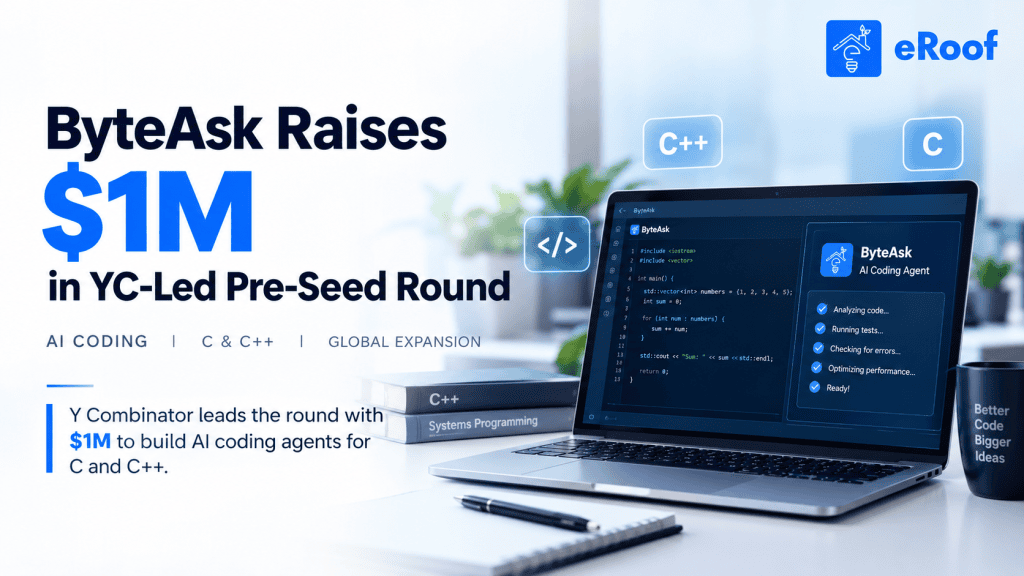
AI coding startup ByteAsk has raised $1 million in pre-seed funding in a round led by Y Combinator and Entrepreneur First, with participation from angel investors.
The company is building AI coding agents specifically for C and C++, two programming languages widely used in systems where performance, reliability and hardware interaction are important.
The funding was announced on September 24, 2026, as ByteAsk also joined Y Combinator’s Fall 2026 batch. The company was founded in June 2026 and is headquartered in San Francisco, with operations in the US and India.
ByteAsk plans to use the new capital for infrastructure, product development, engineering and research hiring, GPU computing, training data, and enterprise security and privacy infrastructure.
Its initial target customers include companies working in high-frequency trading, automotive, aerospace, defence, robotics, embedded systems and semiconductors.
Background
ByteAsk was founded by Anirudha Kulkarni and Pratyush Saini, both computer science graduates from IIT Delhi. Before starting ByteAsk, the founders built LawSutra AI, a legal technology startup that was acquired by Manupatra within four months of its launch, according to ETEntrepreneur and ByteAsk’s Y Combinator profile.
Kulkarni previously worked on low-latency C++ systems at Optiver and in markets engineering at Quantbox Research. Saini has experience in AI infrastructure and AI security, including work at ThirdAI and SimbianAI.
Their previous experience helped shape ByteAsk’s focus on software engineering problems involving performance, debugging and system-level reliability.
ByteAsk describes itself as an AI coding agent for C and C++. Unlike conventional code-completion tools, its platform is designed to work with the development environment, compiler, debugger and testing tools used by engineers.
The company’s website says its system can build code, run tests and sanitizers, and work with debugging environments.
Main Development
The central focus of ByteAsk’s product is the use of AI for complex C and C++ development.
C and C++ are programming languages frequently used for systems software, embedded devices, automotive technology, trading infrastructure, operating systems and other performance-sensitive applications.
These environments can require developers to consider memory management, hardware behaviour, compilation, execution speed and system dependencies.
ByteAsk says generic AI coding tools have not performed equally well on these types of development tasks. The startup is therefore focusing on debugging, performance optimisation, memory optimisation, verification and engineering context rather than only generating new code.
AI coding agents are software systems that use artificial intelligence to perform development tasks with a greater degree of autonomy than traditional code-completion tools. They can analyse code, make changes and interact with development tools.
The company’s approach also puts emphasis on verification, meaning checking whether an AI-generated change actually works as intended. ByteAsk says its system can compile code, execute tests and use debugging and analysis tools before presenting a change to developers.
The startup says its internal benchmark, based on real firmware engineering tickets, showed its grounding environment resolving 89% of tested tickets,compared with 61% for the best frontier model tested without that environment.
These are ByteAsk’s own benchmark results and should therefore be viewed as company-reported results rather than an independent industry comparison.ByteAsk is also working on a specialised post-training approach for C++. According to ETEntrepreneur, the company plans to release a language model specifically post-trained for C++ within the next six to eight months.
The fresh capital will help the startup expand its engineering and research teams in San Francisco and India. It also plans to invest in GPU compute, which provides the processing capacity needed to train and run many modern AI systems, as well as training data and enterprise infrastructure.
Industry Impact
ByteAsk’s funding highlights a broader shift in AI software development from simple code generation toward more specialised engineering workflows.
For developers working on general-purpose applications, AI coding tools can assist with writing functions, fixing errors and generating documentation. However, C and C++ projects can involve additional requirements around memory, hardware, performance and system behaviour.
This makes context particularly important. An AI system working with a large C++ codebase may need to understand dependencies, build systems, compiler settings, debugging information and hardware constraints before suggesting a change.
For businesses, this could make specialised AI coding tools relevant to areas where software reliability is closely connected to the physical product or financial system.
Automotive companies, semiconductor businesses, robotics companies and trading firms are examples of industries where software performance can have direct operational consequences.
ByteAsk is initially focusing on large enterprises in high-frequency trading, automotive and embedded systems before expanding into adjacent markets, according to ETtech.
The company’s emphasis on on-premises infrastructure is also relevant for enterprises handling sensitive source code. On-premises software is deployed within a company’s own computing environment rather than being operated entirely through an external cloud service.
ByteAsk’s Y Combinator profile says the product is available on-premises and can work with tools including compilers, debuggers, sanitizers and profilers.
Future Outlook
ByteAsk’s next phase will involve turning its specialised C and C++ approach into a broader enterprise product.
The company plans to increase hiring, invest in AI infrastructure and expand its presence across San Francisco and India. Its participation in Y Combinator’s Fall 2026 batch is also expected to provide access to investors, technical talent and the broader global startup ecosystem
The company’s longer-term opportunity will depend on how effectively its AI agents perform across different codebases and real-world engineering environments.
Independent testing, broader customer adoption and evidence from production deployments will provide additional information about the technology’s performance beyond ByteAsk’s internal benchmarks.
The startup is entering a market where AI coding tools are increasingly moving beyond autocomplete and basic code generation. ByteAsk is taking a more specialised route by concentrating on C and C++, where developers often work with performance-sensitive and hardware-connected systems.
With $1 million in new pre-seed funding, a place in Y Combinator’s Fall 2026 batch and a product focused on specialised software engineering, ByteAsk is now preparing to expand its technology, team and enterprise capabilities.
Its progress will offer another example of how AI startups are targeting specific technical workflows rather than building only general-purpose coding assistants.
Technical Terms
- AI Coding Agent — An AI system that can analyse code, make changes and perform development tasks with greater autonomy than a basic code-completion tool.
- Pre-Seed Funding — Early-stage investment used by a startup to develop its product, build a team and establish its initial business.
- C and C++ — Programming languages commonly used for systems software, embedded technology, automotive applications, operating systems and performance-sensitive software.
- GPU Compute — Processing power provided by graphics processing units, which are widely used to train and run modern AI models.
- On-Premises Infrastructure — Technology infrastructure operated within an organisation’s own facilities or controlled computing environment.
- AI Verification — The process of checking whether an AI-generated result or code change actually works correctly through tests, compilers or other validation tools.
- Low-Latency Systems — Systems designed to process information and respond with very little delay, which is particularly important in areas such as high-frequency trading.
- Embedded Systems — Computer systems built into devices or machines to perform specific functions, such as those found in vehicles, industrial equipment and electronics.