

Inside the Story
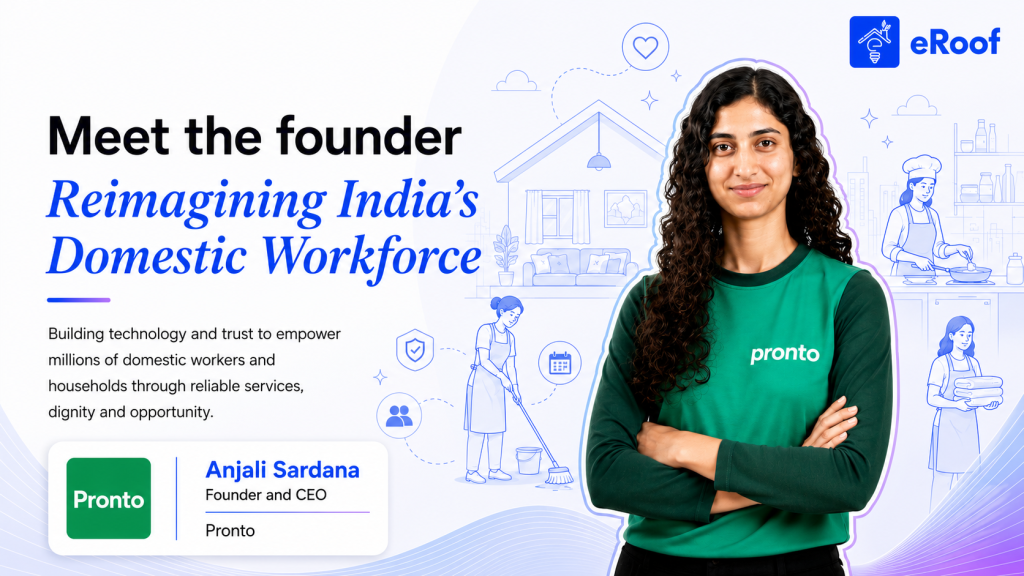
- At just 24, Anjali Sardana set out to solve a challenge hidden inside millions of Indian households: finding reliable domestic help while creating better opportunities for workers.
- What began as an effort to organize an unstructured industry quickly evolved into Pronto, a platform connecting households with trained and verified professionals.
- In less than a year, the company scaled rapidly across multiple cities, attracting significant investor attention and becoming one of India’s fastest-growing home-services startups.
- Today, Pronto’s larger mission extends beyond convenience—it’s about bringing structure, dignity, and economic opportunity to a workforce that has historically operated in the informal economy.
The Bigger Picture
For decades, finding domestic help in India relied on personal referrals, neighborhood networks, and informal arrangements.
While this system worked for some, it often created challenges for both sides.
Households struggled with reliability, verification, and consistency. Workers faced unpredictable income, limited training opportunities, and little professional structure.
As India’s urban workforce grew and lifestyles became increasingly fast-paced, the gap became more visible.
It was this challenge that caught the attention of a young founder who believed technology could help organize one of the country’s largest yet least formalized labor segments.
In This Story
- Before Pronto
- Seeing Opportunity in an Invisible Market
- From Investor to Founder
- Building a Platform for Trust
- Scaling at Startup Speed
- A Bigger Mission Beyond Home Services
- Charting the Future
Before Pronto, There Was a Different Path
Long before becoming the founder of one of India’s fastest-growing workforce platforms, Anjali Sardana was studying businesses from the other side of the table.
After graduating from the University of California, Berkeley, she began her career working with leading investment firms including Bain Capital and 8VC, gaining firsthand exposure to how high-growth startups are built, scaled, and funded.
The experience gave her a front-row seat to innovation across industries. But it also sparked a different ambition.
Rather than evaluating businesses from the outside, she became increasingly interested in building one herself.
As she studied consumer behavior and everyday challenges across India, she noticed something many people overlooked.
Some of the country’s biggest opportunities weren’t hidden inside emerging technologies.
They were hiding inside everyday problems that millions of people faced every single day.
That realization would eventually lead her toward one of India’s largest yet most overlooked workforce sectors.
Seeing Opportunity in an Invisible Market
Before launching Pronto, Anjali Sardana worked with investment firms including Bain Capital and 8VC, where she gained exposure to high-growth businesses and emerging markets.
While studying labor markets and everyday consumer behavior, she noticed something surprising.
Millions of households depended on domestic workers every day, yet the industry itself remained largely fragmented and informal.
What looked like a routine household challenge was actually a massive market waiting to be organized.
Founder’s Perspective
“Large industries often hide in plain sight. Sometimes the biggest opportunities are found inside everyday problems people have simply learned to live with.”
From Investor to Founder
Most people spend years evaluating businesses before deciding to build one.
For Sardana, that transition happened early.
Instead of continuing on the investment side of startups, she chose to step into entrepreneurship and tackle the problem firsthand.
Her vision was simple:
Create a platform that could offer households trusted help while simultaneously creating more structured opportunities for domestic workers.
That vision became Pronto.
Building a Platform for Trust
The challenge wasn’t just matching workers with households.
Trust had to be built on both sides.
Pronto introduced training programs, background verification, structured onboarding, and managed workflows designed to bring greater reliability to domestic services. The company focused on creating a more organized experience for both customers and workers.
In a sector where informal arrangements had dominated for decades, structure itself became a competitive advantage.
Founder’s Perspective
“Technology can improve access, but long-term trust comes from consistency, reliability, and creating value for everyone in the ecosystem.”
Scaling at Startup Speed
Few expected the company to scale as quickly as it did.
Within months of launch, Pronto expanded from a single-city operation into multiple markets across India. Daily bookings climbed rapidly while investor confidence followed close behind.
The startup raised significant funding rounds, reaching a valuation of $100 million and later $200 million as investors backed its vision of organizing domestic labor at scale.
What stood out wasn’t only the growth.
It was the ambition behind it.
Pronto wasn’t positioning itself as another home-services company. It was attempting to build infrastructure for an entire workforce category.
A Bigger Mission Beyond Home Services
At the heart of Pronto’s story is a larger idea.
Domestic work is one of India’s largest employment segments, yet much of it remains unorganized.
By bringing workers into a more structured system through training, predictable work opportunities, and digital access, Pronto hopes to create better outcomes for both households and professionals.
The company’s workforce is predominantly women, making its impact particularly significant within the broader conversation around economic participation and workforce inclusion.
For Sardana, the mission is ultimately about creating a platform that helps millions of workers access more stable opportunities while making essential household services easier to access.
Charting the Future
Pronto’s growth story is still in its early chapters.
The company continues expanding its workforce, entering new service categories, and deepening its presence across Indian cities. Future plans include expanding beyond cleaning into additional home-service offerings while continuing to invest in workforce development and operational infrastructure.
The broader vision remains ambitious:
To build one of the world’s largest platforms for organizing domestic labor, starting with India.
Closing Note
Every successful startup begins with a problem.
The most impactful ones begin with a problem so common that people stop questioning it.
For Anjali Sardana, that problem was hiding inside millions of households across India.
By choosing to bring structure, trust, and technology into an industry long defined by informality, she is building more than a company.
She is helping redefine how domestic work is organized, valued, and experienced in modern India.