

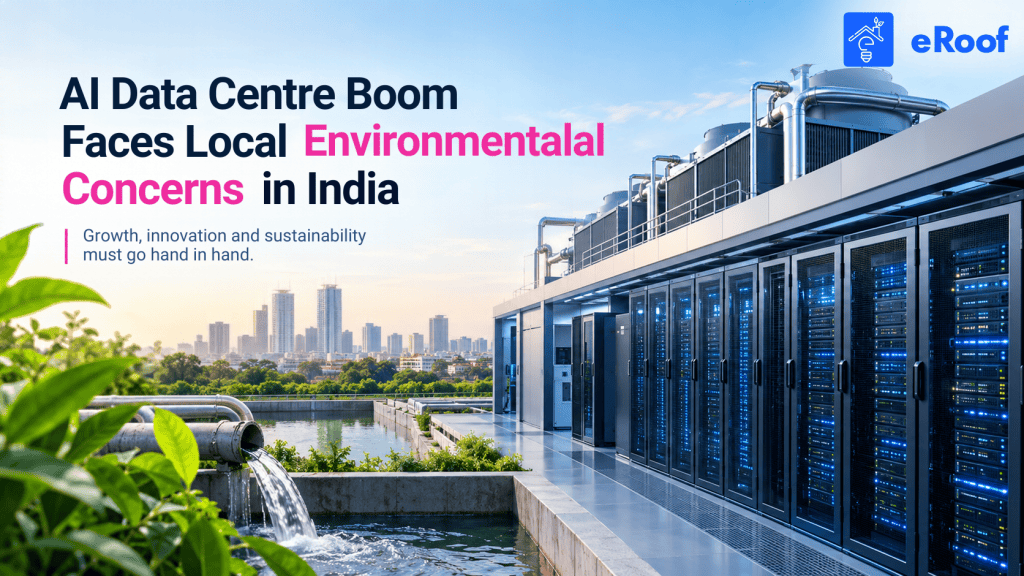
Inside the Story
- India’s AI expansion is increasing demand for data-centre infrastructure.
- Data centres require substantial electricity and cooling capacity.
- Water use and local environmental impacts are attracting attention.
- Sustainable infrastructure planning will be essential for long-term growth.
The Story
Introduction
India’s growing ambitions in artificial intelligence (AI) are increasing interest in data centres, the facilities that power cloud computing, digital services, and advanced AI systems.
As technology companies and infrastructure providers explore new investments, questions about electricity consumption, cooling requirements, water availability, and environmental sustainability are becoming increasingly important.
Data centres are essential to the digital economy, supporting everything from online payments and business software to AI assistants and enterprise applications.
However, their expansion also presents infrastructure challenges for developers, local authorities, utilities, and communities living near proposed or operating facilities.
Fact-check note: Environmental pressures associated with data centres are well-established industry concerns. Specific claims about individual Indian projects, local protests, water consumption, or investment figures should be verified against current reporting and official project records before publication.
Background: Why AI Data Centres Are Expanding
Data centres are specialised facilities that house servers, networking equipment, storage systems, and other hardware required to process and store digital information. Traditional data centres already support banking, e-commerce, telecommunications, and enterprise software.
AI workloads add another layer of demand because training and running advanced models can require substantial computing power.
India is an attractive market for digital infrastructure because of its expanding internet economy, large population of digital users, enterprise technology sector, and increasing adoption of cloud-based services.
Businesses are also exploring AI applications for customer support, software development, logistics, healthcare administration, financial services, and data analysis.
As demand grows, operators need facilities capable of supporting high-density computing equipment. This can require more advanced cooling systems, reliable electricity connections, backup power arrangements, and carefully planned infrastructure.
The challenge is to develop this capacity without placing unnecessary pressure on local resources.
Main Development: Environmental Concerns Grow Around New Projects
A Reuters report published on 9 October 2026 highlighted opposition from residents concerned about the environmental and community impacts of India’s AI infrastructure expansion.
The report described concerns around a planned Amazon-linked facility near Mumbai, including tree removal, noise, electricity demand, and pressure on local water resources.
Similar concerns have emerged around large technology projects in other parts of the country.
Reuters
The debate reflects a wider challenge: data centres provide important digital infrastructure, but their location and operating requirements can affect surrounding communities.
1. Rising Electricity Demand
AI servers require continuous electricity to process large amounts of data. Facilities must also power cooling equipment, networking systems, lighting, and backup infrastructure. As more businesses adopt AI tools, operators may need to expand capacity and secure dependable power supplies.
India’s Ministry of Electronics and Information Technology reported that the country’s data-centre capacity grew from approximately 375 megawatts (MW) in 2020 to around 1,575 MW by August 2026.
The government has also highlighted the importance of energy efficiency and clean-energy measures as the sector expands. Press Information Bureau
The environmental impact depends partly on where electricity comes from. Greater reliance on fossil-fuel-generated electricity can increase emissions, while renewable energy procurement and more efficient equipment can help reduce the carbon footprint.
2. Water Use and Cooling Requirements
Servers generate heat during operation, making cooling systems essential for reliability and performance. Depending on the technology used, cooling may require water directly or consume electricity that has its own environmental footprint.
Water availability is particularly important in regions already facing shortages. If a large facility competes with households, agriculture, or other industries for limited resources, it can create local concerns even when the project brings economic investment.
The Indian government has acknowledged these infrastructure considerations. In an August 2026 parliamentary response, the Ministry of Environment, Forest and Climate Change explained that certain data-centre projects require environmental clearance when they fall within specified building or township project categories.
Assessments can consider freshwater availability, water balances, and wastewater recycling. Press Information Bureau
This distinction matters: not every AI data centre automatically requires a separate environmental clearance, and requirements depend on the project’s classification and applicable regulations.
3. Land Use and Community Impact
Large data-centre developments need land for server buildings, electrical equipment, cooling infrastructure, access roads, and supporting facilities. Construction can change local landscapes and affect nearby residents through noise, traffic, and changes to green spaces.
Community concerns are not necessarily objections to technology itself. Residents may instead want transparent information about resource requirements, construction impacts, public consultation, and the safeguards planned by developers.
Early consultation can help identify problems before construction progresses. Clear communication about water sources, power arrangements, tree management, noise controls, and emergency plans can also help businesses build trust with local communities.
Industry Impact: What This Means for India
India’s data-centre expansion presents both economic opportunities and environmental responsibilities. The country can attract investment, strengthen digital services, support AI innovation, and create demand for skilled workers. At the same time, poorly planned growth could increase pressure on electricity networks, water supplies, land, and local infrastructure.
For businesses, the implications extend beyond large technology companies.
- Startups and MSMEs: More data-centre capacity can support access to cloud computing and AI services, helping smaller firms build digital products without owning expensive infrastructure.
- Technology investors: Reliable power, suitable land, connectivity, and predictable environmental requirements are important factors when evaluating new projects.
- Local communities: Residents need transparent assessments of how projects may affect water availability, electricity infrastructure, noise, and surrounding land.
- Policymakers: States need to balance investment incentives with resource availability, environmental safeguards, and long-term infrastructure planning.
The government has also identified technologies that can improve operational efficiency. These include direct-to-chip liquid cooling, immersion cooling, and closed-loop liquid cooling systems. Their effectiveness depends on facility design, operating conditions, and the cooling method selected.
Renewable electricity procurement, waste-heat recovery where practical, water recycling, and efficient server utilisation can further improve sustainability. However, these measures need to be evaluated against actual resource use rather than marketing claims alone.
For developers, sustainability planning should begin before a site is selected. Assessing local water stress, electricity availability, renewable energy access, and community concerns early can reduce operational risks and help avoid costly disputes later.
For India, the central challenge is not simply how quickly data-centre capacity can grow, but whether that growth can be supported responsibly over the long term.
Conclusion
India’s AI data-centre boom is an important part of the country’s digital transformation, creating opportunities for businesses, startups, investors, and technology users. Yet the environmental concerns highlighted in recent reporting show why infrastructure expansion must be accompanied by responsible planning.
Electricity efficiency, water-conscious cooling, renewable energy, transparent project assessments, and meaningful community engagement will be essential to making this growth sustainable.
By treating environmental planning as a core business requirement rather than an afterthought, India can strengthen its AI ecosystem while better protecting local resources and communities.
Technical Terms Explained
Data Centre: A facility that houses computer servers and networking equipment used to store, process, and distribute digital information.
Artificial Intelligence (AI): Technology that enables computer systems to perform tasks such as language processing, prediction, and image recognition.
Megawatt (MW): A unit of power equal to one million watts, used to describe the power capacity of infrastructure such as data centres.
AI Workload: Computing tasks associated with developing, training, or running AI models and applications.
Renewable Energy: Energy generated from naturally replenished sources, including solar, wind, and hydropower.
Direct-to-Chip Liquid Cooling: A cooling method that circulates liquid through components attached to computer processors to remove heat efficiently.
Closed-Loop Cooling: A cooling system that recirculates fluid within a system, reducing the need for continuous replacement of the circulating liquid.
Environmental Clearance (EC): Regulatory approval required for projects that fall within specified environmental assessment categories under applicable Indian rules.