

Picture two founders with the same idea, the same budget, and the same six months. One stays heads-down, building in isolation. The other spends a couple of evenings every week meeting other founders, mentors, and potential customers. Six months later, which one has the warm introduction to an investor? Which one made a first hire through a referral?
That gap is the quiet superpower behind startup founder networking. It isn’t about collecting business cards or blasting generic connection requests. It’s the deliberate habit of meeting people who can open doors, challenge your thinking, and remind you that you’re not the only one losing sleep over cash flow.
In this guide, we’ll walk through how startup founder networking works in 2027, which startup networking strategies are worth your time, and how to turn casual hellos into relationships that move your business forward. Whether you’re building in Indore or anywhere else, you’ll finish with a plan you can start this week.
What Is Startup Founder Networking?
Startup founder networking is the practice of building intentional relationships with other founders, mentors, investors, operators, and customers so you can share knowledge, find opportunities, and grow faster.
It happens at founder networking events and startup meetups, inside startup communities and online networking groups, and through one-to-one conversations on platforms like LinkedIn.
Think of it as the difference between knocking on a locked door and being handed the key. A cold email to an investor usually disappears into an inbox. A warm introduction from someone they trust gets read. That’s the real value of startup founder networking: trust travels through people, and people travel in circles.
It also differs from general business networking for startups. Traditional networking can feel transactional, with everyone trading pitches. Founder-focused networking is peer-driven. You’re talking to people who have faced the same hiring headaches, pricing doubts, and fundraising rejections, so conversations go deeper, faster.
Why Startup Founder Networking Matters More Than Ever
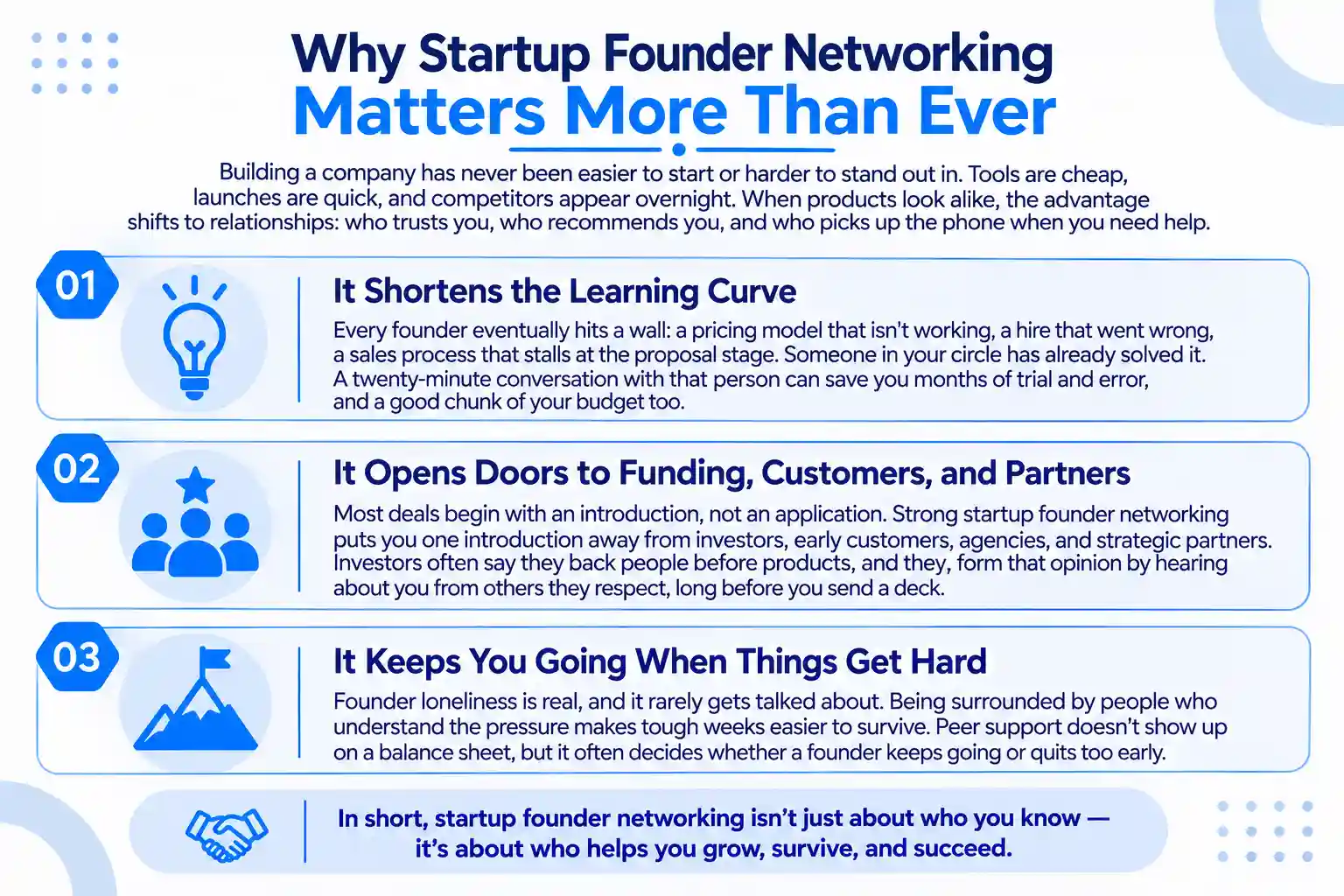
Building a company has never been easier to start or harder to stand out in. Tools are cheap, launches are quick, and competitors appear overnight. When products look alike, the advantage shifts to relationships: who trusts you, who recommends you, and who picks up the phone when you need help.
It Shortens the Learning Curve
Every founder eventually hits a wall: a pricing model that isn’t working, a hire that went wrong, a sales process that stalls at the proposal stage. Someone in your circle has already solved it. A twenty-minute conversation with that person can save you months of trial and error, and a good chunk of your budget too.
It Opens Doors to Funding, Customers, and Partners
Most deals begin with an introduction, not an application. Strong startup founder networking puts you one introduction away from investors, early customers, agencies, and strategic partners. Investors often say they back people before products, and they form that opinion by hearing about you from others they respect, long before you send a deck.
It Keeps You Going When Things Get Hard
Founder loneliness is real, and it rarely gets talked about. Being surrounded by people who understand the pressure makes tough weeks easier to survive. Peer support doesn’t show up on a balance sheet, but it often decides whether a founder keeps going or quits too early.
Where Startup Founder Networking Happens
You don’t need to be everywhere. You need to be in the right two or three places, consistently. Here are the main options and what each one is best for.
Founder Networking Events and Startup Meetups
Good startup founder networking often begins in a physical room.a Founder networking events nd local startup meetups give you something no screen can: unplanned conversations.
The chat over coffee after a talk is frequently more valuable than the talk itself. Look for smaller, recurring startup meetups where the same faces return, because repeat encounters build real relationships far faster than one-time conferences.
Startup Communities and Founder Communities
Startup communities and founder communities turn startup founder networking from a one-off event into a habit. A good community has regular programming, open and welcoming members, and a culture where people share what’s working and what isn’t.
Over time, you stop being a stranger and become the person others think of when an opportunity comes up. That reputation is hard to build any other way.
Startup Accelerators and Incubators
Startup accelerators and incubators bundle mentorship, structure, and a ready-made cohort of peers. The cohort is often the most underrated benefit. The founders sitting beside you today may become your customers, referrers, or co-founders tomorrow.
If you aren’t ready for a formal program, many accelerators host open demo days and workshops that you can attend to start meeting people.
Online Networking Groups
Online networking groups, from Slack communities to WhatsApp circles, make startup founder networking possible when you can’t travel or your city’s ecosystem is small. They’re excellent for quick questions and for finding people in niche industries.
The trade-off is depth. Treat online groups as the start of a relationship, and move the best conversations to a call or an in-person coffee.
LinkedIn Networking for Founders
LinkedIn networking for founders works best when it’s personal. Skip the template message. Reference something specific: a post they wrote, a product they launched, a talk they gave.
Share useful content on your own profile consistently, so that when people check you out, they find a founder who clearly knows their space. Visibility on LinkedIn makes every other kind of networking easier, because people look you up before they reply.
7 Startup Networking Strategies That Actually Work
Knowing where to show up is half the equation. These startup networking strategies cover the other half: what to do once you’re there.
1. Start With a Clear Goal
Are you looking for investors, your first ten customers, a technical hire, or a co-founder? Every serious startup founder networking plan starts with an answer to that question.
A clear goal tells you which events to attend, which people to approach, and what to ask for. Without one, you’ll collect pleasant conversations but few results.
2. Give Before You Ask
Generosity is the most reliable startup founder networking tactic there is. Make an introduction, share a template, recommend a tool, or send a useful article. Giving first builds goodwill and changes how people remember you.
When you eventually need a favor, you’re asking someone who already considers you helpful instead of someone who only appears when they need something.
3. Prepare a Twenty-Second Introduction
“I’m a founder” isn’t memorable. Practice a short introduction that covers who you help, the problem you solve, and what you’re working on now. Keep it human.
Something like “I help small clinics cut missed appointments with a simple reminder tool, and I’m looking for clinic owners to test it” gives people something to respond to and a clear way to help.
4. Follow Up Within 48 Hours
Most of the value in startup founder networking is lost after the event, not at it. Send a short message within two days that mentions something from your conversation, and suggest one next step, such as a call or an introduction.
A thoughtful follow-up puts you ahead of most people, who never send one.
5. Go Deep, Not Wide
Ten strong relationships beat two hundred weak ones. After the first meeting, invest in the few people who are genuinely aligned with your goals.
Check in occasionally, celebrate their wins, and offer help without being asked. This is the heart of building professional connections that last beyond a single transaction.
6. Share Your Own Story
Speak at a session, join a panel, or write about what you’re learning. When you share openly, the right people find you instead of the other way around. Hosting a small founder dinner or a coffee morning works too. The organizer of a room is almost always the most connected person in it.
7. Use Co-Founder Matching Thoughtfully
If you’re building alone and need a partner, co-founder matching through communities and events can help, but treat it like hiring and dating at once. Work on a small project together before committing.
Check how you handle disagreement, how you each think about money, and whether your skills genuinely complement each other. Equity is easy to give and very hard to take back.
Entrepreneur Networking Tips for First-Time Founders
If the idea of walking into a room full of strangers makes your stomach flip, you’re in good company. These entrepreneur networking tips make your first attempts at startup founder networking easier.
Arrive early. Rooms are calmer in the first fifteen minutes, and it’s simpler to start a conversation with the organizer or another early arrival than to cut into a crowded circle.
Ask open questions like “What are you building?” and “What’s been the hardest part this quarter?” Then listen properly. People remember how attentive you were more than what you said.
Set a small target, such as meeting three new people and booking one follow-up call, instead of trying to impress everyone. And keep a simple record: a note on your phone with names, what they do, and what you promised.
Good networking for entrepreneurs is less about charisma and more about consistency, and a basic system keeps you consistent.
How eRoof Community Supports Startup Founder Networking
eRoof is a non-profit startup community based in Indore, built for founders, creators, and builders who want to connect, collaborate, learn, and grow. If you’re looking for a place to practice startup founder networking with people who are actively building businesses, here’s how the platform makes it easier.
The Networking initiative connects founders, creators, and professionals so they can unlock referrals, partnerships, and growth faster. Regular meetups bring members together in person, which is where a profile photo becomes a real person you trust.
Sessions and workshops add structure with expert-led learning, so you walk away with skills as well as contacts.
If you’re early in your journey, the LaunchPad lets you showcase your product, present your idea, and gather feedback and early traction from an active community.
eRoof Talks share stories from builders making real impact, and Skilling focuses on practical, industry-ready learning. You can also explore eRoof’s chapters, and the annual event brings the wider ecosystem into one room.
Want to see how the community works in practice? Browse the success stories, or read why smart founders never skip entrepreneur meetups for a deeper look at in-person connection.
Mistakes That Quietly Kill Startup Founder Networking
Even motivated founders slip up. Watch for these.
Only networking when you need something. People can tell. If your first message in months is an ask, it lands badly. Stay in touch when things are calm.
Treating every event like a sales pitch. Pitching a stranger within thirty seconds shuts the conversation down. Lead with curiosity, and let the pitch emerge naturally when they ask what you do.
Skipping the follow-up. A great conversation with no message afterward is a missed opportunity, because the follow-up is where most of the value lives.
Spreading yourself too thin. Joining ten communities means contributing meaningfully to none. Choose two or three and show up consistently. Effective startup founder networking rewards presence over variety.
Staying inside your bubble. If every person you meet is a founder in your exact niche, you’ll hear the same opinions repeated. Deliberately meet investors, operators, customers, and founders from other industries.
How to Measure Your Startup Founder Networking Results
Networking can feel fuzzy, so give it a few simple metrics. Track how many meaningful conversations you have each month, how many follow-ups turn into a second conversation, and how many introductions you give and receive.
Over a quarter, note concrete outcomes: a customer lead, a hire, a partnership, a mentor, or a piece of advice that changed a decision.
You don’t need a complex spreadsheet. A monthly ten-minute review is enough. If you’re attending plenty of events but nothing changes, adjust your approach: change the events, sharpen your goal, or work on your follow-up.
Treat startup founder networking like any other growth channel, with testing, tracking, and improvement.
Conclusion
The founders who seem lucky usually aren’t. They’ve spent months, sometimes years, showing up, helping others, and staying in touch, so when they need an introduction, a hire, or a hard conversation, someone is ready to help.
That is the quiet compounding effect of startup founder networking.
You don’t have to start big. Pick one goal, choose two places to show up, write a short introduction, and send your first follow-up this week. Then repeat.
If you’d like a welcoming place to begin, become a member of eRoof and meet founders who are building real businesses. Strong relationships are one of the few advantages that can’t be copied, and your next one could be a single conversation away.
Frequently Asked Questions
What is startup founder networking?
Startup founder networking is the practice of building relationships with other founders, mentors, investors, and customers to share knowledge, find opportunities, and grow a business. It includes attending founder networking events and startup meetups, joining startup communities and online groups, and connecting with people on LinkedIn.
Why is startup founder networking important?
It shortens the learning curve, leads to introductions to investors, customers, and partners, and gives founders a support system. Many funding and partnership opportunities come through referrals rather than cold outreach, so strong connections often speed up growth.
How do I start networking as a first-time founder?
Begin with one clear goal, such as finding customers or a mentor. Pick two or three places to show up regularly, such as a local startup meetup, an online networking group, and LinkedIn. Prepare a short introduction, ask open questions, and send a follow-up message within 48 hours.
Which are the best places for startup founder networking?
The best places include startup meetups, founder communities, startup accelerators and incubators, online networking groups, and LinkedIn. The right choice depends on your goals and stage: communities and meetups suit relationship building, while accelerators suit structured support.
How can I find a co-founder?
Co-founder matching through startup communities, accelerators, and events works best when you test the fit first. Work together on a small project, discuss roles and equity openly, and only then formalize the partnership.