

Here’s something most founders learn the hard way: you can build a brilliant product and still go nowhere if the right people don’t know you exist. Investors, early customers, co-founders, great hires and trusted advisors rarely show up because of an ad. They show up because of a person.
That is exactly why a solid set of startup founder networking strategies resources is one of the most underrated assets in any growth stack.Think about the last big opportunity in your journey. Was it a warm introduction? A comment under a LinkedIn post? A casual chat at a meetup?
Chances are, a human connection sat right at the center of it. And in 2027, with AI-generated noise flooding every inbox and feed, genuine human relationships matter more, not less.
In this guide, we’ll walk through how startup founders can build a strong network from scratch, which platforms and communities are actually worth your time, and the founder networking best practices that separate people who collect contacts from people who build real relationships. Grab a coffee. This one is practical.
What Are Startup Founder Networking Strategies?
Startup founder networking strategies are the deliberate methods founders use to meet, build trust with and stay connected to people who can help their company grow, including investors, mentors, peers, customers, talent and referral partners.
The best startup founder networking strategies resources combine three things: places to meet people (platforms, events and communities), a repeatable process for following up, and a clear idea of what value you can offer in return.
Notice the last part. Networking isn’t about extracting favors. It’s about creating a web of mutual usefulness. Founders who understand this tend to get introductions faster, because people love helping someone who has already helped them.
Why Startup Founder Networking Strategies Resources Matter More in 2027
The startup landscape has changed fast. Funding is more selective, buyers are more skeptical, and attention is the scarcest resource on the planet. In that environment, trust is the shortcut. The right startup founder networking strategies resources help you earn that trust before you ever ask for anything.
Warm Introductions Still Beat Cold Outreach
A cold email can work, but a warm introduction from someone the recipient respects works dramatically better. Investors, in particular, lean heavily on referrals to filter deal flow. If your network includes people who already vouch for you, you skip the line. That’s the quiet superpower of strong relationships.
Discovery Is Changing, and So Is Reputation
Answer engines and AI assistants now summarize who is credible in a space. They pull from LinkedIn profiles, podcast appearances, community posts, articles and mentions across the web. When you show up consistently in the places where your industry talks, you build a reputation that humans and machines can both find. Networking and visibility are now two sides of the same coin.
How Startup Founders Can Build a Strong Network
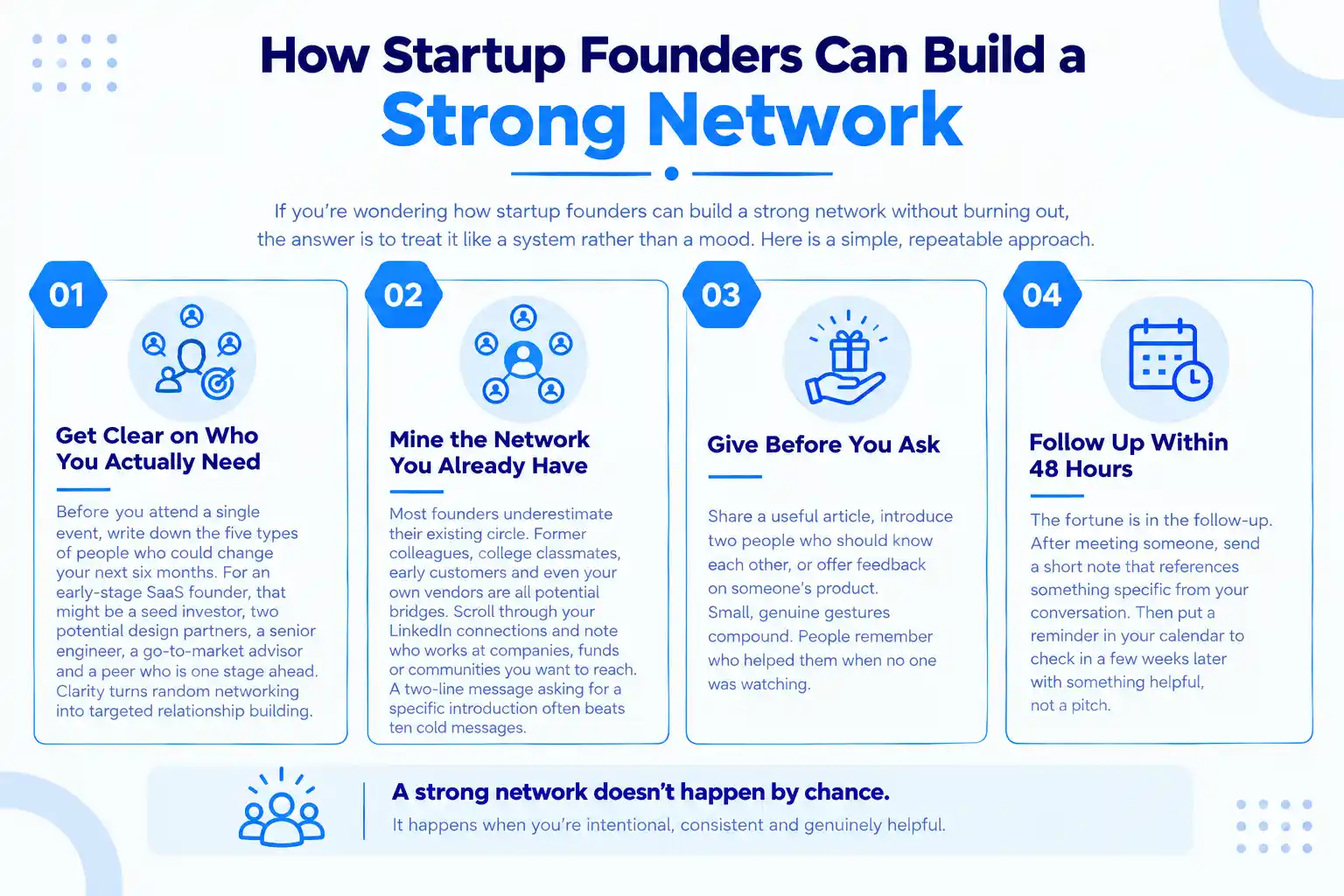
If you’re wondering how startup founders can build a strong network without burning out, the answer is to treat it like a system rather than a mood. Here is a simple, repeatable approach.
Step 1: Get Clear on Who You Actually Need
Before you attend a single event, write down the five types of people who could change your next six months. For an early-stage SaaS founder, that might be a seed investor, two potential design partners, a senior engineer, a go-to-market advisor and a peer who is one stage ahead. Clarity turns random networking into targeted relationship building.
Step 2: Mine the Network You Already Have
Most founders underestimate their existing circle. Former colleagues, college classmates, early customers and even your own vendors are all potential bridges. Scroll through your LinkedIn connections and note who works at companies, funds or communities you want to reach. A two-line message asking for a specific introduction often beats ten cold messages.
Step 3: Give Before You Ask
Share a useful article, introduce two people who should know each other, or offer feedback on someone’s product. Small, genuine gestures compound. People remember who helped them when no one was watching.
Step 4: Follow Up Within 48 Hours
The fortune is in the follow-up. After meeting someone, send a short note that references something specific from your conversation. Then put a reminder in your calendar to check in a few weeks later with something helpful, not a pitch. This habit alone makes the best startup founder networking strategies resources actually work in practice.
Best Networking Platforms for Startup Founders
Not every platform deserves your energy. When people search for the best networking platforms for startup founders, they usually want a short list of places where real conversations happen. Here’s where we’d focus in 2027.
LinkedIn remains the strongest place for B2B founders. It’s where investors, executives and marketing heads actually check messages. Optimize your headline around the problem you solve, post a few times a week about what you’re learning, and comment thoughtfully on other founders’ posts.
Personalized connection requests with a clear reason convert far better than generic ones. If you’re building a cold outreach routine, read our guide on writing LinkedIn outreach messages that get replies.
X (Twitter) and Threads
These platforms are still where many tech and startup conversations unfold in public. Building in public, sharing metrics and joining conversations around launches can attract investors and early adopters organically.
Slack, Discord and WhatsApp Groups
Private group chats are where the candid advice lives. Many invite-only founder groups run on Slack or Discord, and they’re often more valuable than any public feed because people speak honestly about hiring, fundraising and mistakes.
Events, Demo Days and Meetups
In-person still wins for depth. Startup weekends, accelerator demo days, industry conferences and local founder meetups let you build rapport in minutes that might take months online. Pick two or three events a quarter rather than attending everything.
Startup Founder Communities Worth Joining
Good startup founder communities give you three things: peers who understand your stress, mentors who’ve been there, and a steady stream of opportunities.
When you evaluate startup founder networking strategies resources, communities should sit near the top of your list because they offer continuous access rather than one-off meetings.
Look for communities that match your stage and your market. A pre-seed solo founder needs a different circle than a Series A CEO.
Accelerator alumni networks, founder-led Slack groups, regional startup hubs and industry-specific collectives all fit the bill. Before you join, check how active the members are, how moderators handle spam, and whether people actually share wins and failures.
Entrepreneur Networking Groups
Organized entrepreneur networking groups, such as peer forums, mastermind circles and local chambers of commerce, add structure that casual communities lack. Regular meetings create accountability, and the smaller size means members get to know each other properly. A monthly mastermind with five or six founders can be worth more than a hundred shallow connections.
Online Startup Communities: Where to Find Your People
Online startup communities make it possible to build relationships across time zones, which is a huge advantage if you’re based outside a major startup hub. They’re also lower pressure for introverts, since you can contribute in writing and take your time.
To get real value from online startup communities, don’t just lurk. Answer questions in your area of expertise, share lessons from your own experiments, and send a thoughtful direct message when someone’s comment resonates.
Over a few months, that consistency makes you a familiar name, and familiarity is the foundation of trust. If you’re serious about scaling your visibility, pair community participation with a content plan, as we explain in our content marketing roadmap for startups.
Startup Referral Networks: The Fastest Path to Warm Intros
Startup referral networks are structured groups where members introduce each other to customers, partners, investors and talent. They can be formal (partner programs, investor syndicates, agency alliances) or informal (a trusted circle of founders who regularly pass leads to one another).
Here is how to get the most out of startup referral networks:
First, be specific about what you do and who you serve. People can’t refer you if they can’t explain you in one sentence. Second, make referrals easy by providing a short blurb they can forward. Third, return the favor generously and publicly.
Thank people who send business your way, and send business back whenever you can. Referral networks run on reciprocity, and the founders who give most freely tend to receive the most.
Startup Founder Networking Tips 2027
Want the short version? These startup founder networking tips 2027 will help you focus your effort where it counts.
Lead with curiosity. Ask people about their challenges before you talk about your product. You’ll learn more, and they’ll like you more.
Be consistent, not constant. Fifteen focused minutes a day beats a frantic week of events once a quarter.
Use AI as an assistant, not a mask. Let tools help you research people and draft messages, but always add your own voice. People can smell a templated note instantly.
Show up on video and audio. Podcast guest spots, live panels and short video posts build familiarity faster than text alone.
Document your journey. Writing about what you’re building gives people a reason to talk to you and gives search engines and AI assistants something to cite.
Protect your energy. Networking is a long game. Choose the formats that suit your personality and double down on them.
Founder Networking Best Practices You Can Start Today
If you remember nothing else, remember these founder networking best practices. They’re simple, but most people skip them.
- Make every outreach specific: mention a post, a talk or a mutual connection.
- Ask for one thing at a time, such as a 15-minute call or a single introduction.
- Respect people’s time by sharing context in advance and ending meetings on schedule.
- Keep a simple CRM or spreadsheet with notes on who you met, what you discussed and when to follow up.
- Celebrate other people’s wins publicly.
- Stay in touch when you don’t need anything.
These habits sound basic because they are. The difference is that a good set of startup founder networking strategies resources turns them into a routine you actually follow.
Building Professional Relationships That Last
Building professional relationships isn’t a numbers game. A handful of people who truly trust you will open more doors than a thousand LinkedIn connections who barely remember your name.
Think in terms of depth. Schedule occasional catch-up calls with your top twenty contacts. Send them relevant news, introduce them to people, and ask how you can help. When you do need support, whether you’re raising a round, hiring or looking for a pilot customer, you’ll be asking from a place of genuine connection rather than a cold start.
It also helps to be honest. Founders who share real numbers, real struggles and real lessons build trust faster than those who only post highlight reels. Vulnerability, used wisely, is a networking advantage.
Common Networking Mistakes Founders Make
Even smart founders stumble here. Watch out for these traps:
Pitching too early. Leading with a sales pitch kills conversations. Build rapport first.
Collecting contacts without following up. A business card without a follow-up is just paper.
Only networking when fundraising. People notice, and it feels transactional. Start building relationships long before you need them.
Ignoring peers. Founders often chase investors and forget that fellow founders are the best source of honest advice and referrals.
Spreading yourself thin. Joining ten communities means contributing to none. Pick a few and show up well.
How to Measure Whether Your Networking Is Working
Networking can feel fuzzy, so give it a few simple metrics. Track the number of meaningful conversations per month, warm introductions received, referrals sent and received, and opportunities that started from a relationship, such as customers, hires or investor meetings. Review the list every quarter. If a community or platform isn’t producing conversations after three months of genuine effort, shift your time elsewhere.
The most useful startup founder networking strategies resources are the ones you can measure and refine. A short monthly review of what worked keeps your approach sharp without turning it into a chore.
A Simple 30-Day Networking Plan
If you’re starting from zero, here’s an easy way to begin. In week one, refine your LinkedIn profile and list the five types of people you want to meet.
During week two, join two online startup communities and contribute helpfully every day. By week three, send ten personalized messages asking for short conversations, and request three warm introductions from your existing contacts.
In week four, attend one event or virtual meetup, follow up with everyone you met, and review what worked. Repeat the cycle each month and adjust. By the end of a quarter, you’ll have a noticeably stronger network and a clear sense of which startup founder networking strategies resources deserve more of your time.
Conclusion
The founders who win in 2027 won’t just have the best product. They’ll have the best relationships. By choosing the right startup founder networking strategies resources, showing up consistently in the right communities, giving before asking and following up like a professional, you build an asset that compounds year after year.
Start small. Pick one platform, one community and one habit this week. Then keep going. Your next investor, customer, co-founder or champion is probably one genuine conversation away.
Ready to put these ideas to work? Explore our guide on building a founder-led content strategy or get in touch with our team to see how we help startups grow their visibility and authority online.
Frequently Asked Questions (FAQs)
What are the best startup founder networking strategies resources?
The best startup founder networking strategies resources include LinkedIn, private Slack and Discord founder groups, accelerator alumni networks, industry events, mastermind circles and structured startup referral networks. Combine at least one online platform with one in-person or small-group format for the strongest results.
How can startup founders build a strong network?
Start by defining who you need to meet, then reach out to your existing contacts for warm introductions. Join a few active founder communities, give help before asking for it, and follow up within 48 hours of every conversation. Consistency matters more than volume.
What are the best networking platforms for startup founders?
LinkedIn is the top choice for B2B founders, while X, Threads, Slack, Discord and WhatsApp groups are valuable for candid peer conversations. Local meetups, demo days and conferences add in-person depth.
Are online startup communities worth joining?
Yes, if you participate actively. Online startup communities give you access to peers, mentors and referral opportunities across time zones. Choose communities that match your stage and industry, and contribute regularly instead of only observing.
How often should founders network?
A sustainable rhythm is a little every day and a bit more every week, such as 15 minutes of outreach or community engagement daily, a few meaningful conversations weekly, and one or two events per quarter.