

Starting a business means making hundreds of decisions with limited time, money, and resources. Founders need to find customers, build reliable teams, understand their markets, and create a business that can grow. But trying to solve every problem alone can make the journey harder than it needs to be.
Sometimes, the right conversation can help a founder see a problem differently. A discussion with an experienced entrepreneur might reveal a better approach to customer acquisition. Meeting another business owner could lead to a partnership. Even a casual conversation with someone from a different industry might introduce an idea worth exploring.
This is why networking events can be valuable for startup founders. They create opportunities to exchange ideas, build professional relationships, learn from other entrepreneurs, and discover people who may contribute to future business growth.
However, attending an event is only the beginning. The real value comes from meeting relevant people, building trust, and turning useful conversations into long-term professional relationships.
1. Startup Growth Is Not Just About Having a Great Idea
A promising product or service is an important starting point, but it does not automatically guarantee business success.
A founder may have an excellent product but struggle to reach potential customers. Another may understand the market but lack the right technical partner. Some startups need experienced mentors, while others need suppliers, distributors, investors, or people who can provide honest feedback.
These challenges often require more than online research.
Talking to people who have faced similar situations can provide practical perspectives that are difficult to gain from theory alone. For example, a founder preparing to launch a software product might meet a marketing professional who has helped similar businesses reach their target audience. That conversation could lead to a useful introduction, a new marketing approach, or a potential collaboration.
Networking is not a replacement for research, planning, or execution. Instead, it gives founders access to relationships and perspectives that can support those activities.
2. What Can Founders Actually Gain From Networking Events?
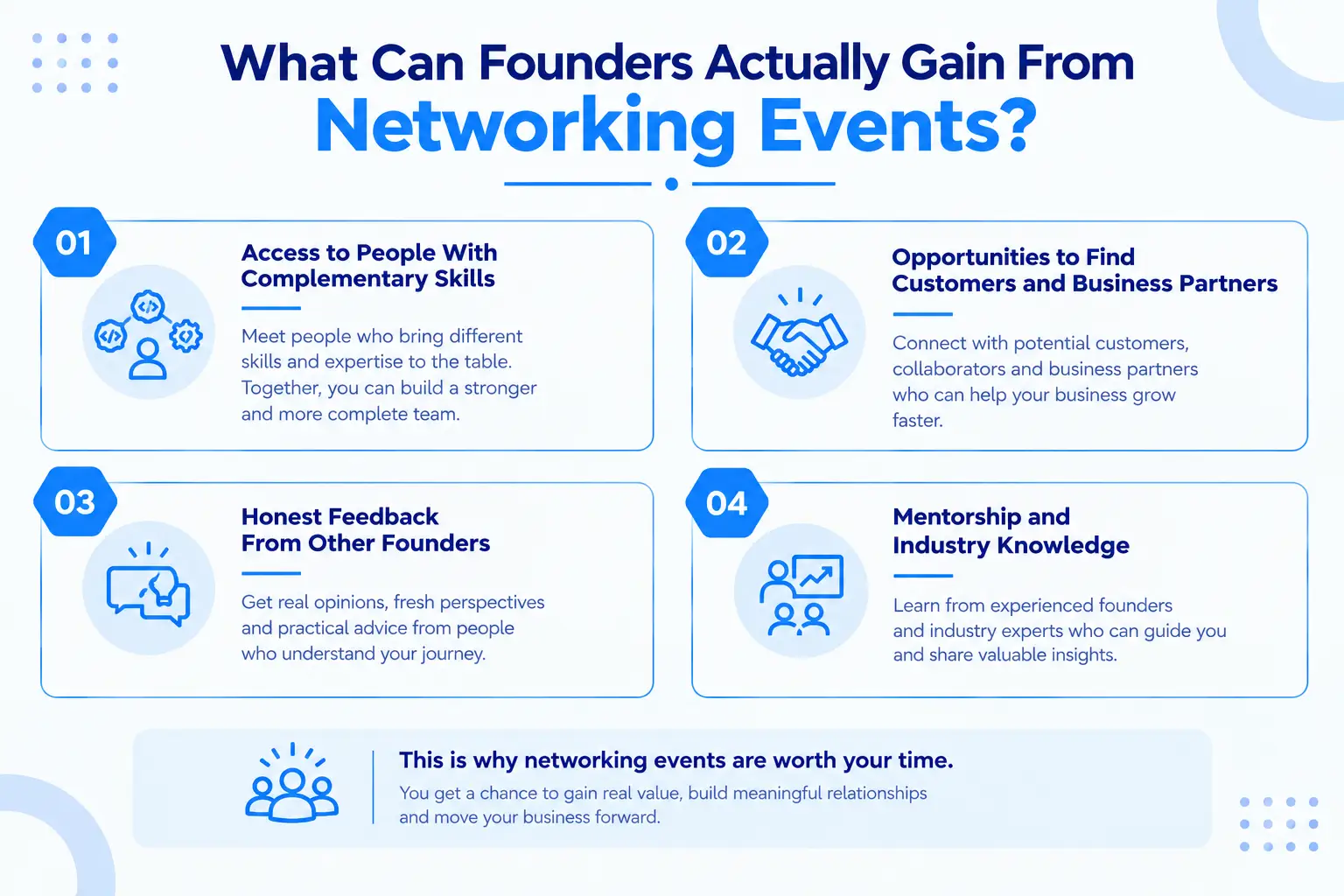
Not every event will generate a customer or partnership immediately. Nevertheless, the right gathering can open several doors over time.
2.1. Access to People With Complementary Skills
Early-stage startups often operate with small teams. One founder may be strong in product development but need help with sales. Another may understand marketing but lack technical expertise.
Meeting people with complementary skills can help founders identify potential collaborators instead of trying to manage every function themselves.
For instance, a founder developing a business management application could meet a consultant who regularly works with small businesses. The consultant may understand the problems potential users experience and help the founder refine the product or identify suitable pilot customers.
The relationship becomes valuable when both sides bring something useful to the table.
2.2. Opportunities to Find Customers and Business Partners
Business networking events can introduce founders to people who understand their industry, serve similar audiences, or need the solutions they offer.
Imagine a startup that provides website development services. At an event, its founder meets a branding consultant who regularly works with businesses launching new products. The two professionals could refer suitable clients to each other or develop a combined service package.
The opportunity does not have to result in an immediate sale. A relevant introduction, referral, or follow-up meeting can be the first step toward a business relationship.
The U.S. Small Business Administration also recommends networking with relevant business groups and collaborating with complementary business owners as ways to help new businesses find customers. Read its guidance on finding first customers.
2.3. Honest Feedback From Other Founders
Friends and family may support a founder’s idea, but they may not understand the challenges of building a business.
Meeting other founders creates opportunities to discuss pricing, customer expectations, hiring decisions, product launches, and operational problems with people who have faced similar situations.
Suppose a founder is struggling to convert product demonstrations into paying customers. A conversation with another startup founder may reveal that the problem lies in the onboarding experience rather than the product itself.
Feedback does not always provide a ready-made solution, but it can help founders ask better questions and avoid relying entirely on assumptions.
2.4. Mentorship and Industry Knowledge
Experience can save founders time, particularly when they are making unfamiliar business decisions.
Professional networking events may bring together experienced business owners, consultants, industry specialists, and early-stage entrepreneurs. These interactions can help founders learn about market expectations, business operations, and common mistakes.
A brief conversation may also lead to a more detailed discussion later. Founders should remember, though, that meeting an experienced professional does not automatically create a mentoring relationship. Mentorship develops through mutual interest, respect, and consistent communication.
3. Startup Networking Events vs. General Business Events
Different events serve different purposes. Choosing the right one depends on what a founder wants to achieve.
Event type | Best suited for | Potential value |
Startup networking events | Early-stage founders and startup teams | Peer connections, collaboration, and startup insights |
Business networking events | Business owners and service providers | Referrals, customers, and partnerships |
Professional networking events | Professionals and industry specialists | Knowledge exchange and career or business connections |
Entrepreneur networking events | Entrepreneurs at different stages | Shared experiences, ideas, and business relationships |
Founder networking events | Startup founders and co-founders | Founder-to-founder learning and potential collaborations |
The best option is not necessarily the largest event. A smaller gathering with relevant attendees can be more useful than a crowded event where most conversations have little connection to your business goals.
Before registering, review the event’s audience, discussion topics, format, and opportunities for interaction. A clear match between your goals and the attendees makes it easier to use your time effectively.
4. How to Make Every Networking Event More Valuable
Attending an event without a plan can leave founders with a handful of contacts but very few meaningful connections. A simple approach can make conversations more productive.
4.1. Before the Event: Know What You Need
Start by identifying one or two goals. You might want feedback on a new product, introductions to potential customers, or conversations with founders who understand a particular industry.
Research the event and prepare a short introduction explaining what your startup does, whom it helps, and what problem it solves.
Avoid preparing a long sales pitch. A clear introduction gives the other person enough context to ask questions and continue the conversation naturally.
4.2. During the Event: Ask Better Questions
Good networking is not about speaking to as many people as possible. It is about having relevant conversations.
Instead of immediately explaining your product, ask people about their work, current priorities, and challenges. Listen carefully and look for shared interests or areas where you can help.
For example, asking another founder, “What is the biggest challenge your team is working on right now?” can create a more meaningful discussion than simply exchanging job titles.
You should also be comfortable acknowledging when there is no obvious fit. Not every conversation needs to become a partnership, and respectful interactions can still create a positive professional impression.
4.3. After the Event: Turn Conversations Into Relationships
Following up is where many networking opportunities are either developed or lost.
Within a day or two, send a short message mentioning something specific from your conversation. If you promised to share a resource, make an introduction, or send additional information, complete that action.
The Small Business Administration recommends following up with new contacts after networking events and taking action on any next steps discussed. Explore its networking guidance.
Do not ask for a major favour immediately after meeting someone. Start with a relevant conversation, share something useful, and allow trust to develop naturally.
5. Why Consistent Networking Matters More Than One Event
One event might introduce you to a potential partner. Another could help you understand a customer problem. A later conversation might connect you with someone who can help your business expand.
These outcomes are not guaranteed, and relationships rarely develop overnight. Their value often increases when people continue to interact, exchange knowledge, and learn how they can support each other.
This is one reason networking events for startups should be viewed as part of a longer-term relationship-building strategy rather than a one-time marketing activity.
Founders can make networking more consistent by choosing a few relevant communities, attending regularly, participating in discussions, and maintaining contact with people they meet.
Over time, familiar faces can become trusted professional contacts. Some relationships may lead to referrals or partnerships, while others may simply provide useful perspectives when a difficult decision arises.
6. Finding the Best Networking Events in India
India’s startup ecosystem includes founders, investors, service providers, business associations, incubators, and professional communities. However, the most suitable event depends on your location, industry, business stage, and objectives.
If you are searching for the best networking events in India, consider exploring:
- Startup incubators and accelerators: Look for founder sessions, mentoring opportunities, and industry discussions.
- Industry conferences: Choose events where potential customers, partners, or specialists from your sector are likely to participate.
- Local business communities: These can help founders meet nearby entrepreneurs and explore regional partnerships.
- Workshops and founder meetups: Smaller, discussion-led gatherings may offer more time for meaningful conversations.
- Online networking sessions: Virtual events can make it easier to connect with people outside your city.
Before paying an event fee, check the attendee profile, agenda, organiser credibility, and expected opportunities to interact. Some events are designed mainly for learning, while others focus on introductions, partnerships, or investment discussions.
Choose based on the value the event can realistically offer your business, not just its popularity.
7. Building Stronger Connections Through eRoof Community
Finding relevant people is only one part of networking. Founders also need opportunities to continue conversations, exchange ideas, and develop relationships beyond a single meeting.
eRoof Community can be positioned as a place for entrepreneurs and business owners to connect, explore shared interests, and discover opportunities for collaboration. For founders, participating in a relevant business community can complement in-person events by helping them maintain relationships and stay engaged with other professionals.
The key is active participation. Share useful insights, ask thoughtful questions, learn about other members’ businesses, and look for opportunities to contribute. Rather than approaching every connection as a potential sale, focus on creating relationships that offer mutual value.
Looking to expand your business network? Explore eRoof Community to learn more about the platform and how it may fit your networking goals.
Editorial note: Before publishing, verify that the specific community features, events, and membership options mentioned on the eRoof website are currently available. Avoid promising introductions, leads, or business results unless these are supported by the service.
8. A Simple Way to Measure Networking Success
Founders often judge networking by the number of business cards collected or contacts added on LinkedIn. Those numbers may show activity, but they do not necessarily show progress.
A more useful approach is to track what happens after an event.
What to track | Why it matters |
Relevant new contacts | Shows whether you are meeting the right audience |
Follow-up conversations | Indicates whether initial discussions are continuing |
Useful introductions | Measures access to relevant people or resources |
Collaboration discussions | Identifies possible partnership opportunities |
Qualified business leads | Connects networking activity with potential revenue |
Long-term relationships | Shows whether your network is becoming more valuable over time |
Review these outcomes regularly. If an event repeatedly attracts people who are unrelated to your goals, try a different format or community. If certain gatherings lead to useful conversations, consider participating more consistently.
The aim is not to turn every interaction into a sales opportunity. It is to build a network that supports learning, collaboration, and sustainable business development.
Conclusion
Building a startup can be challenging, especially when founders try to solve every problem independently. The right professional relationships can provide new perspectives, access to complementary skills, customer introductions, and opportunities to collaborate.
That is what makes networking events valuable for startup founders. They create space for conversations that may develop into meaningful business relationships over time.
Success, however, depends on more than attending. Founders need to choose relevant events, listen carefully, offer value, follow up, and stay connected.
Start with one clear goal, find the people who can help you learn or collaborate, and build relationships consistently. A single conversation may not change your business immediately, but the right network can become an important resource as your startup grows.
10. Frequently Asked Questions
1. Why are networking events important for startup founders?
Networking events help startup founders meet other entrepreneurs, exchange ideas, discover potential customers, find collaborators, and learn from people with relevant business experience.
2. How do startup networking events help businesses grow?
They can create opportunities for referrals, partnerships, customer introductions, knowledge sharing, and collaboration. The results depend on the event’s relevance and how founders maintain the relationships they build.
3. How can founders find relevant networking events?
Founders can explore startup incubators, accelerators, industry associations, local business communities, professional groups, conferences, and online event platforms. They should check the attendee profile and agenda before registering.
4. Are online networking events useful for entrepreneurs?
Yes. Online events can help founders meet people beyond their immediate location, exchange knowledge, and arrange follow-up conversations. Their effectiveness depends on audience relevance and meaningful participation.
.5. How should startup founders prepare for a networking event?
Set a clear goal, research the event, prepare a short introduction, and think of a few useful questions. After the event, follow up with relevant contacts and complete any actions you promised.