

Inside the Story
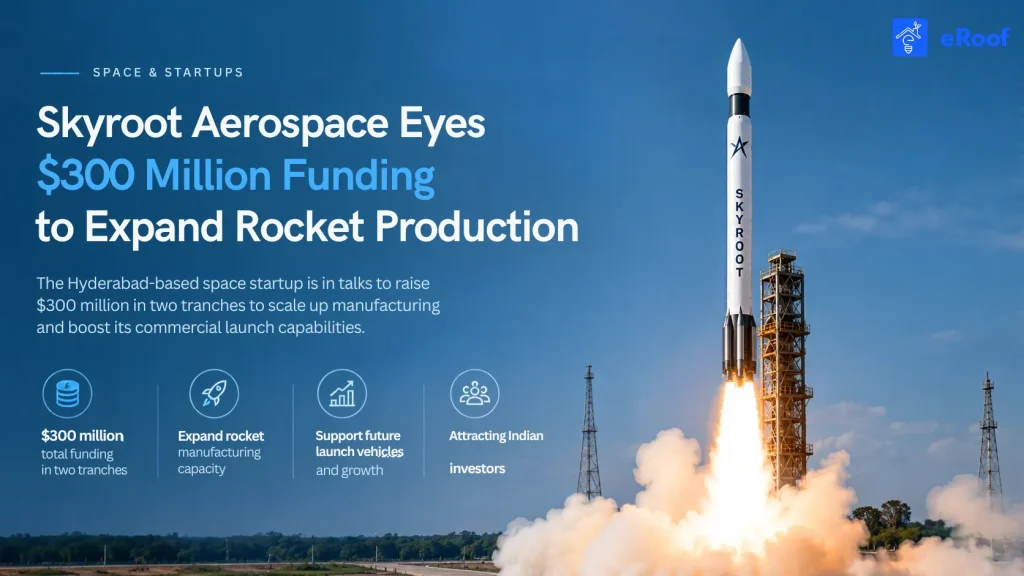
- Skyroot Aerospace is reportedly in talks to raise $300 million in two funding tranches.
- The Hyderabad-based startup aims to expand rocket production following its reported Vikram-1 orbital mission.
- The proposed investment could value the company at $2.3 billion to $3 billion, depending on the investor group.
- The development highlights growing investor interest in India’s private space technology industry.
The Story
Introduction
Skyroot Aerospace, a Hyderabad-based space technology startup, is reportedly in discussions to raise $300 million to expand its rocket manufacturing capabilities and strengthen its commercial launch operations. According to an October 15, 2026, report by The Economic Times, the proposed funding is being discussed in two tranches, with different valuations for domestic and international investors.
The company is seeking $150 million from Indian family offices at a valuation of $2.3 billion to $2.5 billion and another $150 million from global investors at a valuation of up to $3 billion.
The discussions are ongoing, and the final investment terms have not been confirmed.
The proposed fundraising comes as commercial space technology attracts increasing investor attention. For Skyroot, the capital could help increase rocket production, develop launch capabilities and serve a growing market for satellite launches.
The development also reflects the expanding role of private companies in India’s space industry.
Background: How Skyroot Aerospace Started
Skyroot Aerospace was founded in 2018 by Pawan Kumar Chandana and Naga Bharath Daka, both former scientists at the Indian Space Research Organisation (ISRO). The company is headquartered in Hyderabad and focuses on developing launch vehicles designed to carry satellites into space.
India’s space industry historically depended heavily on government-led programmes. However, policy changes that opened more opportunities for private businesses have encouraged startups to develop rockets, satellite systems, propulsion technologies and other space-related services.
Skyroot has emerged as one of the country’s most prominent private space companies.
In May 2026, it raised $60 million in a funding round led by Sherpalo Ventures and Singapore’s GIC, with participation from other investors.
The round valued the company at approximately $1.1 billion, making it India’s first space technology unicorn, according to Reuters
The company is developing its Vikram series of launch vehicles to provide launch services for small satellites. Its business model targets customers seeking access to space without having to develop their own rockets or rely exclusively on larger launch providers.
Main Development: A Proposed $300 Million Funding Round
The latest fundraising discussions indicate that Skyroot is seeking substantial capital to move from technology development towards larger-scale commercial operations.
According to The Economic Times, the proposed investment is structured in two parts:
- Indian investment: The company is reportedly seeking $150 million from Indian family offices at a valuation of $2.3 billion to $2.5 billion.
- International investment: Another $150 million is being discussed with global investors, including General Catalyst, General Atlantic and Benchmark, at a valuation of up to $3 billion
The proposed structure gives different investor groups an opportunity to participate at different valuations. The report suggests that offering domestic investors a lower valuation is intended to retain a greater share of ownership in Indian hands.
If completed on the reported terms, the funding round would represent a substantial increase from the company’s May 2026 valuation of $1.1 billion. However, a proposed valuation is not the same as a completed transaction, and the final terms could change during negotiations.
The funding is intended to support the company’s efforts to scale rocket production. Manufacturing launch vehicles requires specialised engineering, testing infrastructure, skilled personnel and strict quality controls. Increasing production capacity could help Skyroot prepare for more launches and meet customer demand as its commercial operations develop.
The company’s broader plans also include advancing its rocket technology and strengthening its ability to support different satellite missions. Its earlier funding announcement identified increasing Vikram-1 launch frequency, scaling manufacturing and developing the Vikram-2 vehicle as priorities.
Industry Impact: What It Means for India's Space Sector
The proposed investment could have implications beyond Skyroot itself. A larger and better-funded private launch provider may create opportunities for suppliers, engineering companies, manufacturers and other businesses participating in the space technology ecosystem.
- Opportunities for Indian businesses
Rocket manufacturing depends on a network of specialised suppliers that provide materials, electronic components, propulsion systems, testing services and precision-engineered parts. If Skyroot expands production, qualified suppliers could gain opportunities to participate in its supply chain. Actual business gains will depend on production plans, procurement requirements and confirmed launch schedules.
- Growth in the satellite launch market
Satellites support applications such as telecommunications, weather forecasting, agricultural monitoring, navigation and Earth observation. Businesses developing these technologies need reliable access to launch services.
By developing dedicated launch vehicles for smaller payloads, Skyroot aims to serve customers seeking more flexible access to orbit. Greater launch capacity could support the growth of India’s satellite and space services businesses.
- Increased competition
The global launch market includes established providers and emerging private space companies. Additional capital could help Skyroot improve manufacturing capacity, develop its technology and compete for commercial contracts. Nevertheless, competition depends on launch reliability, pricing, delivery schedules, payload capacity and customer confidence—not funding alone.
- Greater investor interest in deep technology
Deep-tech companies often need significant investment before their products reach commercial scale. Space technology is particularly capital-intensive because rockets require extensive engineering, testing and specialised infrastructure.
Skyroot’s reported fundraising discussions could encourage investors to examine other Indian companies working in advanced manufacturing, satellite systems, robotics and aerospace engineering. However, investment interest does not guarantee that every startup in these sectors will secure funding or achieve commercial success.
Expanding rocket production involves substantial technical and commercial risks. Launch failures, delays, rising manufacturing costs and limited customer demand can affect a company’s growth. Skyroot will need to demonstrate consistent performance and build a dependable commercial launch schedule to turn investment into sustainable revenue.
Conclusion
Skyroot Aerospace’s reported $300 million fundraising discussions mark a potentially important development for India’s private space technology industry. The proposed investment could help the company expand rocket production, strengthen its commercial launch capabilities and pursue new opportunities in the satellite market.
For Indian entrepreneurs and businesses, the development highlights the growing importance of advanced manufacturing, engineering expertise and private investment in emerging technology sectors. However, the funding remains under discussion, and the final valuation, investor commitments and use of proceeds will depend on the outcome of negotiations.
If Skyroot successfully secures the proposed capital and converts its manufacturing plans into reliable commercial operations, it could strengthen its position in India’s growing space ecosystem.
Technical Terms Explained
- SpaceTech: Technology used for space exploration, satellite operations, rockets and related services.
- Funding Round: A process in which a company raises money from investors to support its business plans.
- Valuation: The estimated financial worth of a company at a particular point in time.
- Family Offices: Organisations that manage the investments and financial affairs of wealthy individuals or families.
- Deep Tech: Businesses based on advanced scientific or engineering innovations that often require extensive research and development.
- Launch Vehicle: A rocket designed to transport satellites or other payloads into space.
- Orbital Mission: A mission intended to place a spacecraft or satellite into an orbit around Earth or another celestial body.
- Payload: The satellite, equipment or other cargo carried by a rocket.
- Manufacturing Capacity: The amount of products a company can produce within a particular period.
- Commercial Launch: A rocket launch service provided to customers for business purposes, such as deploying satellites into orbit.