

Inside the Story
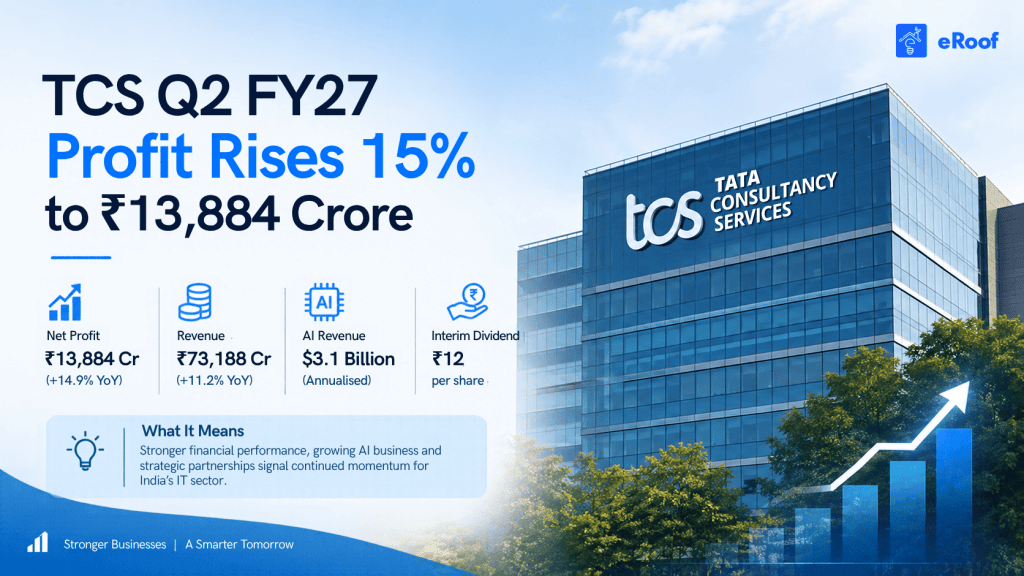
- TCS reports 14.9% year-on-year growth in consolidated net profit.
- Revenue increases 11.2% to ₹73,188 crore in Q2 FY27.
- Annualised AI revenue crosses $3.1 billion as demand expands.
- A ₹12-per-share interim dividend is announced for eligible shareholders.
The Story
Introduction: TCS Reports Stronger Quarterly Profit
Tata Consultancy Services (TCS), one of India’s largest information technology services companies, reported a 14.9% year-on-year increase in consolidated net profit to ₹13,884 crore for the second quarter of the financial year 2026–27 (Q2 FY27), covering July to September 2026.
The company announced its results on October 8, 2026, highlighting revenue growth, expanding artificial intelligence (AI) business and continued demand for technology transformation services.
TCS’s revenue from operations increased 11.2% to ₹73,188 crore, compared with ₹65,799 crore in the corresponding quarter of the previous financial year. However, growth was more modest when measured sequentially in constant-currency terms, with revenue increasing by 0.5% over the preceding quarter.
The company also reported annualised AI revenue of $3.1 billion, demonstrating the growing importance of AI-related services in its business. Its operating margin stood at 24%, while the net margin reached 19%. The results highlight a technology sector balancing opportunities from AI adoption with continued pressure on traditional IT spending and operating costs.
Source: TCS’s official Q2 FY27 financial results and reporting by Reuters.
Background: Understanding TCS and Its Business
Founded in 1968, Tata Consultancy Services is part of the Tata Group and has grown into a major global provider of IT services, consulting and business solutions. Headquartered in Mumbai, the company serves clients across industries, including banking, financial services, manufacturing, retail, telecommunications, healthcare and technology.
TCS helps organisations modernise their technology infrastructure, develop software, manage digital operations, strengthen cybersecurity and implement data-driven business solutions. Its international presence gives it access to enterprise customers across North America, Europe, the United Kingdom, Asia-Pacific and other markets.
Over the years, the company has played an important role in establishing India as a global destination for technology services and business process operations. Its workforce, international client relationships and large-scale delivery capabilities have also contributed to India’s position in the global IT services industry.
Today, TCS is navigating another major technological transition. Businesses are increasingly exploring generative AI, automated workflows, cloud computing and advanced analytics to improve productivity and reduce operating costs. This shift creates new opportunities for technology providers, but it also encourages customers to reassess traditional outsourcing models and the amount they spend on established IT services.
Main Development: Profit Growth, AI Revenue and New Partnerships
The latest quarterly results show that TCS continued to expand its financial performance despite an uneven global technology spending environment.
1. Net profit and revenue increase
Consolidated net profit rose from ₹12,075 crore in the year-ago quarter to ₹13,884 crore in Q2 FY27. Revenue from operations increased by approximately ₹7,389 crore over the same period.
The increase indicates that TCS maintained year-on-year financial growth. However, the reported revenue growth should not be interpreted as equally strong growth in every market or service line. Foreign-exchange movements and differences between reported and constant-currency measurements can affect the comparison.
2. AI becomes a larger business opportunity
One of the most significant developments was the company’s annualised AI revenue crossing $3.1 billion. This figure reflects the growing contribution of AI-related services to TCS’s business.
Companies across industries are exploring AI for customer support, software development, business analytics, process automation and enterprise system modernisation. TCS is positioning its services to help clients adopt these technologies and integrate them into existing operations.
For technology companies, the opportunity extends beyond selling AI tools. Organisations also need implementation, data management, cybersecurity, governance and ongoing support. These requirements can create additional business for IT service providers.
Nevertheless, AI growth does not automatically guarantee faster overall revenue expansion. Customers may also use automation to reduce the amount of traditional technology work they outsource, creating pressure on established service models.
3. New strategic partnerships support transformation services
During the quarter, TCS announced major strategic developments involving Porsche AG and Best Buy.
The company highlighted a five-year strategic partnership with Porsche and the acquisition of MHP, Porsche’s Germany-based management and IT consulting subsidiary. TCS also announced an agreement to transition Best Buy’s Global Capability Center in India to TCS and transform it into an AI Capability Center.
These developments reflect a broader shift towards long-term partnerships focused on business transformation rather than isolated technology projects. Such arrangements can give service providers opportunities to support clients across technology development, operational improvements and AI implementation.
4. Operating performance and dividend announcement
TCS reported an operating margin of 24% and a net margin of 19%. Its total contract value (TCV), a measure of the value of contracts signed during the period, reached $9.6 billion.
The company’s board also declared a second interim dividend of ₹12 per equity share for FY27. The announced record date was October 14, 2026, and the payment date was October 30, 2026, according to the company’s official results.
Investors should note that a declared dividend is a distribution to eligible shareholders; it does not guarantee future share-price performance or future dividend levels.
Industry Impact: What the Results Mean for India
TCS’s results provide useful insight into the direction of India’s IT services sector. The combination of higher reported profit, growing AI revenue and large strategic partnerships suggests that technology transformation remains an important area of enterprise spending.
Opportunities for Indian businesses: Small and medium-sized enterprises can benefit from more accessible AI, cloud and automation services. These technologies may help businesses streamline customer service, improve reporting and reduce repetitive administrative work. However, adoption costs, data quality and employee training remain important considerations.
Implications for employment and skills: The expansion of AI-related services increases the importance of skills in data engineering, cybersecurity, cloud platforms, AI implementation and business consulting. Technology professionals may need to develop new capabilities as routine tasks become increasingly automated.
Effects on competitors: Other Indian IT companies are also expanding their AI offerings and pursuing large enterprise contracts. TCS’s results reinforce the importance of combining technology expertise with measurable business outcomes, strong client relationships and efficient delivery.
Considerations for investors: Profit and revenue growth are important indicators, but investors should also examine constant-currency growth, operating margins, contract wins and future demand. TCS’s modest sequential constant-currency growth shows why a higher year-on-year profit figure should be considered alongside the broader operating environment.
For India’s business ecosystem, the key question is how effectively established IT companies can convert AI demand into sustainable revenue growth while adapting their workforce, pricing models and service delivery.
Conclusion
TCS’s Q2 FY27 results demonstrate continued financial growth, with consolidated net profit rising 14.9% year-on-year to ₹13,884 crore and revenue increasing 11.2% to ₹73,188 crore. Annualised AI revenue of $3.1 billion and strategic partnerships involving Porsche and Best Buy underline the company’s focus on enterprise transformation.
At the same time, sequential constant-currency growth of 0.5% indicates that the broader demand environment remains challenging. For Indian businesses, technology professionals and investors, TCS’s performance highlights both the opportunities created by AI and the importance of adapting to changing customer needs.
The company’s future performance will depend on how successfully it converts AI demand and strategic contract wins into sustained growth, protects profitability and continues to deliver measurable value to clients.
Technical Terms Explained
Consolidated Net Profit: The total profit earned by a company and its subsidiaries after expenses and taxes.
Revenue from Operations: Income generated from a company’s main business activities, such as IT services and consulting.
Year-on-Year (YoY) Growth: A comparison of financial performance with the same period in the previous year.
Constant-Currency Growth: Revenue growth calculated using consistent exchange rates to minimise the effect of currency fluctuations.
Artificial Intelligence (AI): Technology that enables computers to perform tasks such as analysing data, generating content and automating processes.
Operating Margin: The percentage of revenue remaining after operating expenses are deducted, before interest and taxes.
Total Contract Value (TCV): The total value of customer contracts signed during a specified period.
Interim Dividend: A payment distributed to eligible shareholders before a company’s final annual dividend is declared.