

Inside the Story
- RBI’s October MPC decision is due today, with markets watching the repo rate and policy guidance.
- The repo rate has remained at 5.25% through the last four policy reviews.
- Inflation, crude oil prices, the rupee and global interest rates are increasing pressure on monetary policy.
- Banking, real estate, automobiles, bonds and equities could react to the RBI’s decision.
The Story
Introduction
India’s financial markets are heading into a closely watched Reserve Bank of India (RBI) monetary policy decision today, October 7, 2026. The RBI’s six-member Monetary Policy Committee (MPC) has been meeting from October 5 to October 7, with Governor Sanjay Malhotra scheduled to announce the policy decision at 10:00 AM IST.
The key question for investors is whether the central bank will increase the policy repo rate after keeping it unchanged at 5.25% for four consecutive policy reviews. A rate hike would be the first increase since February 2023 and could influence borrowing costs, bond yields, banking stocks, the rupee and interest-rate-sensitive sectors.
Importantly, as of the morning of October 7, the RBI had not yet announced the decision. Market expectations have been leaning toward a 25-basis-point increase, but that remains an expectation rather than a confirmed outcome. A Reuters poll found 35 of 61 economists expected a 25-basis-point hike, while 26 expected the RBI to leave rates unchanged.
Background: Why the RBI Decision Matters
The RBI uses monetary policy to balance economic growth with price stability. The repo rate is particularly important because it influences the cost at which liquidity is provided to the banking system and eventually affects lending and deposit rates across the economy.
At its August policy meeting, the RBI maintained the repo rate at 5.25% and retained its neutral policy stance. The central bank had previously reduced the policy rate by a cumulative 125 basis points during 2025 before pausing its easing cycle.
The economic environment has changed since those rate cuts. Retail inflation increased to 4.82% in August, moving above the RBI’s 4% medium-term target for the third consecutive month. At the same time, rising global energy prices and geopolitical tensions have increased concerns about future inflation.
Main Development: Markets Await the October Decision
The possibility of a rate hike has placed Indian markets under pressure ahead of the announcement.
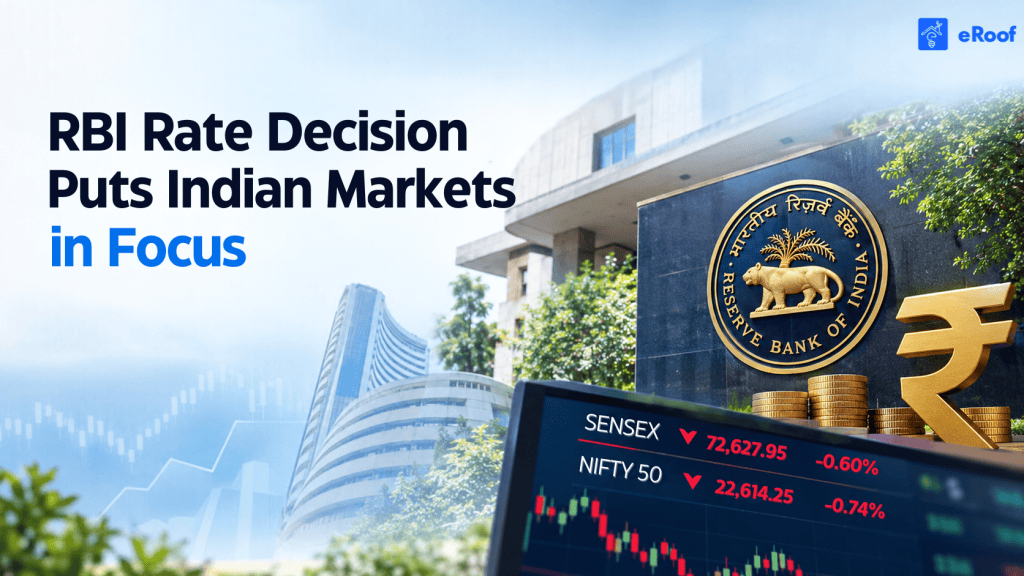
Indian shares opened lower on October 7 as investors waited for the RBI decision. Reuters reported that the Nifty 50 fell 0.74% to 22,614.25, while the Sensex declined 0.60% to 72,627.95 shortly after the market opened. All 16 major sectoral indices were lower at that point.
The rupee is another major focus. Reuters reported that traders expected the rupee to open around ₹96.44–₹96.46 per US dollar, compared with its previous close of ₹96.42. Investors are watching whether the RBI uses the rate decision and liquidity-management measures to support financial stability and the currency.
A 25-basis-point hike would take the repo rate from 5.25% to 5.50%. Such a move could make borrowing more expensive over time, although the actual impact on consumers and businesses would depend on how banks transmit the policy change to lending rates.
The market reaction will also depend heavily on the RBI’s communication. Investors are likely to examine Governor Sanjay Malhotra’s comments about inflation, crude oil prices, liquidity, economic growth and the possibility of further rate adjustments.
Impact on Businesses and Consumers
For businesses, interest rates can influence expansion plans, working capital costs and investment decisions. Companies that rely heavily on bank financing could face higher borrowing costs if lending rates rise.
Banks and NBFCs: Higher rates can improve lending yields in some circumstances, but they can also affect loan demand and funding costs.
Real estate: Higher borrowing costs can make home loans and property financing more expensive, potentially affecting housing demand.
Automobiles: Vehicle purchases are often financed through loans, so higher interest rates can influence consumer affordability.
MSMEs: Small businesses that depend on working-capital loans may experience increased financing costs if banks raise lending rates following an RBI hike.
Equity markets: Higher rates can put pressure on valuations because investors may become more cautious about growth-oriented assets.
Fixed-income investors: Bond yields and fixed-income instruments could react immediately to the RBI’s decision and its future policy guidance.
Industry Impact on India
The RBI decision comes at a particularly important time for India’s economy because domestic growth remains resilient while inflationary and external risks are increasing.
The central bank had previously projected real GDP growth of 6.7% for FY27, supported by domestic demand, manufacturing, services and exports
However, higher crude oil prices represent a major external risk. India imports a significant portion of its energy requirements, meaning a sustained rise in oil prices can increase import costs, put pressure on inflation and affect the country’s external balance.
The rupee’s performance is also closely connected to global interest rates and capital flows. Reuters reported that the rupee had weakened by around 6% against the US dollar during 2026, while foreign investors had been withdrawing funds from Indian equities and debt markets.
This creates a difficult policy balance for the RBI. A rate increase could help contain inflationary expectations and support the currency, but tighter monetary conditions could also increase financing costs for businesses and households.
For Indian entrepreneurs and MSMEs, the policy decision therefore goes beyond stock-market movements. It can influence access to credit, business expansion, equipment purchases, working capital and investment confidence.
What Investors Will Watch Next
The immediate market reaction will depend not only on whether the RBI changes the repo rate but also on what the central bank signals about future policy.
If the RBI raises rates but indicates that the move is primarily aimed at addressing temporary inflationary pressures, markets could interpret the decision differently than if the central bank signals a prolonged tightening cycle.
Investors will therefore focus on three major areas: the repo rate, the policy stance and the Governor’s forward guidance.
The October policy decision is particularly important because markets have already priced in a significant possibility of a 25-basis-point increase. Reuters reported that swap markets had already incorporated expectations of such a move, although a hold or a larger move could trigger a different market reaction.
For businesses, the larger question is whether borrowing costs remain manageable while India’s growth momentum continues. For investors, the focus will be on whether the RBI can control inflation without unnecessarily weakening economic activity.
Conclusion
The RBI’s October 2026 policy decision has placed Indian financial markets at a critical juncture. With inflation rising, crude oil prices elevated, the rupee under pressure and global interest rates creating additional uncertainty, the central bank faces a delicate balance between price stability and economic growth.
Whether the RBI raises the repo rate or keeps it unchanged, its guidance on future monetary policy may be just as important as the decision itself. Investors, businesses, borrowers and savers will closely monitor the announcement for signals about the direction of India’s economy in the months ahead.
Technical Terms Explained
- Repo Rate – The rate at which the RBI provides short-term liquidity to banks against eligible securities.
- Monetary Policy Committee (MPC) – The six-member committee responsible for determining India’s policy repo rate.
- Basis Point (bps) – One basis point equals 0.01 percentage point. A 25-bps hike means a 0.25 percentage-point increase.
- Inflation – The sustained increase in the general prices of goods and services.
- Policy Stance – The RBI’s broad approach toward monetary policy, such as neutral, accommodative or tightening.
- Liquidity – The amount of money and readily available funds circulating through the financial system.
- Bond Yield – The return an investor receives from holding a bond, expressed as a percentage of its price.
- Forward Guidance – Signals from a central bank about the likely future direction of monetary policy.