

Inside the Story
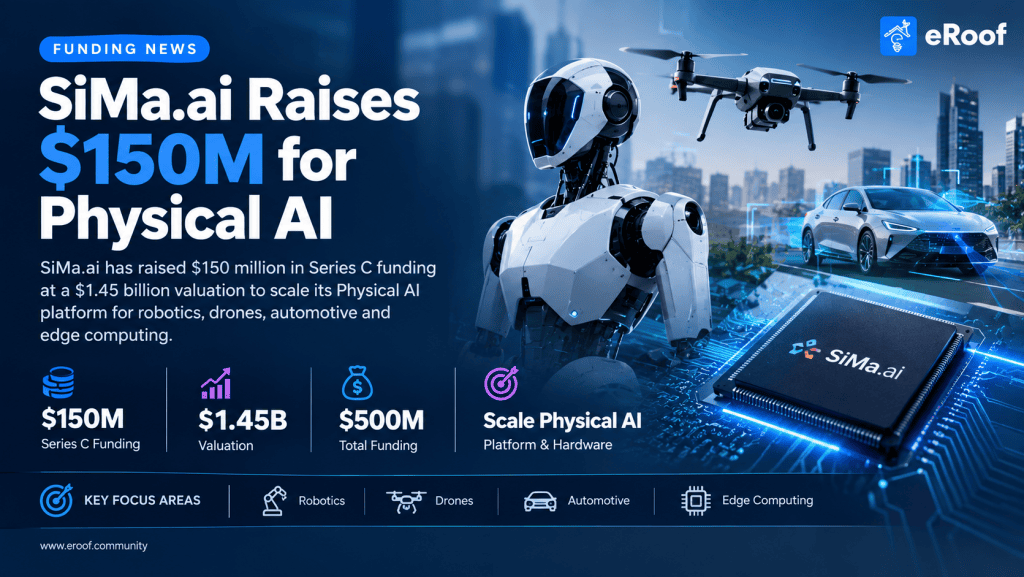
Ma.ai raises $150M in Series C funding
Company valuation reaches $1.45B.
Total funding rises to $500M.
Capital will scale its Physical AI platform.
The Story
Introduction
SiMa.ai has raised $150 million in Series C funding to expand its Physical AI technology for robotics, drones, automotive systems and other real-world applications. The round was co-led by Fidelity Management & Research Company and Amplify, with participation from existing investors and several new investors. The financing values the company at approximately $1.45 billion and brings its total capital raised to $500 million.
Founded by Krishna Rangasayee, SiMa.ai is a San Jose-based semiconductor and software company with a significant engineering presence in India. The company develops purpose-built computing technology designed to run AI directly on physical devices rather than relying entirely on remote cloud computing.
The new funding will be used to scale the company’s Palette Neat software environment and develop its next-generation hardware platform. SiMa.ai says its future products will include machine-learning intellectual property, chiplets and system-on-chips designed for applications such as drones, humanoid robots, automotive systems and AI-powered vehicle cockpits.
Background
SiMa.ai operates at the intersection of semiconductors, edge computing and artificial intelligence. Its focus is Physical AI, a term used for AI systems that operate in the physical world through machines such as robots, drones, vehicles and industrial equipment.
Unlike conventional AI applications that can perform tasks inside cloud or data-centre environments, Physical AI systems need to process information close to where it is generated. A drone, for example, may need to analyse camera data while flying rather than continuously sending large amounts of information to a remote server.
This creates specific requirements around power consumption, computing performance, size and latency. These requirements are particularly important for battery-powered devices such as drones and mobile robots.
SiMa.ai’s platform combines specialised silicon with software intended to simplify the process of deploying AI models on edge devices. The company says its technology supports computer vision, transformer-based models and generative AI workloads.
The company also has an established presence in India. Business Standard reported that SiMa.ai has around 90 employees in India, while Times of India reported a larger global workforce with roughly half based in Bengaluru. Workforce figures can change over time, so they should be treated as point-in-time company or media reports.
Main Development
The newly announced $150 million Series C is the company’s latest major financing round. Fidelity Management & Research Company and Amplify co-led the investment. Other participating investors include Alter Venture Partners, Dell Technologies Capital, Maverick Capital, +ND Capital, Point72 and StepStone Group. AllianceBernstein, Baron Capital, J.P. Morgan and the State of Michigan were among the new investors listed by SiMa.ai.
A Series C is a later-stage venture funding round generally used by companies that have already developed products and are working to expand their commercial operations.
The financing brings SiMa.ai’s cumulative funding to $500 million and its reported valuation to $1.45 billion. The company raised $85 million in its previous major financing round in 2025.
SiMa.ai plans to use the new capital to accelerate development of its next-generation platform, referred to as Gen 3. The company says the new architecture is planned to provide up to 1,000 tera operations per second (TOPS) of AI computing performance. The next-generation products are scheduled for the first half of 2028, so this remains a future product target rather than a currently available specification.
The planned hardware will include machine-learning IP, chiplets and SoCs. These components are intended to support applications ranging from drones and humanoid robots to automotive advanced driver-assistance systems and AI-powered cockpits.
SiMa.ai’s current platform is already being used in physical-AI applications. The company lists organisations including Bosch, Emerson, Micron, Synopsys, L&T Technology Services and others among its customers and partners.
Industry Impact
The funding highlights the growing investment around AI computing that takes place at the edge, close to the device generating the data.
For robotics and drones, local AI processing can be important because these systems often operate with limited connectivity and strict power constraints. A robot moving through a warehouse, for example, may need to interpret camera or sensor information immediately to navigate its surroundings.
This makes performance per watt an important consideration. A processor that can deliver useful AI performance while consuming less power can be valuable for battery-operated devices. SiMa.ai has positioned power efficiency as one of the key characteristics of its platform.
The company’s technology also addresses the software side of deployment. SiMa.ai says its Palette Neat environment is designed to make it easier for developers to deploy AI applications on Physical AI hardware. The company claims that its platform can reduce deployment timelines from months to days or hours; this is a company-reported performance claim rather than an independently verified industry benchmark. The broader market is also attracting attention from semiconductor companies, robotics businesses and investors. SiMa.ai cited Counterpoint Research’s projection that cumulative shipments of Physical AI devices across robotics, automotive and drones could reach 145 million units by 2035. That figure is a market forecast, not a current shipment total.
For India, the company’s Bengaluru engineering operations are relevant because AI hardware requires expertise across semiconductor design, software, systems engineering and testing. SiMa.ai’s India team contributes to several parts of the product-development process, according to company and media reports.
Future Outlook
The immediate priority for SiMa.ai is to use the new capital to expand its Physical AI platform and accelerate development of its next-generation hardware.
The company expects its Gen 3 platform to target up to 1,000 TOPS and plans to introduce the technology during the first half of 2028. Its stated target markets include robotics, drones, automotive ADAS and AI-enabled vehicle systems.
SiMa.ai is also expanding its software capabilities through Palette Neat. The company describes the platform as an agentic software environment for Physical AI, intended to help developers build and deploy AI applications across specialised hardware.
The company reported that revenue growth quadrupled between 2024 and 2025 and said it continues to see growth momentum in 2026. These figures are based on SiMa.ai’s own disclosures and should be distinguished from independently audited financial results.
The $150 million financing therefore gives SiMa.ai additional capital to develop its semiconductor and software technology while expanding into markets where AI increasingly needs to operate directly on machines. Its progress will depend on the company’s ability to deliver its next-generation hardware, expand commercial deployments and convert Physical AI demand into sustained business growth.
Technical Terms Explained
- Physical AI — AI designed to operate in the physical world through machines such as robots, drones and autonomous vehicles.
- Edge AI — AI processing performed directly on or near the device generating the data instead of relying entirely on a remote cloud server.
- TOPS — Tera Operations Per Second, a measurement of how many trillions of computing operations an AI processor can perform each second.
- SoC — System-on-Chip. A single chip that combines multiple computing and electronic components required for a system.
- Chiplet — A small specialised semiconductor component that can be combined with other chiplets to build a larger computing system.
- ML IP — Machine-learning intellectual property, referring to reusable hardware designs or technology used to accelerate AI workloads.
- ADAS — Advanced Driver-Assistance Systems, technologies that help vehicles perform functions such as sensing surroundings, lane assistance and collision detection.
- Performance per Watt — A measure of how much computing performance a processor delivers for each unit of electrical power consumed.