

Inside the Story
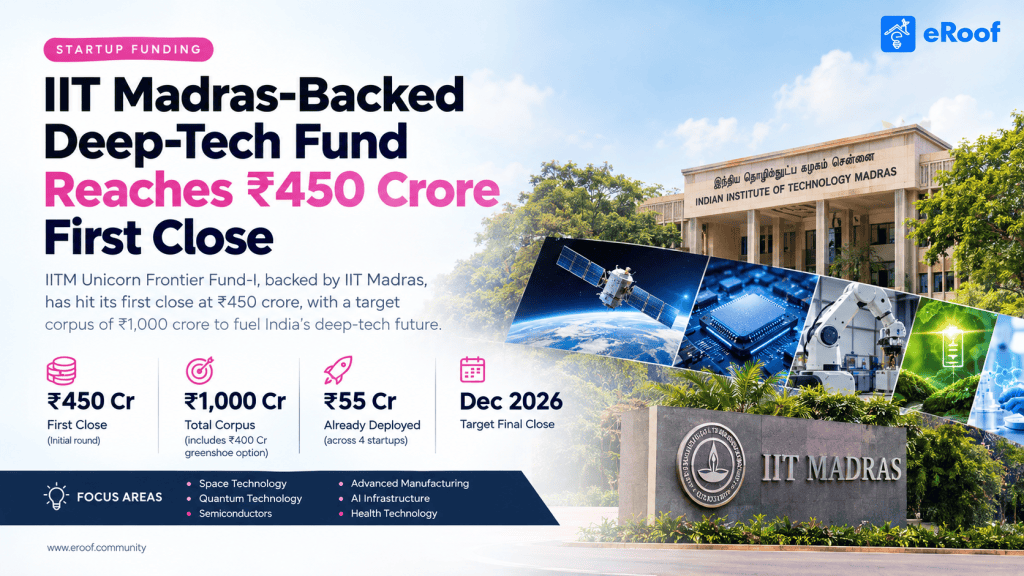
IITM Unicorn Frontier Fund reaches ₹450 Cr first close.
Fund targets a ₹1,000 Cr total corpus.
₹55 Cr already deployed across four startups.
Final close is targeted for December 2026.
The Story
Introduction
The IITM Unicorn Frontier Fund-I, backed by IIT Madras, IIT Madras Research Park and venture capital firm Unicorn India Ventures, has reached its first close at ₹450 crore. The fund has a target corpus of ₹1,000 crore, including a ₹400 crore greenshoe option, and has already deployed nearly ₹55 crore across four deep-tech startups.
The first close was achieved within three months of receiving approval from the Securities and Exchange Board of India (SEBI). The fund is targeting its final close by December 2026.
The initiative is designed to provide long-term capital to technology-intensive startups working in areas such as space technology, quantum technology, semiconductors, advanced manufacturing, artificial intelligence infrastructure and health technology.
Background
Deep-tech startups often require significantly more time and capital to develop than conventional software businesses. Their products may involve scientific research, hardware development, laboratory testing, manufacturing and regulatory approvals before reaching commercial markets.
The IITM Unicorn Frontier Fund-I was created to address this funding requirement by connecting the IIT Madras innovation ecosystem with venture capital expertise from Unicorn India Ventures. IIT Madras Research Park serves as the research and incubation partner, while Unicorn India Ventures acts as the fund manager.
The fund was announced earlier in 2026 with a planned corpus of ₹1,000 crore, including the greenshoe option. A greenshoe option allows a fund or financial vehicle to increase its size beyond its initial target under specified conditions.
The fund plans to build a portfolio of approximately 25 intellectual-property-led and engineering-heavy startups. Most investments are expected to focus on early-stage deep-tech companies that have reached Technology Readiness Levels, or TRLs, of 3–4.
Main Development
The ₹450 crore first close represents capital that has been formally committed to the fund at its initial closing stage. It does not mean the entire ₹1,000 crore target has already been raised.
According to Economic Times and Business Standard, the fund has already deployed nearly ₹55 crore across four startups. These companies operate across different technology areas, including space, quantum technology, batteries and carbon capture.
The four startups are Hathor Rocket, Quanstra, Triolt Energy and Carbelim.
Hathor Rocket is working on rocket propulsion technology. Quanstra operates in quantum instrumentation. Triolt Energy is developing advanced lithium-ion battery technology, while Carbelim is focused on carbon capture and air purification.
The reported individual investment cheques have ranged from around ₹10 crore to ₹20 crore in the four companies already backed by the fund.
The fund’s broader investment strategy covers six major technology areas: defence technology and import substitution, space technology, semiconductors, manufacturing and robotics, AI infrastructure and generative AI, and health technology.
A key feature of the fund is its focus on what investors describe as patient capital.
Patient capital refers to investment where investors are prepared to wait longer for a company to develop its technology and reach commercial scale. This approach can be particularly relevant to deep-tech businesses because hardware development, scientific validation and industrial deployment can take several years.
Industry Impact
The fund’s launch comes as Indian investors and institutions continue to focus on technologies that require significant research and engineering capabilities.
For deep-tech founders, access to capital can be particularly important because developing a physical product or scientific technology often requires spending on laboratories, specialised equipment, engineers, researchers, prototypes and testing.
The fund’s planned portfolio of around 25 companies therefore extends beyond traditional software startups. Its focus includes sectors where technology development can involve both intellectual property and physical infrastructure.
The involvement of IIT Madras is also significant because the institute already has a research, incubation and entrepreneurship ecosystem. The fund is intended to connect research-driven startups with capital and strategic support as they move toward commercialisation.
Technology Readiness Level (TRL) is a framework used to measure how mature a technology is, generally progressing from early research to technologies that have been demonstrated and are ready for wider commercial deployment.
The fund’s focus on companies around TRL 3–4 means it is targeting businesses that have moved beyond purely theoretical research but are still relatively early in their technology-development journey
Another important aspect is the fund’s planned co-investment and follow-on capital approach. Unicorn India Ventures says it will work to mobilise additional capital so portfolio companies can continue funding their development as they grow.
This can be important for deep-tech startups because the initial investment may not be enough to take a technology from prototype to mass production or commercial deployment.
The fund is also backed by IIT Madras alumni and family offices, while institutional investors, corporations and banks are expected to participate as the fund moves toward its final close.
Future Outlook
The IITM Unicorn Frontier Fund-I is targeting its final close by December 2026. The final corpus could reach ₹1,000 crore if the full target, including the greenshoe option, is achieved.
Following the ₹450 crore first close, the fund plans to continue investing in early-stage deep-tech businesses and work toward its proposed portfolio of around 25 startups.
Its initial investments provide an indication of the sectors being prioritised: rocket propulsion, quantum technology, advanced batteries and carbon capture. Future investments are expected to extend across the fund’s other focus areas, including semiconductors, robotics, AI infrastructure and healthcare technology.
The initiative also reflects a broader effort to connect academic research, intellectual property and private investment. For technology that requires years of development before generating commercial revenue, such links can provide an alternative to short-term funding models.
However, reaching the ₹1,000 crore target remains a future objective rather than a completed fundraising result. Likewise, the commercial success of the startups backed by the fund will depend on their ability to validate their technologies, develop scalable products and find customers.
With ₹450 crore secured in its first close and nearly ₹55 crore already deployed, the fund has moved from fundraising into active investment. Its progress through the remainder of 2026 will provide a clearer picture of how much capital it can ultimately mobilise and how its portfolio develops across India’s deep-tech ecosystem.
Technical Terms Explained
- Deep Tech — Technology based on scientific research or advanced engineering, such as quantum computing, space systems, robotics or advanced materials.
- First Close — The initial stage at which a fund formally secures committed capital from investors and can begin deploying it.
- Greenshoe Option — A provision that allows a fund or financial vehicle to raise additional capital beyond its initial target, subject to the agreed terms.
- Technology Readiness Level (TRL) — A scale used to measure how developed and commercially ready a technology is.
- Intellectual Property (IP) — Legally protected creations such as inventions, designs, software, technologies or technical processes.
- Patient Capital — Investment designed to remain committed for a longer period while a technology or business develops.
- Co-Investment — When multiple investors participate in funding the same company or investment opportunity.
- Follow-On Investment — Additional funding provided to an existing portfolio company in later financing rounds to support continued growth.