

Inside the Story
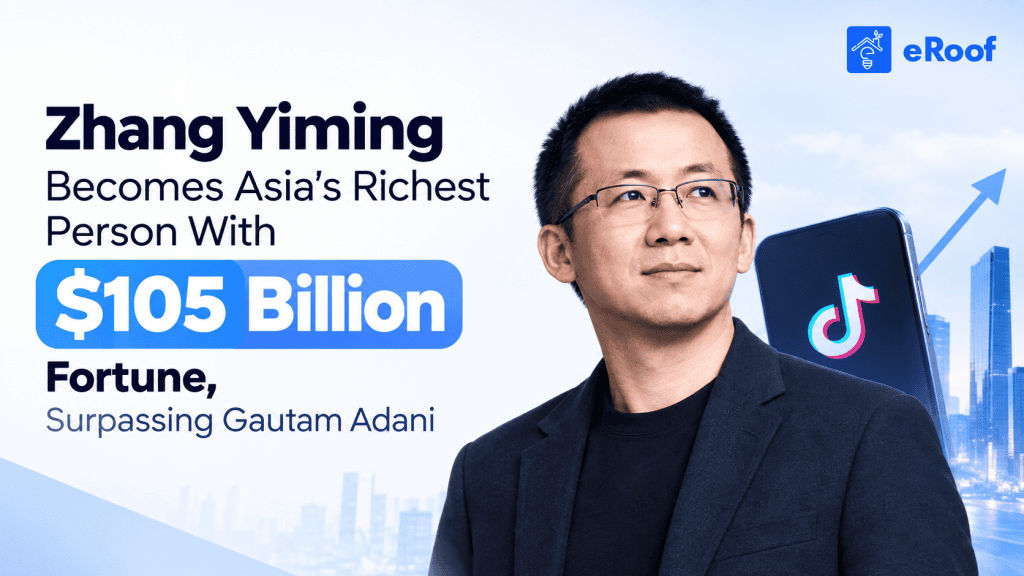
- ByteDance founder Zhang Yiming has reportedly become Asia’s richest person, according to the Bloomberg Billionaires Index.
- His estimated wealth has crossed $105 billion, placing him ahead of Gautam Adani.
- Rising valuations of ByteDance and its artificial intelligence businesses havesupported the increase.
- The development highlights the growing influence of technology and AI on global wealth creation.
The Story
Introduction
Zhang Yiming, the founder of Chinese technology company ByteDance, has reportedly become Asia’s richest person, overtaking Indian industrialist Gautam Adani, according to the Bloomberg Billionaires Index. His estimated fortune has risen to approximately $105 billion, with some reports placing it at around $105.5 billion.
The increase in Zhang’s wealth has been linked to updated valuations of ByteDance by major investment firms and the company’s expansion into artificial intelligence. ByteDance is best known globally as the parent company of TikTok, but its business portfolio also includes platforms such as Douyin, CapCut, Doubao and AI-focused products developed by its research division.
The ranking is based on estimated billionaire wealth and can change frequently because ByteDance is privately held. Therefore, the reported figure should not be treated as a fixed or publicly traded market value.
Who Is Zhang Yiming?
Zhang Yiming co-founded ByteDance in 2012 with Liang Rubo. The company initially focused on developing content-recommendation technology and launched the news-aggregation platform Toutiao.
ByteDance later expanded into short-form video through Douyin in China and TikTok in international markets. TikTok became one of the world’s most widely used video platforms, helping ByteDance establish a major position in the global digital economy.
Zhang stepped down as ByteDance’s chief executive in 2021 and later gave up his role as chairman. However, he has remained an important shareholder in the company. Reports indicate that he owns approximately 21% of ByteDance, although the exact value of his holding depends on the company’s private-market valuation.
His wealth is therefore primarily connected to his ownership stake in ByteDance rather than a publicly traded salary or a listed share portfolio.
How Zhang’s Wealth Increased
The latest increase in Zhang’s fortune is linked to new private-market valuations of ByteDance. Reports said that investment firms, including BlackRock and Fidelity, used higher valuations for the company when assessing their holdings.
Because ByteDance is not listed on a public stock exchange, its value is estimated through private funding rounds, secondary transactions and investment-firm assessments. These valuation updates can significantly affect the estimated wealth of major shareholders.
According to reports, Zhang’s fortune increased by more than $12 billion during September after updated valuations were incorporated into the Bloomberg Billionaires Index. His wealth has reportedly grown more than eightfold since Bloomberg began tracking his fortune at around $13 billion in 2019.
Artificial Intelligence Becomes a Major Growth Driver
ByteDance’s artificial intelligence expansion has become an important part of its growth strategy. The company has developed and invested in several AI-related products, including Doubao, an AI chatbot, and Seedance, a text-to-video generation model.
These products operate in the rapidly expanding generative AI market, where companies are developing systems capable of producing text, images, audio, video and software code from user instructions.
ByteDance’s existing recommendation technology also provides a potential advantage in AI development. The company has extensive experience processing large volumes of user data, understanding content preferences and delivering personalised recommendations. These capabilities are important for developing consumer-facing AI products and improving digital engagement.
However, AI investment also requires significant spending on computing infrastructure, advanced chips, data centres, research teams and model development. The long-term financial impact will depend on whether ByteDance can convert AI usage into sustainable revenue and profits.
Zhang Yiming Versus Gautam Adani
Zhang’s rise has changed the composition of Asia’s billionaire rankings. His wealth is closely tied to technology, digital advertising, social media and AI, while Gautam Adani’s fortune is connected primarily to infrastructure, ports, energy, logistics and other industrial businesses.
Adani remains one of India’s most prominent business leaders and the founder and chairman of the Adani Group. His estimated wealth is influenced by movements in the share prices of listed Adani Group companies, changes in investor sentiment and developments across the group’s businesses.
In contrast, Zhang’s estimated fortune is heavily affected by the private valuation of ByteDance. This means the two wealth figures are calculated using different underlying mechanisms: Adani’s wealth is largely linked to publicly traded market prices, while Zhang’s is based substantially on private-company valuation estimates.
The difference between their reported fortunes can therefore change rapidly, particularly when market conditions or private investment valuations shift.
What the Development Means for the Technology Sector
Zhang’s position at the top of the Asian wealth ranking reflects the growing financial importance of technology platforms. Companies that combine large user bases, advertising businesses, artificial intelligence and digital services can create substantial shareholder value.
The development also demonstrates how AI has become a major investment theme. Investors are increasingly evaluating technology companies not only on their existing products but also on their ability to develop AI models, applications and infrastructure.
For ByteDance, AI could support growth in several areas:
- Content creation: AI tools can generate videos, images and other digital media.
- Advertising: Machine-learning systems can improve ad targeting and campaign performance.
- Search and recommendations: AI can make content discovery more personalised.
- Productivity software: AI assistants can support writing, coding and workplace tasks.
- Consumer applications: Chatbots and creative tools can generate new revenue opportunities.
At the same time, technology companies face regulatory scrutiny, data-privacy concerns, geopolitical restrictions and rising infrastructure costs. ByteDance’s global operations, particularly those connected to TikTok, remain exposed to regulatory and political developments in several markets.
The Limits of Billionaire Rankings
Billionaire rankings are useful indicators of wealth trends, but they are not exact financial statements. Estimated net worth can change because of stock-market movements, exchange-rate fluctuations, changes in private-company valuations and revisions to ownership information.
ByteDance’s private status makes Zhang’s wealth particularly sensitive to valuation changes. A higher valuation increases the estimated value of his stake, while a lower valuation could reduce his position in the ranking.
The title of Asia’s richest person should therefore be understood as a time-specific measurement rather than a permanent status.
Conclusion
Zhang Yiming’s reported rise to become Asia’s richest person marks another major example of technology-driven wealth creation. His estimated fortune of around $105 billion reflects ByteDance’s global digital platforms, private-market valuation and growing involvement in artificial intelligence.
The development also highlights the changing balance between traditional industrial wealth and technology-based wealth. While Gautam Adani’s business empire remains significant across infrastructure and energy, Zhang’s rise demonstrates the financial impact that global consumer platforms and AI technologies can have on private-company founders.
Whether Zhang can retain the position will depend on future ByteDance valuations, AI business performance, market conditions and regulatory developments.
Technical Terms Explained
- Private-Market Valuation: The estimated value of a privately held company based on funding rounds, investor transactions or financial assessments.
- Generative AI: Artificial intelligence that creates new content such as text, images, audio, video or code.
- Market Capitalisation: The total value of a publicly listed company’s shares, calculated by multiplying its share price by the number of outstanding shares.
- Secondary Transaction: A transaction in which existing shareholders sell their shares to another investor rather than the company issuing new shares.
- Machine Learning: A branch of AI in which computer systems learn patterns from data and use them to make predictions or decisions.
- Digital Advertising: Online advertising delivered through websites, applications, search engines and social-media platforms.
- Shareholder Stake: The percentage of ownership an individual or institution holds in a company.
- Generative AI Infrastructure: The computing systems, data centres, chips and software required to train and operate AI models.