

Inside the Story
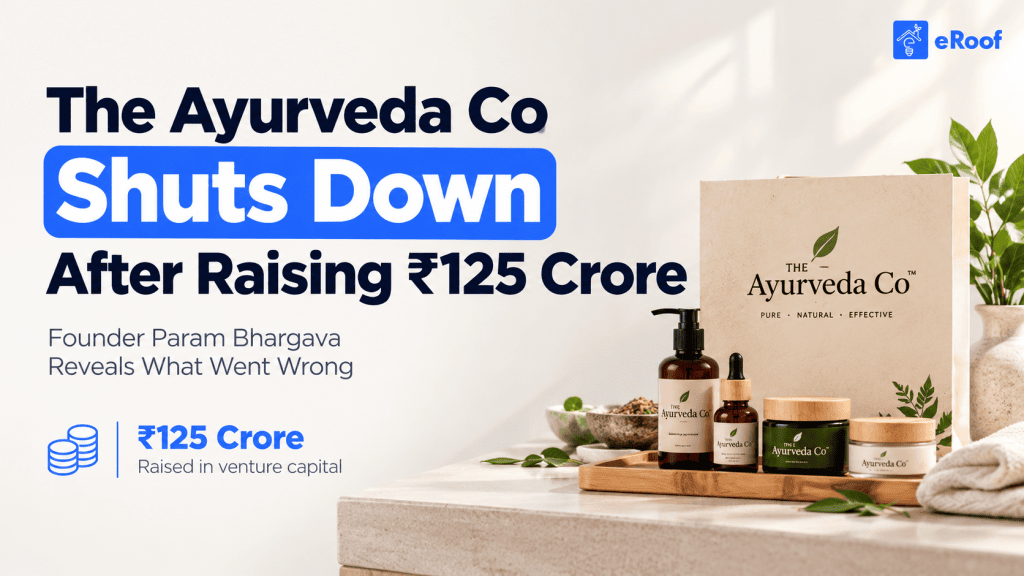
- The Ayurveda Co has formally shut down after stopping operations in July 2025.
- The startup raised about ₹125 crore in venture capital.
- Co-founder Param Bhargava blamed rapid expansion and premature senior hiring.
- TAC had scaled to 20 stores, 800+ beauty-adviser counters and 10,000+ touchpoints.
The Story
Introduction
D2C beauty and wellness startup The Ayurveda Co (TAC) has formally shut down after raising around ₹125 crore in venture capital and building a large online and offline distribution network.
Co-founder Param Bhargava announced the closure in September 2026, saying the business had expanded faster than its internal systems and economics could support.
The shutdown, however, did not happen immediately. TAC and its sister brand Khadi Essentials stopped operations in July 2025, after which their assets were liquidated. The companies are now going through a formal winding-up process.
The company’s story is significant for India’s D2C startup ecosystem because TAC managed to attract institutional capital, expand into physical retail and reach a large consumer base before ultimately becoming another example of the risks associated with scaling faster than the underlying business can support.
Background: From Ayurveda Startup to Omnichannel Brand
The Ayurveda Co was founded in 2021 by Param Bhargava and Shreedha Singh. The business focused on Ayurveda-based beauty, personal care and wellness products, including skincare, haircare, natural makeup, wellness products and supplements.
The founders had earlier launched Khadi Essentials in 2019.
TAC followed a direct-to-consumer (D2C) model but quickly moved beyond its own website. Its products were sold through its website, ecommerce marketplaces, exclusive brand outlets and multibrand retail stores.
The company positioned Ayurveda as a more accessible and contemporary proposition for younger consumers. In 2023, TAC raised ₹100 crore in Series A funding led by Sixth Sense Ventures, with participation from other investors and venture-debt funds.
At the time, the company said the capital would be used to expand offline presence, improve manufacturing, increase research and development, and strengthen digital awareness.
Sixth Sense’s portfolio description also highlighted TAC’s early move into offline retail and its focus on a mass-premium Ayurveda proposition.
Main Development: Why The Ayurveda Co Shut Down
The formal closure announced in September 2026 came more than a year after TAC stopped operating.
According to Bhargava, the central problem was overexpansion. He said the company expanded too quickly across channels and hired too many senior employees before its organisational systems were ready for that level of complexity.
This created a difficult situation for the business. TAC was simultaneously trying to manage online sales, offline stores, retail distribution, beauty-adviser counters and a growing workforce.
Such expansion increases the company’s fixed costs, working-capital requirements, inventory needs and operational complexity.
Bhargava said the founders attempted to keep the business alive during the downturn, including mortgaging parental property and going without salaries for more than a year. He also acknowledged responsibility for decisions that he would approach differently today.
The case illustrates a fundamental startup problem: revenue growth does not automatically translate into a sustainable business.
TAC's Scale Was Significant
Before shutting down, TAC had reached considerable scale.
According to Bhargava’s account reported by Inc42, the company had 20 retail stores, more than 800 beauty-adviser counters and 110 operational distributors. The business had also reached around 20 lakh consumers.
The founders have also said that TAC and Khadi Essentials generated approximately ₹250 crore in cumulative net revenue during their operations. This figure should not be confused with annual revenue or funding raised.
The company had also raised around $15 million in total funding, according to Inc42, with investors including Sixth Sense Ventures, Wipro Consumer Care Ventures and angel investors.
Despite that scale, TAC’s financial performance showed the pressure building underneath the growth story. Inc42 reported that FY24 revenue increased 67% year on year to ₹59.6 crore, while losses increased to ₹68 crore, with expenses nearly doubling to ₹109.5 crore.
That gap between revenue growth and rising losses is an important part of understanding the eventual shutdown.
The Problem With Scaling Too Quickly
For consumer startups, rapid expansion can create a capital-intensive operating model.
Opening physical stores requires rent, employees, inventory, store fit-outs and ongoing operating expenses. Expanding distribution requires additional inventory and logistics.
Hiring senior executives adds fixed payroll costs. Meanwhile, customer acquisition and marketing can require substantial spending before the revenue generated from each customer fully covers acquisition and servicing costs.
This makes unit economics critical.
If the contribution generated by each product or customer is insufficient to cover acquisition, fulfilment, overhead and other operating costs, increasing sales can actually increase cash burn.
TAC’s experience therefore highlights the difference between growth and sustainable growth. A startup may have strong consumer adoption, increasing revenue and significant investor backing, but still face financial pressure if its cost structure expands faster than its underlying economics.
Industry Impact
The shutdown comes at a time when India’s D2C beauty, personal care and wellness market continues to attract entrepreneurs and investors.
Ayurveda has become increasingly relevant to modern consumer brands attempting to combine traditional formulations with contemporary packaging, ecommerce distribution and digital marketing.
TAC’s early strategy demonstrated how an Ayurveda-focused company could build an omnichannel presence and attract institutional investment.
But its closure also highlights the risks involved in moving from a digitally focused startup to a large omnichannel business too quickly.
For D2C companies, the key lesson is that physical expansion should generally follow proven store-level economics, repeat purchasing and predictable demand rather than simply a desire for geographic scale.
The same applies to organisational expansion. Hiring senior leadership can strengthen a company, but adding expensive management layers before processes, revenue visibility and organisational requirements justify them can increase the company’s burn rate.
What the Shutdown Means for Startup Founders
TAC’s story provides several lessons for India’s startup ecosystem.
First, funding is not the same as financial sustainability. Raising ₹125 crore provides a company with capital to pursue growth, but it does not guarantee that the resulting business model will work.
Second, channel expansion must be economically justified. Moving from ecommerce to stores, distributors and other retail channels can increase reach but also increases operational complexity.
Third, unit economics must keep pace with scale. A company needs to understand contribution margins, customer acquisition costs, inventory turnover and cash conversion before aggressively increasing its footprint.
Finally, organisational growth needs to match business maturity. TAC’s founders themselves identified premature senior hiring and rapid expansion as major problems.
Conclusion
The Ayurveda Co’s shutdown is more than the closure of a single D2C brand. It is a case study in the challenges of converting venture-funded growth into a sustainable consumer business.
TAC raised substantial capital, built a sizeable distribution network and reached millions of consumers. Yet the company’s own founders say expansion moved faster than the systems and economics required to support it.
For India’s startup ecosystem, the takeaway is clear: scale matters, but the quality of that scale matters more. Strong unit economics, disciplined capital allocation, operational readiness and sustainable growth can be just as important as fundraising and market expansion.
Technical Terms Explained
- D2C (Direct-to-Consumer) — A business model where brands sell directly to customers instead of relying entirely on traditional distributors or retailers.
- Omnichannel — A strategy combining multiple sales channels such as websites, marketplaces, stores and third-party retail.
- Unit Economics — The revenue and costs associated with a single customer, product or transaction.
- Burn Rate — The rate at which a startup spends cash while operating before becoming self-sustaining.
- Customer Acquisition Cost (CAC) — The average cost of acquiring one new customer.
- Contribution Margin — The amount remaining from sales after variable costs, which contributes toward fixed costs and profit.
- Working Capital — Funds required to operate the day-to-day business, particularly inventory, receivables and payables.
- Cash Conversion — How effectively a company’s accounting revenue is converted into actual cash available to the business.