

Inside the Story
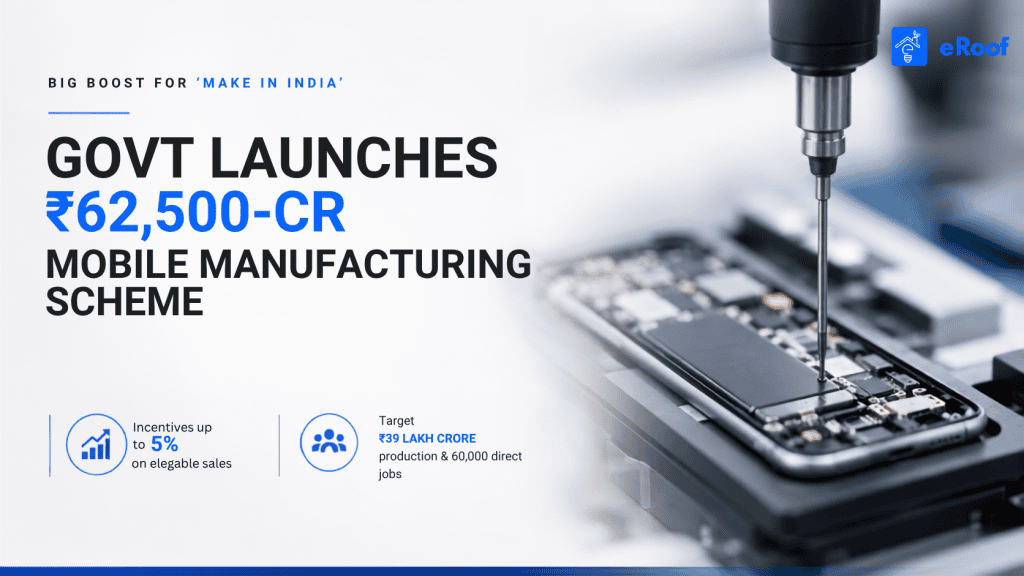
- India notifies ₹62,500 crore mobile manufacturing scheme.
- Incentives range from 2.25% to 5%.
- Domestic sourcing can earn an extra 1.5%.
- Scheme targets ₹39 lakh crore production.
The Story
Introduction
The Government of India has notified a ₹62,500-crore Mobile Phone Manufacturing Scheme (MPMS) to expand mobile phone production, deepen domestic manufacturing and strengthen India’s position in the global electronics industry.
The scheme, notified by the Ministry of Electronics and Information Technology (MeitY) on August 21, 2026, will run for five years from FY2026-27 to FY2030-31. It provides production-linked incentives for eligible manufacturers and additional support for Indian mobile phone brands, domestic component sourcing, product design and research and development.
The government expects the programme to generate approximately ₹39 lakh crore in cumulative mobile phone production and around 60,000 direct jobs during its tenure.
The announcement comes after India’s earlier Production Linked Incentive (PLI) programme helped expand the country’s mobile manufacturing and export ecosystem.
Background
India has rapidly expanded its electronics manufacturing capacity over the past decade.
According to the government, India is now the world’s second-largest mobile phone manufacturer by volume, while 99.2% of mobile phones used in India are manufactured domestically. Smartphones also became India’s largest exported product category in 2025.
Much of this growth was supported by the Production Linked Incentive Scheme for Large Scale Electronics Manufacturing (PLI-LSEM).
A Production Linked Incentive (PLI) is a government incentive in which eligible companies receive financial benefits linked to incremental production or sales after meeting specified conditions.
The earlier electronics PLI programme ended on March 31, 2026. During its tenure, mobile phone production reached around ₹11.61 lakh crore, exceeding its original target of ₹8.12 lakh crore. Investment also crossed ₹20,500 crore against a target of ₹7,000 crore.
The new MPMS is designed to continue that momentum while placing greater emphasis on domestic value creation.
Main Development
The MPMS has been divided into two major target segments.
Target Segment 1 (TS1) focuses on mobile phone manufacturing.
Eligible companies can receive incentives ranging from 2.25% to 5% on qualifying sales. The programme is aimed primarily at large mobile phone manufacturers and Electronics Manufacturing Services (EMS) companies operating in India.
Target Segment 2 (TS2) focuses on supporting Indian mobile phone brands.
Indian brands can receive an incentive of 5%, along with an additional 3% incentive for eligible design and research and development activities. The government will also provide non-fiscal support to Indian brands.
An Electronics Manufacturing Services (EMS) company manufactures or assembles electronic products for other companies rather than necessarily selling products under its own consumer brand.
The scheme also introduces an additional incentive of up to 1.5% for domestic sourcing of key components and sub-assemblies. To qualify for this benefit, the relevant components must be localised for at least 25% of the total mobile phone units manufactured during a financial year.
Who Can Qualify?
The scheme establishes different eligibility requirements for manufacturers and Indian brands.
For TS1, eligible mobile phone manufacturers and EMS companies must be registered in India and have a minimum turnover of ₹10,000 crore in FY2025-26.
Existing brands must also achieve additional sales above their FY2025-26 baseline to continue claiming incentives.
For TS2, companies need a minimum turnover of ₹1,000 crore in FY2025-26 and must satisfy requirements to qualify as an Indian brand. These include Indian registration or incorporation, intellectual property and trademarks held in India, management control by Indian citizens, more than 51% Indian ownership and in-house design and R&D capabilities.
Domestic Value Addition Takes Centre Stage
One of the most important aspects of the new scheme is its focus on Domestic Value Addition (DVA).
Domestic Value Addition refers to the portion of a product’s overall economic value that is created within the country through activities such as manufacturing, component production, design, engineering and research.
According to MeitY, domestic value addition in India’s mobile phone industry has increased from around 15% to 23%.
The government’s objective is now to push that figure higher by encouraging manufacturers to source more components and sub-assemblies from Indian suppliers.
This is significant because assembling smartphones domestically does not necessarily mean that most of their components are manufactured in India.
A deeper domestic supply chain can create opportunities for component manufacturers, electronics suppliers, engineering companies and technology firms.
From Assembly to Indian Brands
Another major objective is to encourage the development of Indian-owned mobile brands.
The government wants Indian companies to develop their own intellectual property (IP), product designs and technologies rather than relying mainly on contract manufacturing.
Intellectual Property (IP) refers to legally protected creations such as patents, trademarks, designs and proprietary technology.
The scheme specifically requires qualifying Indian brands to have their IP and trademarks held in India, along with in-house R&D and design capabilities.
The government has also indicated that it wants to see a strong Indian-owned mobile phone brand emerge during the scheme’s tenure.
This represents a shift from simply increasing the number of phones manufactured in India toward creating greater ownership of technology, design and brands within the country.
Industry Impact
The new scheme could affect several layers of India’s electronics ecosystem.
Large manufacturers are expected to benefit from production-linked incentives, while EMS companies can gain from higher manufacturing volumes.
Component manufacturers could benefit from the additional incentive for domestic sourcing.
Indian technology companies may also receive greater opportunities in product design, engineering and R&D.
The policy could also strengthen India’s position in global value chains.
A global value chain refers to the network of companies and countries involved in designing, manufacturing, assembling, distributing and selling a product.
India’s participation in these chains has expanded significantly through electronics manufacturing and mobile phone exports.
According to government data, electronics manufacturing has grown seven-fold and electronics exports have increased eleven-fold since FY2014-15. The previous PLI programme attracted major global manufacturers and helped create a larger electronics manufacturing ecosystem.
The new scheme aims to take that ecosystem further toward component localisation and design-led manufacturing.
Impact on Consumers
The immediate impact on consumers may not be visible through lower smartphone prices.
The primary objective of MPMS is industrial development rather than direct consumer subsidies.
However, increased domestic production and component manufacturing could gradually strengthen supply chains, improve manufacturing efficiency and create more opportunities for locally developed products.
Greater competition among Indian brands could also give consumers more choices in the longer term.
The scale of the programme means that its impact will depend heavily on whether manufacturers meet production targets and whether domestic component suppliers expand alongside handset assembly.
Future Outlook
The MPMS is intended to run until FY2030-31, giving companies several years to expand production and build manufacturing capacity.
The government’s headline target is approximately ₹39 lakh crore in cumulative mobile phone production and around 60,000 direct jobs over the five-year period. The bigger policy objective, however, goes beyond production numbers.
India is attempting to move from being primarily an assembly destination toward a more complete electronics manufacturing ecosystem involving components, design, intellectual property, R&D and Indian-owned brands.
The scheme also comes as India seeks to strengthen its position in global electronics supply chains and reduce dependence on imported components.
If manufacturers, EMS companies and domestic suppliers successfully expand together, the programme could deepen India’s role in the global smartphone industry.
For now, the ₹62,500-crore MPMS marks the government’s next major step after the earlier PLI programme — with the focus shifting from manufacturing more phones to creating more value within India.
Technical Terms Explained
- MPMS — Mobile Phone Manufacturing Scheme: Government programme providing incentives to expand mobile manufacturing and support Indian brands.
- PLI — Production Linked Incentive: Financial incentive linked to eligible production or sales achieved by participating companies.
- EMS — Electronics Manufacturing Services: Companies that manufacture or assemble electronic products for other brands.
- DVA — Domestic Value Addition: The share of a product’s value created within India through manufacturing, components, design and related activities.
- IP — Intellectual Property: Legally protected creations such as patents, trademarks, designs and proprietary technology.
- R&D — Research and Development: Activities focused on developing new products, technologies, designs and improvements.
- Global Value Chain: The international network involved in designing, manufacturing, supplying and distributing a product.
- Sub-assembly: A partially completed component or unit that becomes part of a larger finished product.