

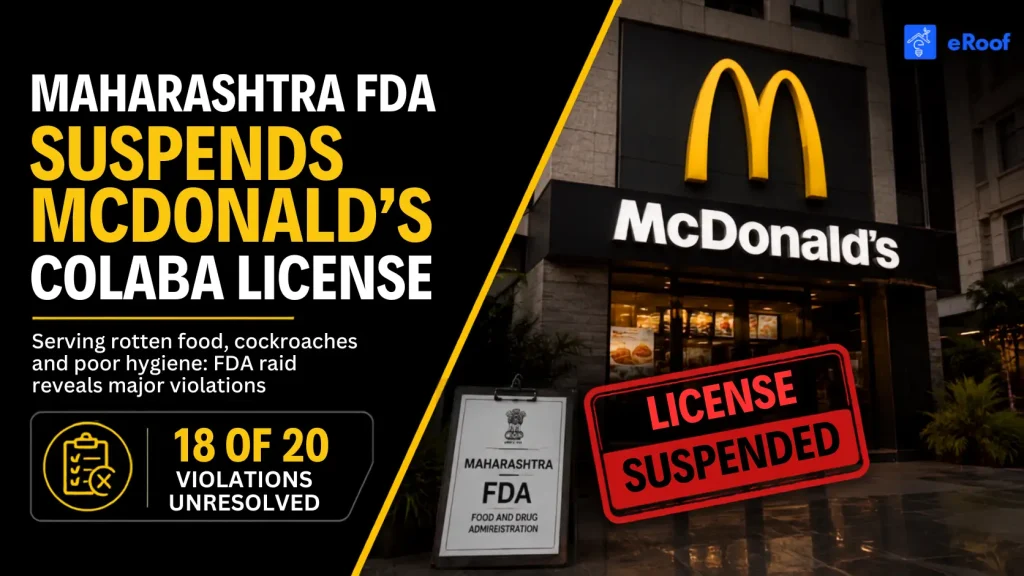
The Maharashtra Food and Drug Administration (FDA) has suspended the food licence of a McDonald’s outlet in Mumbai’s Colaba after a reinspection found multiple food-safety and hygiene violations.
The action was taken against the McDonald’s Family Restaurant kiosk operated by Hardcastle Restaurants Pvt Ltd at Metro House, Colaba. The licence suspension took effect on August 19, 2026, following a series of inspections and reinspections.
According to the FDA, inspectors found that 18 of 20 deficiencies listed in an earlier improvement notice had not been adequately rectified. The reported findings included live cockroaches, rotting food waste on the kitchen floor, inadequate pest-control measures, problems with refrigeration equipment and lapses in employee hygiene.
The action is part of a wider food-safety enforcement campaign led by Maharashtra FDA Commissioner Tukaram Mundhe, which has targeted restaurants, hotels, roadside eateries and major food chains across the state.
The Food Safety and Drug Administration (FDA) is the Maharashtra state authority responsible for enforcing food-safety and other regulatory requirements within its jurisdiction.
At the national level, food businesses operate under the framework established by the Food Safety and Standards Authority of India (FSSAI). FSSAI requires food businesses to obtain the appropriate licence or registration and follow prescribed hygiene and safety requirements.
A Food Business Operator (FBO) is a person or company responsible for a business involved in manufacturing, processing, storing, distributing or selling food.
For larger food businesses, an FSSAI licence is mandatory. The licence comes with conditions covering sanitation, hygiene, food handling and other safety requirements.
McDonald’s operates in India through different franchise and business entities. The Colaba outlet involved in this action is operated by Hardcastle Restaurants Pvt Ltd, according to reports on the FDA action.
Main Development
The immediate trigger for the latest action was an FDA reinspection conducted on August 19.
The regulator said the outlet had previously received an Improvement Notice, which identifies deficiencies that a food business is required to correct.
An Improvement Notice is a formal regulatory direction requiring a food business to address specified safety or compliance failures within a given period. FSSAI guidance states that a licensing authority may suspend a licence when a food business fails to comply with an improvement notice.
In this case, the FDA said 18 of the 20 previously identified deficiencies remained unresolved during the reinspection.
Among the reported findings were live cockroaches, insufficient pest-control arrangements and rotting food waste on the kitchen floor near food storage and preparation areas.
Officials also reported problems with refrigeration equipment.
Temperature control is a critical part of food safety because perishable foods can become unsafe if stored outside appropriate temperature ranges. The FDA reportedly found refrigeration equipment that was not properly calibrated.
Calibration means checking and adjusting a measuring instrument so that its readings accurately reflect the actual temperature or measurement.
Inspectors also reported that employees handled ready-to-eat food after touching dirty footwear and soiled cleaning cloths without washing their hands.
Ready-to-eat food refers to food that can be consumed without another cooking or treatment step that would eliminate harmful microorganisms. Because there is no later cooking stage, hygiene during handling is particularly important.
The FDA also raised concerns about cleaning cloths, dust-covered light fixtures without protective covers and other conditions inside the premises.
The Compliance Report Question
Another issue highlighted by the FDA was the outlet’s earlier compliance documentation.
The outlet had reportedly submitted a 148-page compliance report on August 12, stating that the deficiencies identified earlier had been addressed. However, the August 19 reinspection found that most of the serious deficiencies remained, according to the FDA.
A compliance report is a document submitted by a regulated business to demonstrate that it has addressed requirements or deficiencies identified by authorities.
The discrepancy between the submitted report and the subsequent inspection findings has therefore become part of the regulatory action.
The FDA has also raised concerns about product labelling and the use of processed non-dairy or analogue preparations in connection with claims displayed to customers. Reports said officials questioned the use of a product identified as “GO Cheese Sauce” alongside claims about real cheese and paneer.
Food misbranding generally refers to situations where information presented about a food product, including its description or labelling, does not comply with applicable requirements or could mislead consumers.
A Wider Food-Safety Crackdown
The McDonald’s action is not an isolated inspection.
During a special two-day drive on August 19 and 20, Maharashtra FDA teams inspected 89 hotels, restaurants and dhabas across the state. Officials issued improvement notices to 71 establishments and suspended 13 food-business licences, according to reports.
Several Mumbai establishments were also affected.
At the Bombay Presidency Radio Club in Colaba, inspectors reportedly found live flies, dead cockroaches and other hygiene problems. The establishment recorded a reported 47% non-compliance rate.
Status Restaurant in Nariman Point and Khar Gymkhana were among other establishments facing regulatory action over issues involving sanitation, food storage, pest control and temperature monitoring.
The campaign has also extended beyond Mumbai, with enforcement action reported in other parts of Maharashtra.
Industry Impact
The crackdown could have wider implications for India’s restaurant and food-service industry.
For consumers, stricter inspections can provide greater visibility into whether restaurants are following basic food-safety standards.
For restaurants and food chains, the action highlights the importance of maintaining Food Safety Management Systems (FSMS) rather than treating compliance as a paperwork exercise.
An FSMS is a structured system used by food businesses to identify, control and monitor food-safety risks throughout their operations. FSSAI says licensed food businesses should maintain an FSMS plan based on principles including Hazard Analysis and Critical Control Point (HACCP) and good hygiene practices.
HACCP is a preventive food-safety approach that identifies potential hazards at important stages of food preparation and establishes controls to prevent those hazards from reaching consumers.
Another important term is cross-contamination. This occurs when harmful microorganisms, allergens or other contaminants move from one food, surface or object to another. Proper handwashing, separation of raw and cooked foods, clean equipment and controlled storage are among the measures used to reduce this risk.
The McDonald’s case also demonstrates why pest control, temperature monitoring, sanitation records and employee hygiene are important parts of food-service compliance.
Future Outlook
The immediate question is when the Colaba outlet will be allowed to resume operations.
Under India’s food-safety framework, a suspended food licence cannot simply be treated as a routine business interruption. The operator must address the regulatory deficiencies and meet the conditions required by the authorities before normal operations can resume.
FSSAI’s licensing framework allows authorities to suspend licences when businesses fail to comply with improvement notices.
The broader Maharashtra campaign is also likely to keep attention on food-safety practices across restaurants and food businesses.
For large chains, the episode carries an additional lesson: brand recognition does not replace regulatory compliance. Standardised operating procedures, staff training, pest control, refrigeration checks and accurate compliance documentation all remain essential.
The McDonald’s Colaba action therefore forms part of a larger regulatory push rather than being an isolated restaurant dispute. The central issue is whether food businesses can consistently meet India’s prescribed safety and hygiene standards — and demonstrate that compliance during inspections.
Technical Terms Explained
- FSSAI Licence — Official approval required for eligible food businesses to legally operate under India’s food-safety framework.
- Food Business Operator (FBO) — A person or company responsible for a business that handles, stores, prepares, distributes or sells food.
- Improvement Notice — A formal direction requiring a food business to correct identified safety or compliance deficiencies.
- Food Misbranding — Presenting or labelling food in a way that does not meet regulatory requirements or could mislead consumers.
- Calibration — Checking and adjusting equipment so its measurements, such as temperature readings, are accurate.
- Ready-to-Eat Food — Food that can be consumed without another cooking step, making hygienic handling particularly important.
- Cross-Contamination — Transfer of harmful microorganisms, allergens or contaminants between food, surfaces, equipment or people.
- HACCP — A preventive food-safety system that identifies hazards and controls them at critical stages of food preparation.