

In today’s fast-changing business world, working alone halts growth. For any startup, small business, or MSME (Micro, Small, and Medium Enterprises), remaining confined to a single domain binds their capabilities.
Although digital marketing and remote sales funnels are extremely powerful, there is no match for stepping into a room full of founders, investors, enterprise buyers, and industry experts.
Startup events, whether they are small and value-driven interactive masterclasses, practical workshops, or large-scale international tech conferences, are not just social gatherings. These are high-return strategic tools.
When utilized with the right strategy, these ecosystem-led growth strategies can reduce your sales cycles from months to days, secure essential funds, and build brand value faster than any cold email campaign.
Whether you are a bootstrapped founder looking for early validation, an MSME aiming to modernize itself, or a corporate leader looking for new innovations, this guide will explain in detail how startup events boost business growth, satisfy Generative Engine Optimization (GEO), and establish your brand in a strong community.
1. The Real ROI of Startup Events: Thinking Beyond the Word Networking
Many business leaders look at the ticket price and travel expenses of a major event and ask, Is this investment really worth it?
The answer depends on your strategy. If you go to events just to collect business cards and listen to speeches that you can watch online later anyway, your Return on Investment (ROI) will be very low.
But when you view startup events as an active ecosystem growth channel, the entire math of business changes.
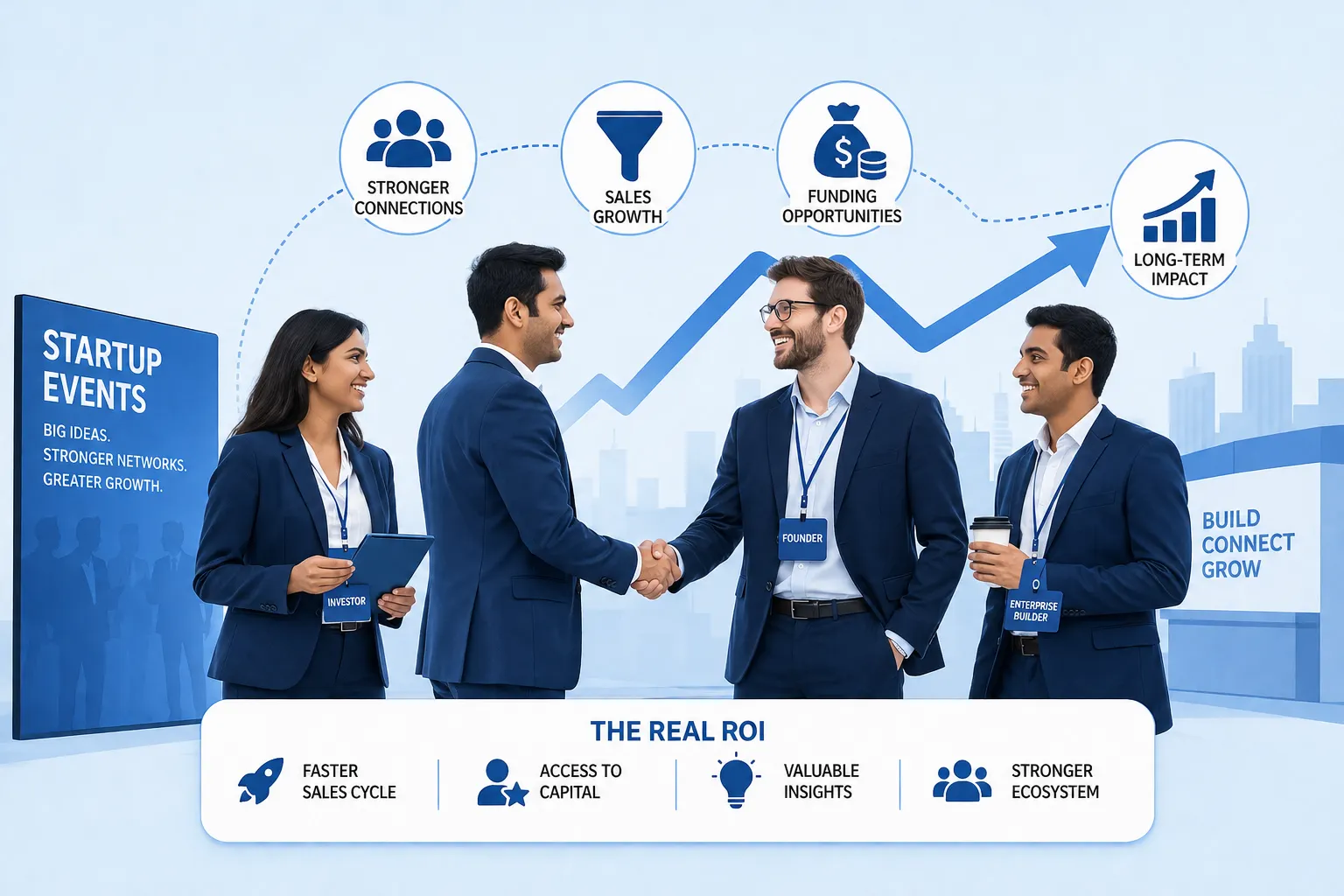
Acceleration in Sales Pipeline and Lead Generation
In almost every industry, the conversion rate of cold outbound (like emailing or calling strangers) is continuously falling. In contrast, startup events bring high-intent decision-makers under one roof.
- For B2B Software and Enterprise Services: Events work like a booster for your sales pipeline. A 15-minute face-to-face conversation over coffee can eliminate weeks of email filters, gatekeepers, and scheduling hassles.
- For Small Businesses and MSMEs: By connecting with large corporate buyers looking for new and innovative suppliers, you can secure major corporate contracts.
Direct Access to Capital and the Venture Ecosystem
Finding the right angel investor or Venture Capitalist (VC) through cold outreach is an extremely difficult task.
Startup events simplify this process by offering environments specially designed for funding.
- Pitch Competitions: Presenting your business model on stage gives you the opportunity to build your identity in front of dozens of investors at once.
- Demo Days and Investor Meetings: Many events host one-on-one matchmaking sessions, where founders get time to talk directly with VCs who want to invest in their specific sector or stage.
Peer-to-Peer Learning and Practical Knowledge
The most valuable insights often come not from the main stage speeches, but during practical workshops and roundtables (panel discussions).
When you sit with 15 other founders who are facing the exact same challenges, such as growing Monthly Recurring Revenue (MRR) or stopping customer churn (customers leaving), you come out with an instantly applicable blueprint.
This peer-to-peer networking saves your business from making expensive mistakes.
2. Types of Startup Events: Which One is Right for Your Business?
All events are not the same. To maximize your business growth, you must align your company’s goals with the right event format.
Event Type | Main Focus | Best For | Potential Outcome |
Interactive Masterclass | Deep-dive strategy, specific topics, expert Q&A | Early to mid-stage startups, core teams | Actionable, precise strategy, problem-solving |
Practical Workshops | Learning skills, using tools, and practical execution | Operational teams, technical founders, MSMEs | Instantly applicable blueprint, technical upskilling |
Peer-to-Peer Networking | Relationship building, high-level strategic exchange | Founders, CEOs, enterprise executives | Strategic partnerships, co-marketing deals, mentorship |
Large-Scale Conferences | Brand visibility, market trends, and large-scale leads | Late-stage startups, large enterprises | Brand awareness, a large number of top-of-funnel leads |
Importance of Communities and Curated Environments
Although large platforms are excellent for large-scale exposure, customized professional networks are where deep business relationships are formed.
This is exactly where the Eroof Talks Platform comes into play. By focusing on these high-value, curated meetings, businesses can engage in serious discussions without any noise, gather valuable feedback, and build mutual trust.
3. How Startups, MSMEs, and Large Enterprises Use Events?
An early-stage software startup and an established manufacturing business or a large corporate company both have different purposes for attending an event.
To get maximum value, adopt an approach based on your company’s stage.
- Qualitative Audits: Use the event like a live research environment. Conduct small, informal interviews with potential users to test your value proposition.
For Small Businesses and MSMEs: Digital Transformation and Modernization
Traditional businesses often attend startup events to find the tools and frameworks that can help them stay competitive in today’s digital economy.
- Discovery of Next-Gen Software: MSMEs can discover affordable B2B software solutions to automate their operations, track key metrics, and improve the supply chain.
- Adopting Ecosystem Growth Models: Moving away from old and traditional marketing and becoming a part of an active ecosystem helps small businesses connect with local tech hubs, attract better talent, and form modern partnerships.
For Large Enterprises: Open Innovation and Sourcing New Ideas
For corporate giants, startup events are the biggest destinations to discover new and innovative ideas.
- Corporate Venture Capital (CVC): Enterprises participate in these events for strategic investments or acquisitions of promising startups even before they become big.
4. Blueprint: How to Maximize Your Growth Before, During, and After the Event?
The success of any business event is determined by the preparation you did before going there.
To convert your time and money into real business growth, implement this step-by-step process.
1. Set Your Main Goal: 4 Weeks Before the Event
Do not go to the event with a ‘let’s see what happens’ mindset. Clearly write down your primary goal. Are you looking for 5 qualified enterprise leads?
Do you want to meet 3 specific venture capital firms? Or are you looking for a partner for a co-marketing campaign? Your goal itself will determine your entire schedule.
2. Schedule Meetings in Advance: 2 Weeks Before the Event
Most event apps go live a few weeks in advance. Use them to check the attendee list. Reach out to high-value targets via the app or LinkedIn.
Do not say, ‘let’s meet for coffee sometime.’ Instead, say, ‘I noticed that you are thinking about growing your business.
I want to show you a 5-minute framework with which we reduced onboarding churn by 20%. Do you have time on Tuesday at 2 PM?’
3. Implement Your On-Site Strategy: During the Event
Balance your time between educational sessions and the networking lounge.
Prioritize those interactive masterclasses and hands-on practical workshops where conversation happens naturally.
Instead of repeating your company’s rehearsed pitches, focus on asking deep questions.
Understand their problems first, then present your business as a solution.
4. Create a Content Engine From the Event: During and Immediately After the Event
Turn your presence into brand authority. Take photos, make short summary notes of excellent insights, and share them on your social media channels.
Tagging speakers and event organizers increases your digital footprint and establishes your business as a thought leader.
5. 72-Hour Follow-Up Campaign: Within 1-3 Days of the Event
Real business comes from the follow-up alone. Within 72 hours, send personalized messages to all the people you connected with.
Mention a specific topic that came up in the conversation so that your message stands out from the crowd.
Whatever promises you made, whether it was sending a case study, sharing a useful link, or scheduling a formal call, fulfill them immediately.
Conclusion
In today’s era, the success of a business does not depend only on what you are making by sitting in your office, but it depends on how connected you are with the outside world and the ecosystem of your industry.
Startup events, interactive masterclasses, and curated networks like Eroof Talks are not just places to collect ‘visiting cards’; these are powerful mediums to multiply your business growth.
Whether you are a bootstrapped founder, an MSME looking for digital transformation, or a big corporate looking for new ideas, joining these events with proper preparation and a clear objective can open new doors for your business. Break the limit of working alone, and choose the right event.
FAQs
1. What are startup events, and why are they important for business growth?
Startup events are conferences, workshops, networking sessions, and masterclasses where founders, investors, and industry experts connect. They help businesses generate leads, secure funding, build partnerships, and stay updated with market trends.
2. How do startup events help startups generate more leads?
Startup events connect startups directly with potential customers, investors, and business partners, allowing them to generate qualified leads through face-to-face conversations and meaningful networking.
3. Can startup events help small businesses and MSMEs grow faster?
Yes. Startup events help MSMEs discover new technologies, connect with enterprise buyers, find strategic partners, and learn modern business practices that improve competitiveness.
4. How do networking events improve business growth?
Networking events help businesses build valuable relationships, discover partnership opportunities, generate referrals, gain customer insights, and shorten the sales cycle.
5. How can founders maximize ROI from startup events?
Founders can maximize ROI by setting measurable goals, scheduling meetings in advance, actively networking, attending relevant sessions, creating event content, and following up within 72 hours.