

Inside the News
- Samsung has reportedly become the world’s most profitable company.
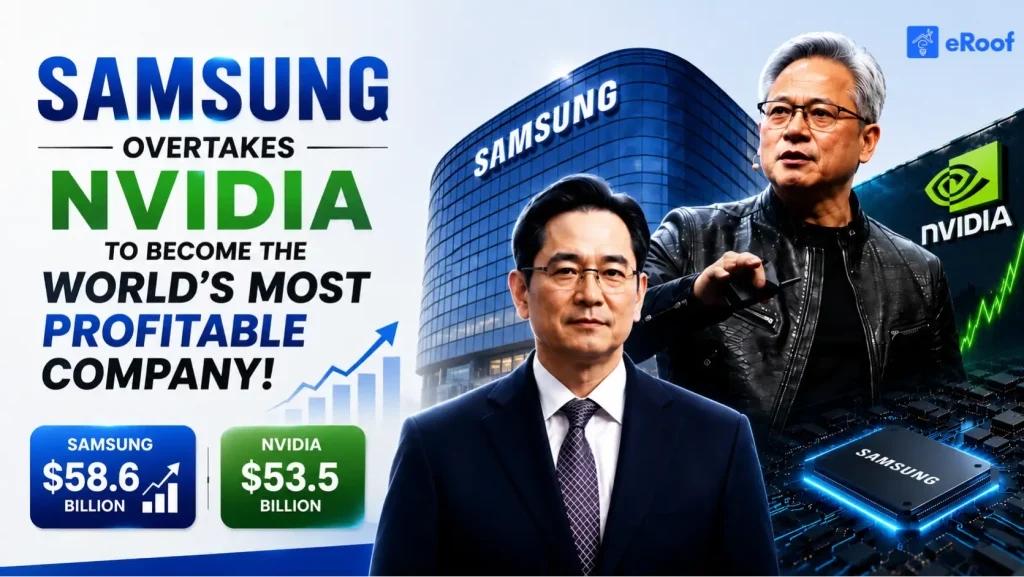
- The South Korean tech giant posted approximately $58.6 billion in profits.
- Nvidia followed closely with around $53.5 billion in profits.
- Strong semiconductor demand significantly boosted Samsung’s earnings.
- AI memory chips, particularly HBM (High Bandwidth Memory), played a major role in revenue growth.
- The achievement reflects the continued boom in artificial intelligence and advanced chip manufacturing.
- Samsung strengthens its position as a global leader in the semiconductor industry.
Samsung Becomes the World's Most Profitable Company
South Korean technology giant Samsung Electronics has reportedly overtaken Nvidia to become the world’s most profitable company, marking a major milestone in the global semiconductor industry.
According to recent financial reports, Samsung generated approximately $58.6 billion in profits, surpassing Nvidia’s estimated $53.5 billion. This achievement highlights the growing demand for AI-powered technologies and advanced semiconductor chips.
What Drove Samsung's Record Profits?
Samsung’s impressive financial performance was driven by the recovery of the global memory chip market. Demand for DRAM, NAND Flash, and High Bandwidth Memory (HBM) increased significantly as AI adoption accelerated worldwide.
Additionally, major technology companies continued investing heavily in AI infrastructure. As a result, demand for Samsung’s advanced memory chips reached record levels.
How AI and Semiconductor Demand Boosted Growth
While Nvidia remains a leader in AI GPUs, Samsung has benefited from supplying high-performance memory chips used alongside AI processors.
Furthermore, Samsung’s diversified business portfolio, including smartphones, display panels, consumer electronics, and foundry services, contributed to its strong financial performance. This balanced business model helped the company maintain stable earnings across multiple industries.
Future Outlook for Samsung
The latest milestone reflects the growing importance of semiconductor manufacturers in the AI era. Governments and technology companies continue investing billions in AI infrastructure, creating long-term growth opportunities.
Industry experts believe competition among Samsung, Nvidia, TSMC, Intel, and other semiconductor companies will continue to intensify. However, Samsung’s continued investment in advanced manufacturing and AI memory technologies is expected to strengthen its market position.
Understanding the Terms
Semiconductor: A material used to manufacture computer chips that power electronic devices.
HBM (High Bandwidth Memory): Advanced memory technology designed for AI processors and high-performance computing.
GPU (Graphics Processing Unit): A specialized processor used for AI training, gaming, and graphics-intensive computing.
DRAM: A type of memory used in computers, smartphones, and servers for fast data processing.
Foundry: A semiconductor manufacturing facility that produces chips designed by other companies.
AI Infrastructure: The hardware and computing systems required to develop, train, and run artificial intelligence applications.