

Let’s face it: the traditional outbound sales playbook is broken. Cold email response rates have cratered below 2%, paid advertising channels are bleeding cash, and the average customer acquisition cost (CAC) for B2B brands has climbed dramatically.
Buyers are exhausted by generic automated sequences, feature-heavy pitches, and aggressive LinkedIn InMails that offer zero context. To overcome this, building modern networking habits is crucial; you cannot rely solely on software to scrape lists and blast cold messages.
If you want to build a predictable, healthy sales funnel today, your routine must shift toward genuine relationships. You have to win in the dark funnel, those untracked spaces like private Slack groups, industry workshops, peer masterminds, and direct messages where actual buying decisions are influenced.
The most successful revenue leaders aren’t out-prospecting the market; they are out-networking it. By shifting from transactional selling to relationship-driven authority, you can build a high-converting sales pipeline that reduces your CAC and drives sustainable business growth.
Here are three non-negotiable networking habits that will directly fill your pipeline with high-intent, qualified deals.
1. Shift from Feature-Heavy Pitching to Outcome-Driven Value Drops.
The fastest way to kill a networking opportunity is to lead with a product demo or a laundry list of software features. Decision-makers don’t care about your product’s underlying infrastructure; they care about their own bottlenecks. To catch the attention of busy founders, marketing heads, or procurement managers, your conversational habit must pivot entirely toward outcome-driven value.
Instead of explaining what your business does, focus on the tangible transformation you deliver. When you engage with a peer or potential prospect at an industry roundtable or on social media, practice the habit of dropping un-gated, high-impact insights often called a value drop.
How to Leverage Existing Communities for Pipeline Growth:
- Audit before you talk: Look at a prospect’s public assets (their website, content strategy, or LinkedIn presence) before initiating a deep conversation.
- Identify a hidden gap: Find a specific friction point. For instance, notice if their site speed is lagging, or if they are missing targeted content for their ideal customer profile (ICP).
- Provide the fix for free: Send a short, highly tailored voice note or message detailing exactly how to fix the issue.
When you consistently provide a high level of upfront value without immediately demanding a sales call, you trigger the law of reciprocity. You stop looking like a vendor trying to extract budget and start acting like a trusted advisor. This structural shift positions your business as the obvious solution when they are ready to buy.
2. Intentionally Join and Actively Engage in Ecosystem Micro-Communities
Fast-growing startups and agile MSMEs are now driving over 40% of their total sales pipeline through ecosystem-led growth. This means instead of chasing individual buyers one by one, you must embed yourself into the broader networks where your ideal clients already gather.
However, simply hitting the Join button isn’t a habit; how you show up inside that community determines your pipeline velocity.
How to Leverage Existing Communities for Pipeline Growth:
- Identify the Right Waterholes: Join highly gated, curated spaces where your Ideal Customer Profile (ICP), whether they are SaaS founders, marketing heads, or procurement managers, frequently ask questions.
- Become a Value Anchor in Comment Sections: Make it a daily habit to spend 15 minutes answering complex questions inside these groups without pitching your services. Provide detailed, step-by-step solutions right in the thread.
- Shift from Member to Contributor: Volunteer to speak at the community’s internal workshops, join their peer-to-peer panels, or contribute original research to their newsletter.
When you consistently show up as a high-value member of an existing ecosystem, you don’t need to pitch. The community members themselves will start tagging you as the resident expert, transforming a simple membership into a consistent source of warm, inbound leads.
3. Implement the 24-Hour Contextual Follow-Up System
An incredible conversation at a conference or an engaging exchange in a private forum is completely wasted if it isn’t institutionalized. Most professionals lose potential pipeline because their follow-up workflow is slow, generic, or absent.
To bridge the gap between a casual handshake and an active sales opportunity, you need a strict, automated habit for post-event outreach.
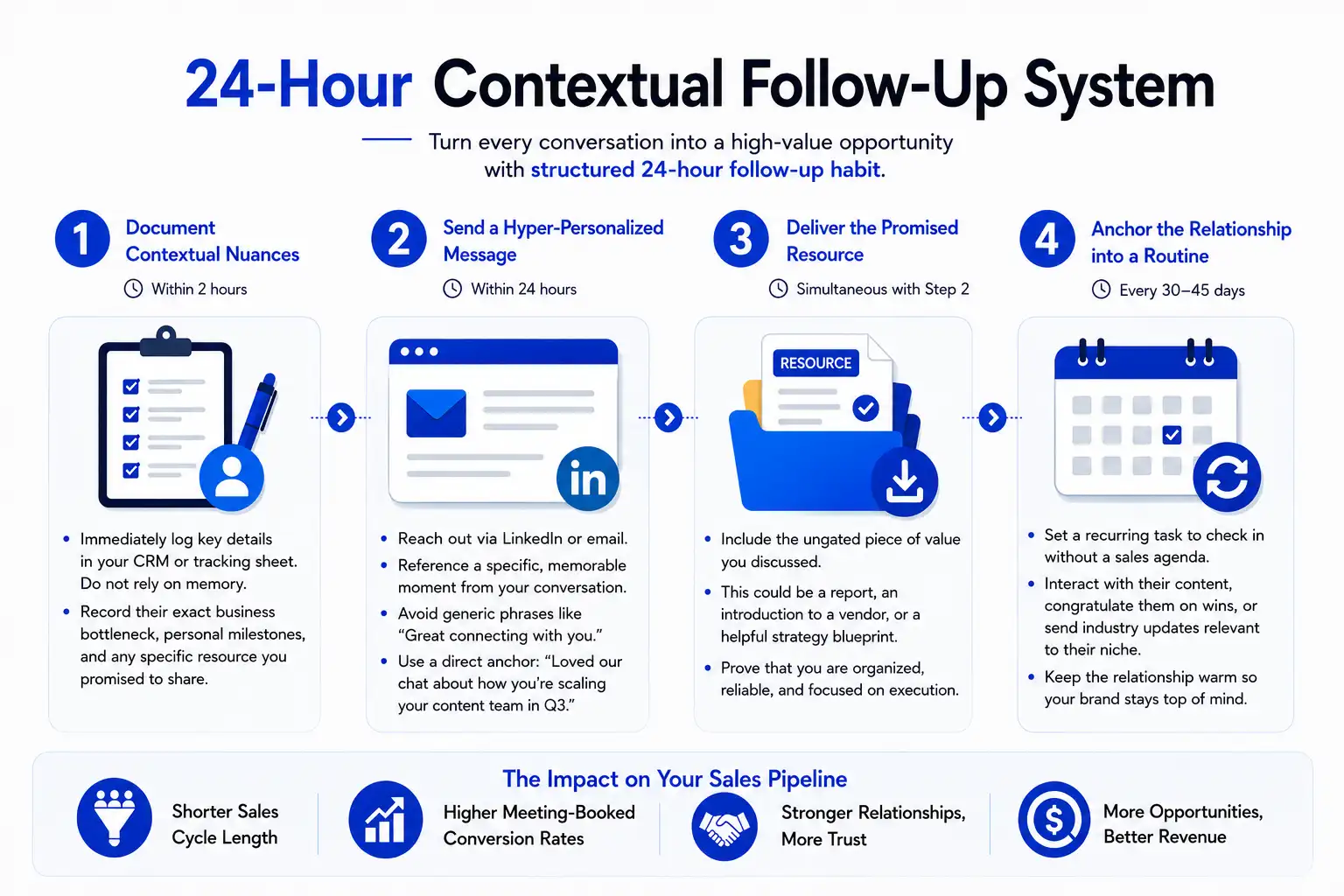
1. Document Contextual Nuances: Within 2 hours.
Immediately after a networking conversation, log the key details into your CRM or tracking sheet. Do not rely on memory. Record their exact business bottleneck, personal milestones mentioned, and any specific resource you promised to share.
2. Send a Hyper-Personalized Message: Within 24 hours:
Reach out via LinkedIn or email. Reference a specific, memorable moment from your conversation. Avoid generic phrases like Great connecting with you. Instead, use a direct anchor: Loved our chat about how you’re scaling your content team in Q3.
3. Deliver the Promised Resource: Simultaneous with Step 2.
Include the ungated piece of value you discussed. This could be an original research report, an introduction to a vendor, or a helpful strategy blueprint. Prove that you are organized, reliable, and focused on execution.
4. Anchor the Relationship into a Routine: Every 30-45 days.
Set a recurring task to check in without a sales agenda. Interact with their content, congratulate them on company wins, or send an industry update relevant to their niche. Keep the relationship warm so your brand stays top of mind.
By treating follow-ups as a mandatory operational process rather than an afterthought, you ensure that high-value relationships never slip through the cracks. Over time, this disciplined cadence systematically converts initial rapport into predictable inbound revenue.
Comparing the Pipeline Impact of Networking Habits
Networking Habit | Core Focus | Primary Pipeline Metrics Impacted | Time to Realize Revenue |
Outcome-Driven Value Drops | Solving immediate, micro-level prospect pain points. | Higher SQL conversion rates, lower initial customer acquisition cost (CAC). | 1 – 3 Months |
Ecosystem Micro-Communities | Building peer-to-peer trust. | Increased contract value, larger pipeline coverage ratio, partner-influenced revenue. | 3 – 6 Months |
Contextual Follow-Up Systems | Eliminating deal drop-off through organized, structured CRM workflows. | Shorter sales cycle length, higher meeting-booked conversion rates. | Immediate / Compounding |
The Golden Rule of B2B Networking
Approach every interaction with a clear understanding of your connection’s motivations. If your default mindset is to offer strategic support, share knowledge, and facilitate warm introductions, your sales pipeline will naturally expand as a byproduct of your ecosystem authority.
Conclusion
For startups and small businesses, a sales pipeline isn’t just about revenue; it’s about survival. In a market where everyone is desperately racing to sell, your willingness to selflessly deliver upfront value is what will make you stand out from the crowd.
Remember: People don’t buy from companies; they buy from people. Pick just one micro-community today, build your authority there through consistent habits, and tighten your follow-up system. This is the exact zero-budget marketing strategy that can transform your MSME into a powerhouse brand.
FAQs
1. What are the best networking habits to increase a sales pipeline?
The best networking habits include sharing outcome-driven value, engaging in niche business communities, and maintaining a consistent follow-up system with prospects and industry peers.
2. How does networking help generate qualified leads?
Networking builds trust and credibility with potential buyers. Strong relationships often lead to warm referrals, inbound inquiries, and higher-quality leads with better conversion potential.
3. Why are communities important for business growth?
Communities contain highly targeted audiences where decision-makers actively discuss problems, making them ideal spaces for building authority and generating warm leads.
4. How quickly can networking improve a sales pipeline?
Some networking strategies, like contextual follow-ups, can produce results within weeks, while community-based authority building may take 3–6 months for consistent pipeline growth.
5. How can networking build long-term business authority?
By consistently sharing expertise, solving industry problems, and supporting peers, businesses become trusted authorities that naturally attract clients, referrals, and partnership opportunities.